
- Catalogs
- Format Messtechnik GmbH
- Resimat® - Recovery Measurement of Viscoelastic Foams

- Company
- Products
- Catalogs
- News & Trends
- Exhibitions
Resimat® - Recovery Measurement of Viscoelastic Foams
Resimat® - Recovery Measurement of Viscoelastic Foams
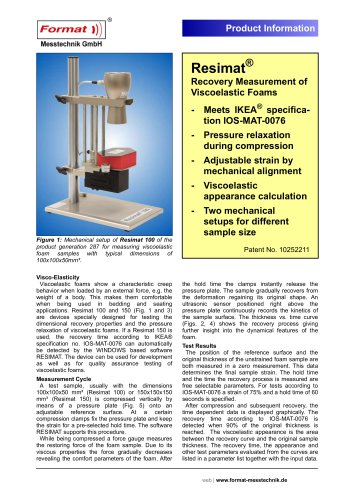
Resimat devices are designed for testing the recovery and pressure relaxation properties of viscoelastic foams, meeting the IKEA specification IOS-MAT-0076. These devices, Resimat 100 and 150, are used for both development and quality assurance of viscoelastic foams.
Visco-Elasticity
Viscoelastic foams exhibit creep behavior under load, providing comfort in bedding and seating applications. The Resimat devices measure the dimensional recovery and pressure relaxation of these foams.
Measurement Cycle
The test involves compressing a foam sample with a pressure plate onto a reference surface. The sample dimensions are typically 100x100x50 mm³ for Resimat 100 and 150x150x150 mm³ for Resimat 150. The compression is held for a pre-selected time, during which a force gauge measures the restoring force. After the hold time, the sample's recovery is monitored using an ultrasonic sensor, which records the thickness over time.
Test Results
The initial thickness and reference surface position are measured to determine sample strain. Parameters such as hold time and recovery measurement duration are adjustable. For IOS-MAT-0076 compliance, a 75% strain and 60-second hold time are specified. Recovery time is determined when the sample regains 90% of its original thickness. The viscoelastic appearance is calculated as the area between the recovery curve and the original thickness.
Graphical Data
Figures illustrate the mechanical setup and graphical results of the tests, showing the relaxation and recovery phases. The recovery rate is derived from the thickness curve gradient.
Product Information
Resimat devices are available for order, with contact information provided for Format Messtechnik GmbH.
Catalog excerpts
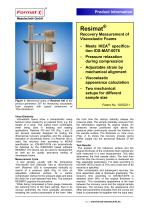
Product Information Resimat® Recovery Measurement of Viscoelastic Foams Figure 1: Mechanical setup of Resimat 100 of the product generation 287 for measuring viscoelastic foam samples with typical dimensions of 100x100x50mm³. Visco-Elasticity Viscoelastic foams show a characteristic creep behavior when loaded by an external force, e.g. the weight of a body. This makes them comfortable when being used in bedding and seating applications. Resimat 100 and 150 (Fig. 1 and 3) are devices specially designed for testing the dimensional recovery properties and the pressure relaxation of viscoelastic foams. If a Resimat 150 is used, the recovery time according to IKEA® specification no. IOS-MAT-0076 can automatically be detected by the WINDOWS based software RESIMAT. The device can be used for development as well as for quality assurance testing of viscoelastic foams. Measurement Cycle A test sample, usually with the dimensions 100x100x50 mm³ (Resimat 100) or 150x150x150 mm³ (Resimat 150) is compressed vertically by means of a pressure plate (Fig. 5) onto an adjustable reference surface. At a certain compression clamps fix the pressure plate and keep the strain for a pre-selected hold time. The software RESIMAT supports this procedure. While being compressed a force gauge measures the restoring force of the foam sample. Due to its viscous properties the force gradually decreases revealing the comfort parameters of the foam. After Meets IKEA® specification IOS-MAT-0076 Pressure relaxation during compression Adjustable strain by mechanical alignment Viscoelastic appearance calculation Two mechanical setups for different sample size Patent No. 10252211 the hold time the clamps instantly release the pressure plate. The sample gradually recovers from the deformation regaining its original shape. An ultrasonic sensor positioned right above the pressure plate continuously records the kinetics of the sample surface. The thickness vs. time curve (Figs. 2, 4) shows the recovery process giving further insight into the dynamical features of the foam. Test Results The position of the reference surface and the original thickness of the unstrained foam sample are both measured in a zero measurement. This data determines the final sample strain. The hold time and the time the recovery process is measured are free selectable parameters. For tests according to IOS-MAT-0076 a strain of 75% and a hold time of 60 seconds is specified. After compression and subsequent recovery, the time dependent data is displayed graphically. The recovery time according to IOS-MAT-0076 is detected when 90% of the original thickness is reached. The viscoelastic appearance is the area between the recovery curve and the original sample thickness. The recovery time, the appearance and other test parameters evaluated from the curves are listed in a parameter list together with the input data.
Open the catalog to page 1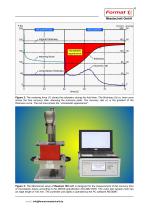
original thickness viscoelastic appearance restoring force recovery rate compression thickness Figure 2: The restoring force (F) shows the relaxation during the hold time. The thickness (H) vs. time curve shows the free recovery after releasing the pressure plate. The recovery rate (v) is the gradient of the thickness curve. The red area shows the “viscoelastic appearance”. Figure 3: The Mechanical setup of Resimat 150 (left) is designed for the measurement of the recovery time of viscoelastic foams according to the IKEA® specification IOS-MAT-0076. The cubic test sample (red) has an edge length...
Open the catalog to page 2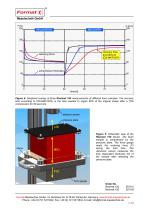
recovery time according to IOS-MAT-0076 compression thickness Figure 4: Graphical overlay of three Resimat 150 measurements of different foam samples. The recovery time according to IOS-MAT-0076, is the time needed to regain 90% of the original shape after a 75% compression for 60 seconds. distance sensor pressure plate Figure 5: Schematic view of the Resimat 150 device. The foam sample is compressed by the pressure plate. The force gauge reads the restoring force (F) during the hold time. The ultrasonic sensor measures the time dependent thickness (H) of the sample after releasing the pressure...
Open the catalog to page 3All Format Messtechnik GmbH catalogs and technical brochures



- Measuring device
- Automatic test kit
- Digital gauge
- Manual test equipment
- Industrial test kit
- Benchtop measuring module
- Temperature measuring module
- Measuring instrument with display
- Digital test equipment
- Laboratory measuring instrument
- High-precision gauge
- Recuperator
- Laboratory test kit
- Electronic gauge
- Analog distance sensor
- Compact test kit
- USB measuring module
- Benchtop test equipment
- Precision test kit