
- Catalogs
- Format Messtechnik GmbH
- New sleeved test containers for measuring the generation process of polyurethane foam

- Company
- Products
- Catalogs
- News & Trends
- Exhibitions
New sleeved test containers for measuring the generation process of polyurethane foam

New sleeved test containers for measuring the generation process of polyurethane foam
The document discusses the development and advantages of new sleeved test containers, Sleener 150 and Sleener 225, designed by Format Messtechnik GmbH for measuring the generation process of polyurethane foam. These containers are used in conjunction with the Foam Qualification System FOAMAT® for quality control and development of new foam formulations.
Specifications
The Sleener 150 has an inner diameter of 150 mm and a test volume of up to 5 liters, suitable for low-density rigid and flexible foams. The Sleener 225 has a larger inner diameter of 225 mm and a test volume of up to 16 liters, ideal for slabstock foams or automotive seat production formulations.
Design and Features
Both Sleener models are made of a cylindrical plastic hard tube and a specially designed clamp ring. They are lightweight, easy to handle, and do not require disposable cardboard cylinders, reducing waste and storage needs. The containers are equipped with sensors for measuring rise pressure, dielectric polarization, rise height, and core temperature.
Procedures
Before testing, a protective liner (paper, plastic, or metal foil) is placed inside the tube to prevent contamination. The upper part of the Sleener is clamped onto the bottom part, sealing the test container. After testing, the upper part can be easily removed for further analysis of the foam sample.
Performance and Benefits
Comparison measurements with traditional test containers show that the Sleener models provide significantly higher repeatability in rise pressure measurements. They offer an ecological and economical solution by eliminating the need for disposable cylinders and reducing the application of release agents and subsequent cleaning.
Applications
The Sleener containers are suitable for developing new polyurethane foam formulations and for quality or production control. They can be used with existing FOAMAT devices, making them versatile for various testing needs.
Conclusion
The Sleener 150 and 225 provide a modern, efficient, and environmentally friendly approach to polyurethane foam testing, offering improved measurement accuracy and reduced operational costs.
Catalog excerpts
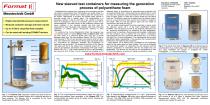
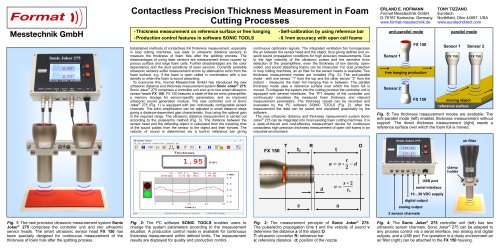
New sleeved test containers for measuring the generation process of polyurethane foam • Can be used with existing FOAMAT devices distance sensor hard tube paper sleeve PU foam clamp ring flexible foam bottom part dielectric polarization rise height rise pressure rigid foam rise pressure CURING TIME dielectric polarization „Sleener 225" upper part foam sample in aluminum coated paper liner Fig. 5: The plastic hard tube of Sleener 225 is protected against contamination by a coated paper liner. After the foam generation test using FOAMAT, the sample is available for further investigation, i. e. mechanical testing. „Sleener 150" measurement position Fig. 1: The Sleener 225 comprises a plastic hard tube of 225 mm inner diameter and a heated bottom part, containing sensors for foam analysis. The Sleener 225 is connected to the Foam ® Qualification System FOAMAT 285. rise height TONY TIZZANO Eurotech Northfield, Ohio 44067 USA distance sensor rise pressure / dielectric polarization • Up to 16 liters unspoiled foam samples slabstock foams or formulations for automotive seat production that are injected directly from a mixing head into the Sleener 225. In order to protect the cylindrical tube of the Sleener from the fresh foam, a piece of paper, plastic or metal foil is placed inside the tube before each test. The Sleener upper part is clamped onto the Sleener bottom part. As a result, the foil is fixed, and the test container is sealed to the bottom. After the test the Sleener upper part can easily be removed from the lower part (Fig. 5). For rise height measurement the whole assembly is placed under the ultrasonic sensor LR 4 of the Foam Qualification System FOAMAT. The rise pressure as well as the dielectric polarization can be measured simultaniously. For measuring the core temperature, several holes for inserting a thermocouple are available. Additionally, the test container can be heated from the bottom. Comparison measurements have been performed with flexible (Fig. 2) as well as with rigid (Fig. 3) foam formulations. The measurement curves show significantly higher repeatability in rise pressure than measurements performed in the traditional test containers. Using Sleener 150 or Sleener 225 is facilitated by their lightweight design of the upper parts and their handles. They are an ecological and economical solution for measuring the rise pressure and the dielectric polarization in combination with the rise height and core temperature. The devices can be used for the development of new PU foam formulations, as well as for quality or production control. rise height / temperature • Reduced container storage and trash volume rise pressure / dielectric polarization • Highly reproducible pressure measurement Established test containers for measuring the rise pressure and the rise profile of polyurethane foam formulations are usually made of a disposable cardboard cylinder and a bottom plate with sensors from the bottom. Alternatively a reusable and heated metal cylinder is provided coated with a release agent. The disadvantage of a disposable cylinder is that for each test a new cylinder is required. From an ecological as well as an economic point of view, this is disadvantageous: The water content of the cardboard cylinders may cause variations in the chemical reaction and thus spoil the measurement result. Reusable metal cylinders need time consuming application of release agents. Subsequent cleaning is often necessary. To overcome this, Format Messtechnik GmbH has designed new sleeved test containers named Sleener 150 and Sleener 225. They are both made of a cylindrical plastic hard tube and a special designed clamp ring. The new container Sleener 150 (Fig. 4) has an inner diameter of 150 mm and provides a test volume of up to 5 liters. This is the perfect test volume for low density rigid and flexible foams e.g. formulations for refrigerator insulation and formulations for automotive seat production. The cylindrical hard tube of the Sleener 150 upper part fits to the bottom part, containing sensors for rise pressure and dielectric polarization measurement. The larger version Sleener 225 (Fig. 1 ) has a inner diameter of 225 mm and provides a test volume of up to 16 liters. This is the perfect test container for PU ERLAND E. HOFMANN Format Messtechnik GmbH D-76187 Karlsruhe Germany Fig. 2: Two superimposed measurements (black and red) of a flexible polyurethane foam generated in the Sleener 225. The colored bands are master curves for quality control, showing the acceptable margins. Fig. 3: Reproducibility measurements of a rigid polyurethane foam tested in the Sleener 150 which has a nominal diameter of 150 mm. The RISE TIME and the CURING TIME evaluated by the software FOAM are displayed. Fig. 4: The Sleener 150 has an inner diameter of 150 mm and a test volume of up to 5 liters. It replaces the Foam Pressure Measurement device FPM 150. No disposable cardboard cylinders are needed fo
Open the catalog to page 1All Format Messtechnik GmbH catalogs and technical brochures



- Measuring device
- Automatic test kit
- Digital gauge
- Manual test equipment
- Industrial test kit
- Benchtop measuring module
- Temperature measuring module
- Measuring instrument with display
- Digital test equipment
- Laboratory measuring instrument
- High-precision gauge
- Recuperator
- Laboratory test kit
- Electronic gauge
- Analog distance sensor
- Compact test kit
- USB measuring module
- Benchtop test equipment
- Precision test kit