
- Catalogs
- Format Messtechnik GmbH
- Gel Time and Curing Determination of Slabstock Foam

- Company
- Products
- Catalogs
- News & Trends
- Exhibitions
Gel Time and Curing Determination of Slabstock Foam

Gel Time and Curing Determination of Slabstock Foam
The document discusses the Universal Foam Qualification System FOAMAT® 285, developed by Format Messtechnik GmbH, which provides detailed insights into the gelling and curing processes of slabstock foam. This system is designed for quality control testing and features advanced measurement technology.
Specifications
The FOAMAT® 285 system includes the Advanced Test Container (ATC) XL, which is a cylindrical container with a volume of approximately 10 liters. It is equipped with two closed-loop electrical heaters and an open top for foam rise and height measurement using an ultrasonic distance sensor. The system also includes a high-resolution pressure sensor and a Curing Monitor Device (CMD) for measuring dielectric polarization.
Measurement Capabilities
The system simultaneously records rise height, reaction temperature, rise pressure, and dielectric polarization. The software FOAM V4.0 processes these data, allowing users to display all four physical values in one graph. This enables detailed analysis of the foam's gelling and curing processes.
Procedures
The document describes the testing process using the ATC XL, which involves measuring foam pressure, rise profile, and dielectric polarization under temperature-controlled conditions. The system's high-resolution pressure input allows for smooth pressure curves, indicating the start of the gelling reaction and enabling analytical determination of gel time.
Key Findings
Figures in the document illustrate the influence of cell opener and catalyst on foam formulations. High and low amounts of cell opener affect the rise pressure and gel time, while the curing time can be detected by changes in dielectric polarization. The document notes that curing occurs faster at higher temperatures and with more catalyst.
Conclusion
The FOAMAT® 285 system offers improved measurement technology for analyzing slabstock foam, making it suitable for quality control testing. Its easy handling and detailed data output provide valuable insights into the foam production process.
Catalog excerpts
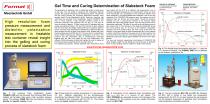
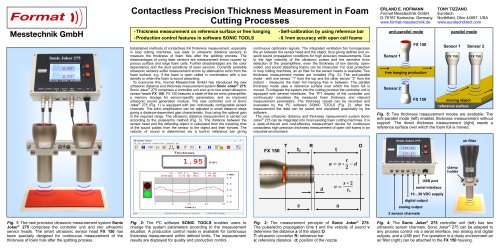
Slabstock Foam Influence of Cell Opener GELLING dielectric polarization dielectric polarization CURING CELL OPENING Fig. 5: Two flexible foam formulations with high (—–) and low (—–) amount of catalyst. The CURING TIME can be detected by the dielectric polarization (D). temperature controlled Fig. 1: The Universal Foam Qualification System FOAMAT® 285 with the Advanced Test Container ATC shows detailed cell formation data using a high resolution pressure sensor. The software FOAM V4.0 has new features, including density and specific volume curves. pressure plate rise height 760 3200 pressure / dielectric polarization rise height / temperature rise profile specific volume dielectric polarization been tested with the ATC XL at different wall temperatures. Due to consistent elevated temperatures, the measurement results are much more reproducible and comparable to the production situation than those measured in non-thermostatted test containers. Due to the high resolution of the FOAMAT® 285 pressure input, the pressure curves of slabstock foam are smooth and show details. Though the pressure readings are low, a pronounced increase of the pressure signal indicates the start of the gelling reaction. From this the gel time can be determined analytically. The blow off, as well as the cell opening can be seen clearly (Fig. 3). The decrease of the dielectric polarization shows the curing process (Fig. 5). As soon as the dielectric polarization reaches a low and constant value, the main curing of the foam has finished. Curing goes faster at higher temperatures and if more catalyst is added. Upon test completion, the upper part of the test container can be removed from the lower part. The special shape of the ATC XL and additional coating with release agent facilitate the removal of the foam sample. The new and improved measurement technology of FOAMAT® 285 gives detailed insight into the gelling and curing process of slabstock foam. Its easy handling makes it suitable for quality control testing. FRANK BERTUZZI Eurotech Distributors Inc. Northfield, Ohio 44067 USA High resolution foam pressure measurement and dielectric polarization measurement in heatable test container reveal insight into the gelling and curing process of slabstock foam The generation of slabstock foam is traditionally tested in large boxes or big cups. The rise profile is measured with contactless distance sensors, the reaction temperature by temperature probes. The gel time and the curing process are commonly determined manually using wooden sticks. Format Messtechnik GmbH, Karlsruhe, Germany, has introduced the Universal Foam Qualification System FOAMAT® 285 (Fig. 1) which features a high resolution pressure sensor in the innovative Advanced Test Container ATC XL (Fig. 4). The ATC XL forms a cylinder of approx. 10 liters volume and it is equipped with two closed loop electrical heaters. The top of the cylinder is open, enabling free rise of the foam and height measurement by an ultrasonic distance sensor. The foam core temperature is detected by a thermocouple (TC) being inserted into the hot spot of the reaction zone. Besides the Foam Pressure Measurement (FPM) the ATC XL has a built in Curing Monitor Device (CMD) measuring the dielectric polarization of the foam. The pressure and the polarization data is simultaneously measured together with the foam rise height and the core temperature. The software FOAM processes all data and enables the user to display all four physical values superimposed in one graph (Fig. 2). For engineering purposes, several slabstock foam formulations have specific volume Gel Time and Curing Determination of Slabstock Foam ERLAND E. HOFMANN Format Messtechnik GmbH D-76187 Karlsruhe Germany Fig. 2: Rise height (H), reaction temperature (T), rise pressure (P), and dielectric polarization (D) are simultaneously recorded by the software FOAM. The curves show the reaction of a slabstock foam measured with the ATC XL. The colored areas are master curves for quality control. Fig. 3: Comparison of two slabstock foam formulations with high (—–) and low (—–) amount of cell opener. The CELL OPENING can especially be seen in the decrease of the rise pressure (P). The pressure curve also reveals information about the GEL TIME. Fig. 4: The test containers BFC 200 and ATC XL. Whereas the BFC 200 is limited to rise height and temperature measurement, the ATC XL can also measure the rise pressure and the dielectric polarization of slabstock foam formulations under temperature contr
Open the catalog to page 1All Format Messtechnik GmbH catalogs and technical brochures



- Measuring device
- Automatic test kit
- Digital gauge
- Manual test equipment
- Industrial test kit
- Benchtop measuring module
- Temperature measuring module
- Measuring instrument with display
- Digital test equipment
- Laboratory measuring instrument
- High-precision gauge
- Recuperator
- Laboratory test kit
- Electronic gauge
- Analog distance sensor
- Compact test kit
- USB measuring module
- Benchtop test equipment
- Precision test kit