
- Catalogs
- Format Messtechnik GmbH
- FOAMAT® 285 - Universal Foam Qualification System

- Company
- Products
- Catalogs
- News & Trends
- Exhibitions
FOAMAT® 285 - Universal Foam Qualification System

FOAMAT® 285 - Universal Foam Qualification System
The quality of foams such as polyurethane, polyisocyanurate, phenolic, silicone, and epoxy is influenced by formation conditions. Regular sampling and recording of these parameters are essential for maintaining consistent product quality. The Universal Foam Qualification System FOAMAT 285 enhances measurement accuracy, surpassing its predecessor, FOAMAT 281.
Foam characterization involves measuring the rise height or profile, indicating the start and maximum expansion. The ultrasonic fan sensor LR 4 provides precise measurements, with the rise profile serving as a quality assurance fingerprint.
Exothermal reactions during foam formation are measured using thin thermocouples for accurate temperature readings without interference.
Pressure during the gelling reaction affects foam expansion. The patented Foam Pressure Measurement (FPM) device offers insights into cell properties and catalyst effects.
Pressure data from the FPM allows viscosity calculation using Hagen-Poisseuille's equation, resulting in a viscosity vs. time curve.
This parameter, measured by the Curing Monitor Device (CMD) sensor, provides insights into electrochemical processes during foam formation, indicating intermediate formation and final curing.
Accurate weighing of reaction components is crucial for reproducible data, with the FOAMAT 285 system recording component mass and foam density.
Room temperature, humidity, and air pressure are measured and stored with other test data for comprehensive analysis.
Advanced Test Containers (ATC) simulate production conditions with temperature-controlled environments, ensuring reliable test results comparable to actual production scenarios.
The ATC facilitates easy ejection of foam samples and consistent measurement results, enhancing quality control and foam formulation development.
- Advanced Test Containers (ATC): Available in standard and XL sizes with test volumes up to 2.5 liters and 10 liters respectively.
- Foam Pressure Measurement (FPM): Models available with test volumes ranging from 170 ml to 3.2 liters.
- Box Foam Container (BFC 200): Test volume up to 8 liters.
- Sleeved Containers (Sleener 150 and 225): Test volumes up to 4.2 liters and 15.8 liters respectively.
- Balance Integration: Capacity of 3.2 kg with readability of 0.01 g.
- Meteorological Station: Measures ambient air pressure, temperature, and humidity.
- Analog Mixer: Maximum rotation speed of 3000 rpm.
- One Component Foam Measurement (OCFM): Measures rise profile, rise pressure, and reaction temperature of One Component Foams (OCF).
- Foam Analysis: The Sleener 225 is equipped with sensors for foam analysis and a heatable bottom part.
- Figure 15: Protection of the Sleener 150 against contamination and sample removal process.
- Figure 16: Alignment of the FPM 50 and cardboard cylinder under the ultrasonic sensor for OCFM.
- Figure 17: Reaction of One Component Foam with rise height, pressure, and temperature recorded.
- Figure 18: Cross-section of the OCFM device, showing foam confinement and measurement setup.
- Format Messtechnik GmbH, located in Karlsruhe, Germany, specializes in high-quality measuring devices since 1994.
Catalog excerpts
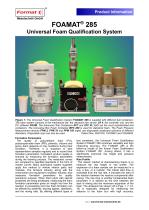
Product Information FOAMAT® 285 Universal Foam Qualification System Figure 1: The Universal Foam Qualification System FOAMAT 285 is supplied with different test containers. The base system consists of the mechanical set, the ultrasonic fan sensor LR 4, the controller unit, and the PC software FOAM. The Advanced Test Containers ATC and ATC XL (left) are the most sophisticated test containers. The innovative Box Foam Container BFC 200 is used for slabstock foam. The Foam Pressure Measurement devices FPM 2, FPM 70 and FPM 150 (right) use disposable cardboard cylinders of different diameters. Disposable cups can also be used. Patent Nos. 3621819, 19730891 and 10044952 Formation Parameters The quality of polyurethane foam (PU), polyisocyanurate foam (PIR), phenolic, silicone and epoxy foam depends on the conditions during their formation. Therefore, it is important to take representative samples regularly and to record their formation parameters. Consistent product quality is ensured by measuring the formation parameters during the foaming process. The measured curves are compared to specified standards in the form of master curves. Many automotive system suppliers apply this method to vehicle interior parts and modules. The furniture industry, along with the construction and equipment insulation industry, also measures formation parameters for quality assurance purpose. When foam parts with special properties are being developed, measuring the foam formation parameters gives an insight into how the reaction is proceeding and how foam formation can be affected by additives, blowing agents, stabilizers, and the mixing ratio. By offering different types of test containers, the Universal Foam Qualification System FOAMAT 285 combines versatility and high measuring accuracy. The FOAMAT 285 is the follow-up model of the former Foam Qualification System FOAMAT 281. Among others, it has a significantly improved rise height and pressure measurement. Rise Profile The classic method of characterizing foams is to measure the rise height or rise profile. The expansion of a foam sample can be measured in a cup, a box, or a cylinder. The critical start time is evaluated from the rise rate. It indicates the start of the reaction between the reactive components after mixing. The rise time is another fundamental foam parameter. It is defined as the time between the start of mixing and the maximum expansion of the foam. The ultrasonic fan sensor LR 4 (Figs. 1, 7, 10, 14) is especially designed for measuring the distance to the foam bun with high accuracy.
Open the catalog to page 1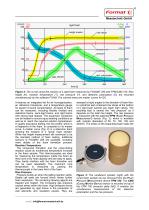
rigid foam height master CURING diel. polarization Figure 2: The curves show the reaction of a rigid foam measured by FOAMAT 285 with FPM/CMD 150. Rise height (H), reaction temperature (T), rise pressure (P), and dielectric polarization (D) are recorded simultaneously by the software FOAM. The colored areas are master curves for QC. It features an integrated fan for air homogenization, an ultrasonic transducer, and a temperature gauge for speed of sound compensation. All types of foam can be measured, including flexible molded and slabstock foams, semi-rigid foams, and rigid foams with strong...
Open the catalog to page 2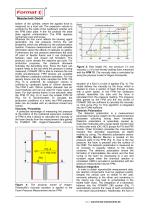
bottom of the cylinder, where the applied force is measured by a load cell. The expansion volume is confined by the walls of the cardboard cylinder and the FPM base plate. A thin foil protects the base plate against contamination. The FPM replaces normal test cups and boxes. Whereas the rise curve reflects the blowing agent generation, the rise pressure mirrors the cell properties which are affected by the polymerization reaction. Pressure measurement can yield valuable information about the effects of catalysts on gelling. Furthermore the rise pressure determines the blow off point of flexible...
Open the catalog to page 3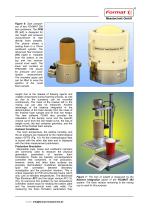
Figure 6: Size comparison of two FOAMAT 285 test containers: The FPM 70 (left) is designed for rise height and pressure measurement of high density foam samples. The picture shows a sealing foam in a 70mm cardboard cylinder. The Advanced Test Container ATC (right) is heatable from the bottom to the top and has reverseconical inner walls. The lower part contains an FPM/CMD 150 device for pressure and polarization measurement. The insulated upper part can be lifted to ease the ejection of the cured foam sample. weight due to the release of blowing agents and volatile components during foaming process,...
Open the catalog to page 4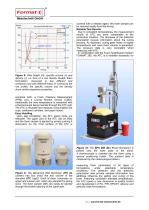
low density flexible foam rise height covered with a release agent, the foam sample can be removed easily from the device. Reliable Test Results Due to consistent temperatures, the measurement results of ATC are more comparable to the production situation. The decrease of the dielectric polarization reveals information about the curing process. As expected, curing goes faster at higher temperatures and more foam volume is generated. The pressure data is very consistent when measured with ATC. In combination with the Foam Qualification System FOAMAT 285, the ATC is a versatile accessory for Figure...
Open the catalog to page 5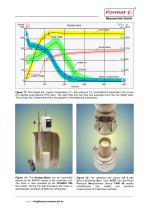
flexible foam rise height RISE TIME CURING START TIME Figure 11: Rise height (H), reaction temperature (T), rise pressure (P), and dielectric polarization (D) curves of a flexible polyurethane (PU) foam. The start time and rise time are evaluated from the rise height data. The curing time is determined from the gradient of the dielectric polarization. Figure 12: The Analog Mixer can be connected directly to the MIXER socket of the controller unit. The mixer is then operated by the FOAMAT 285 foot switch. During the test procedure the mixer is automatically switched off after the mixing time....
Open the catalog to page 6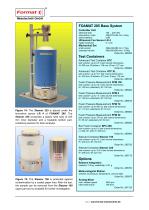
FOAMAT 285 Base System Controller Unit electrical data dimensions, mass serial interface Ultrasonic Fan Sensor LR 4 height resolution Mechanical Set small version extended version Test Containers Advanced Test Container ATC test volume= up to 2.5 l; test volume dimensions: H=180 mm, Ø bottom= 139 mm, Ø top= 127 mm Advanced Test Container ATC XL test volume= up to 10 l; test volume dimensions: H= 350 mm, Ø bottom= 210 mm, Ø top= 175 mm Foam Pressure Measurement FPM 150 test volume= up to 3.2 l; test volume dimensions: H= 180 mm (standard), Ø= 150 mm Foam Pressure Measurement FPM 2 test volume=...
Open the catalog to page 7All Format Messtechnik GmbH catalogs and technical brochures


- Measuring device
- Automatic test kit
- Digital gauge
- Manual test equipment
- Distance sensor
- Industrial test kit
- Benchtop measuring module
- Temperature measuring module
- Measuring instrument with display
- Digital test equipment
- Laboratory measuring instrument
- High-precision gauge
- Recuperator
- Laboratory test kit
- Electronic gauge
- Analog distance sensor
- Compact test kit
- USB measuring module
- Benchtop test equipment
- Precision test kit