
- Catalogs
- Format Messtechnik GmbH
- Foam Rise Height and Pressure Measurement in Narrow Containers

- Company
- Products
- Catalogs
- News & Trends
- Exhibitions
Foam Rise Height and Pressure Measurement in Narrow Containers

Foam Rise Height and Pressure Measurement in Narrow Containers
This document discusses the measurement of rise height and pressure in rigid and flexible polyurethane foams using advanced sensor technology. The focus is on the use of ultrasonic and laser sensors to obtain precise measurements in small test containers.
Measurement Technology
The ultrasonic fan sensor LR 4, equipped with the Sound Centering Blow Tube (SCBT), is designed to measure foam rise height in narrow containers. This sensor is part of the FOAMAT 285 system and can be combined with the Foam Pressure Measurement device FPM 50 for simultaneous rise height and pressure measurements.
Key Features
- High-resolution measurements of rise height and pressure for small foam samples.
- Objective determination of cream time, rise time, and gel time.
- Integration with the Foam Qualification System FOAMAT 285 for comprehensive data collection.
Applications
The SCBT and laser distance sensor SL 1 are suitable for laboratory development of new foam formulations and quality control testing. They provide solutions for measuring rise profiles in small test containers, even at high mold temperatures.
Technical Specifications
- The SCBT reduces the ultrasonic beam to measure accurately in small openings without edge reflection.
- The SL 1 laser sensor can measure foam rise height in narrow molds and at high temperatures.
Conclusion
The document highlights the importance of precise measurement technology in foam characterization, emphasizing the role of the SCBT and SL 1 sensors in enhancing measurement accuracy and reproducibility.
Catalog excerpts

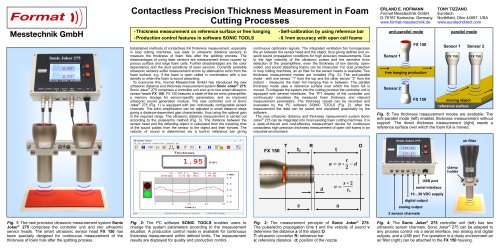
• Objective and reproducible cream time, rise time and gel time determination Using SCBT, the ultrasonic fan sensor LR 4 can also be combined with the Foam Pressure Measurement device FPM 50 (Fig. 4). With an inner diameter of 50 mm only, it is the perfect rise pressure measurement device for small foam samples. The rise pressure (Fig. 3) reveals important information about the gel time and the tensioning of the foam. Connected to the Foam Qualification System FOAMAT 285 the rise pressure can be recorded simultaneously with the rise height and the core temperature. Additionally, a laser distance sensor SL 1 can be integrated into the Foam Qualification System FOAMAT 285. The SL 1 can measure foam rise height in narrow molds. It can also measure thermally expanding foam samples at high mold temperatures (Fig. 5). In summary, the SCBT and the laser distance sensor SL 1 offer a solution for measuring rise profiles of foaming samples in small test containers. The new measurement technology, in combination with the pressure measurement device FPM 50 can be used in laboratory for the development of new formulations as well as in quality and production control testing. flexible foam, measured with the SL 1 laser sensor rise rate • High resolution rise height and rise pressure measurements of small foam samples The classical method of characterizing foams is to measure their rise profile. The expansion of a foam sample is measured in a cup, a box, or a cylinder, typically by using ultrasonic distance sensors. Sealing foams or microcellular foams are usually tested in small cups. For machine tests even disposable shot glasses are common. Due to the small inlet opening of these test containers, standard ultrasonic distance sensors cannot be used, as they receive an echo from the edge of the cup. To overcome this, Format Messtechnik GmbH has introduced a new Sound Centering Blow Tube SCBT for their proofed ultrasonic fan sensor LR 4 (Fig. 1). The LR 4 is part of the ® Foam Qualification System FOAMAT 285. The SCBT reduces the ultrasonic beam to its central part, so that it can measure into the small opening of a test container without being reflected at the edge of the opening. This part of the ultrasonic lobe is then reflected by the foam surface and is detected by the ultrasonic sensor. The distance from the foam surface or the height of the foam can be determined precisely from the travel time of the echo and the velocity of sound (Fig. 2). TONY TIZZANO Eurotech Northfield, Ohio 44067 USA rise height Foam Rise Height and Pressure Measurement in Narrow Containers ERLAND E. HOFMANN Format Messtechnik GmbH D-76187 Karlsruhe Germany Fig. 5: The new laser sensor SL 1 measures the rise height in a narrow mold. The measurement is also possible at high mold temperatures. RISE TIME CREAM TIME Fig. 1: The ultrasonic fan sensor LR 4 with the new Sound Centering Blow Tube SCBT is especially designed for measuring the distance to the foam bun in tiny test cups. ® The LR 4 is part of the FOAMAT 285 system. Clamp Ring rise height / viscosity rise rate rise height rise height rise height Rigid Foam rise pressure Flexible Foam Fig. 2: Reproducibility measurements of a flexible polyurethane foam expanding in a tiny test cup. The yellow band is a master curve of the rise height. The CREAM TIME and RISE TIME are determined by height criteria. Fig. 3: Rise height and rise pressure of a rigid polyurethane foam, measured with the ultrasonic fan sensor LR 4 and the Foam Pressure Measurement device FPM 50. The viscosity is calculated according to the Hagen-Poisseuille's equation. Fig. 4: The proofed ultrasonic fan sensor LR 4 with SCBT can be combined with the Foam Pressure Measurement device FPM 50. This enables simultaneous rise height and pressure meas
Open the catalog to page 1All Format Messtechnik GmbH catalogs and technical brochures



- Measuring device
- Automatic test kit
- Digital gauge
- Manual test equipment
- Industrial test kit
- Benchtop measuring module
- Temperature measuring module
- Measuring instrument with display
- Digital test equipment
- Laboratory measuring instrument
- High-precision gauge
- Recuperator
- Laboratory test kit
- Electronic gauge
- Analog distance sensor
- Compact test kit
- USB measuring module
- Benchtop test equipment
- Precision test kit