
- Catalogs
- Forbo Siegling GmbH
- Marmoleum Decibel


- Company
- Products
- Catalogs
- News & Trends
- Exhibitions
Marmoleum Decibel

Marmoleum Decibel
Marmoleum Decibel is a resilient linoleum floor covering known for its high impact sound reduction of 17 dB. It is 3.5 mm thick, consisting of 2.5 mm Marmoleum Real laminated onto a 1 mm layer of polyolefin foam. Manufactured by Forbo, Marmoleum is made from natural renewable materials and has a high recycled content, contributing to its low environmental impact.
This EPD is in accordance with ISO 14025 and EN 15804, providing LCA-based information to assist in making informed product comparisons. It includes details on human health impacts and eco-toxicity.
Marmoleum Decibel complies with EN-ISO 24011 and ASTM F 2034 standards. It is classified for use in domestic, commercial, and industrial areas (Classes 23, 33, and 41 respectively). Key technical specifications include fire resistance (Cfl - s1), slip resistance (DS: ≥ 0.30), and thermal conductivity (0.17 W/mK).
The product is composed of natural and recycled materials such as linseed oil, gum rosin, wood flour, and calcium carbonate. The backing is made of jute and polyolefin foam.
The production involves several stages, starting with the oxidation of linseed oil to form linoleum cement, followed by mixing with other materials, calendaring, curing, and finishing. Waste materials are reused in the manufacturing process.
Installation involves cutting and adhesive application, with 5% material waste considered. The product is designed for easy maintenance, requiring regular vacuuming and damp mopping.
Marmoleum Decibel is mechanically deconstructed at the end of its life, with energy recovery through incineration due to its high calorific value.
A comprehensive LCA has been conducted, covering all life cycle stages to assess the environmental impacts of Marmoleum Decibel.
The document provides a comprehensive Life Cycle Assessment (LCA) of Marmoleum Decibel, a resilient linoleum floor covering, according to ISO 14025 & EN 15804 standards. The assessment covers various stages: Production, Transport, Installation, Use, and End of Life.
The functional unit is defined as one square meter of installed product with a one-year service life.
The cut-off criteria include 1% of renewable and non-renewable primary energy usage and 1% of the total mass of the unit process, with a maximum of 5% of energy usage and mass being neglected.
No co-product allocation occurs. Allocation in multi-input processes, such as incineration, is based on mass flows or calorific values. Energy substitution credits are allocated to the production stage.
The GaBi 6 Software System is used for life cycle modeling, with datasets from the GaBi 6 database. Data quality corresponds to PCR specifications, with foreground data based on 2012 averages.
The assessment includes all materials, products, energy, and waste processing across all stages, considering worldwide distribution for transportation.
Non-renewable primary energy is mainly consumed during production, with significant contributions from raw material production and energy generation. Renewable energy is primarily from raw materials like linseed oil and jute.
Tables provide detailed data on waste categories and non-renewable resource consumption across all life cycle stages.
Tables present the environmental impacts for one lifecycle, including Global Warming Potential, Ozone Layer Depletion, Acidification, Eutrophication, and more. The production stage is the main contributor to most impact categories.
The results interpretation considers assumptions and limitations. The production stage significantly impacts most categories, with raw material supply being a major contributor.
Forbo Flooring provides additional impacts on human health and eco-toxicity using the USEtox model, classified as Level II/III for characterization modeling.
Production stage dominates toxicity impact categories, with thermal energy and electricity as main contributors. Transport, installation, and use phases have negligible impacts on human toxicity (cancer).
Marmoleum Decibel complies with AgBB requirements for VOC emissions and indoor air quality. It holds several accreditations including ISO 9001 for Quality Management and ISO 14001 for Environmental Management, among others.
The product has a nominal thickness of 3.5 mm and a weight of 3000 g/m². It is available in rolls with a width of 2.0 meters and a length of up to 32 meters.
The floor covering is composed of various materials including linseed oil, gum rosin, tall oil, wood flour, calcium carbonate, and pigments. These materials are sourced globally, with significant contributions from the USA, Canada, Europe, and Asia.
The production involves several stages starting with the oxidation of linseed oil, tall oil, and rosin to form linoleum cement. This is mixed with other materials and calendared on a substrate, cured, and finished with a lacquer. Waste materials are reused in the process.
The production process adheres to ISO 14001 standards. Waste materials are recycled, and packaging is collected for external recycling. The product is distributed globally, with specific transport distances and capacities noted.
Installation involves cutting and adhesive application, with recommendations for low-emission adhesives. The product's service life is modeled for one year, with cleaning and maintenance regimes specified for different use levels.
The product is designed for mechanical deconstruction, with energy recovery through incineration due to its high calorific value. The life cycle assessment covers all stages from production to end-of-life, using the GaBi 6 software for modeling.
The LCA follows ISO 14040 and ISO 14044 standards, assessing stages from production to end-of-life. Data quality is ensured through specific datasets, and system boundaries are clearly defined for each stage.
The document discusses the calculation of global warming potential in carbon dioxide equivalents (CO2-Eq.), which considers the greenhouse potential of emissions relative to CO2. The assessment typically spans a 100-year period, incorporating the gases' atmospheric residence time.
Acidification occurs when air pollutants transform into acids, lowering the pH of rainwater and fog. Sulphur dioxide and nitrogen oxides contribute significantly, damaging ecosystems and materials. The acidification potential is measured in sulphur dioxide equivalents (SO2-Eq.).
Eutrophication involves nutrient enrichment, leading to excessive algae growth in water bodies, reducing oxygen levels, and harming aquatic life. On land, it can degrade plant stability and increase nitrate levels in groundwater. The potential is calculated in phosphate equivalents (PO4-Eq.).
Ground-level ozone, a damaging trace gas, results from photochemical reactions involving nitrogen oxides and hydrocarbons. High ozone concentrations are toxic and can damage vegetation and materials. POCP is measured in ethylene-equivalents (C2H4-Equiv.).
Ozone depletion, primarily caused by CFCs and nitrogen oxides, reduces the protective ozone layer, increasing UV radiation exposure. The potential is measured in CFC 11 equivalents, considering long-term global effects.
The document references various standards and guidelines, including ISO 14025, EN 15804, and DIN EN ISO 14044, which provide frameworks for environmental product declarations and life cycle assessments.
Catalog excerpts

Environmental Product DECLARATiON Marmoleum Decibel FORBO FLOORING SYSTEMS RESILIENT LINOLEUM FLOOR COVERING (forth© FLOORING SYSTEMS Marmoleum Decibel provides the highest reduction of impact sound by 17 dB. It is 3.5 mm thick: 2.5 mm Marmoleum Real laminated onto a 1 mm layer of polyolefin foam. Marmoleum the most globally used brand of linoleum has been manufactured by Forbo for more than 150 years. Marmoleum is produced having low environmental impacts as a result of the combination of natural renewable materials and high recycled content. Forbo was the first flooring manufacturer to publish a complete Life Cycle Assessment (LCA) report verified by CML in 2000. In addition, Forbo is now publishing Environmental Product Declarations (EPD) for all products including full LCA reports. This EPD uses recognized flooring Product Category Rules and includes additional information to show the impacts on human health and ecotoxicity. By offering the complete story, we hope that our stakeholders will be able to use this document as a tool that will translate the environmental performance of Marmoleum Decibel into true value and benefits for all our customers and stakeholders alike. For more information visit: www.forbo-flooring.com
Open the catalog to page 1
Environmental Product Declaration Marmoleum Decibel Resilient Linoleum Floor Covering According to ISO 14025 & EN 15804 This declaration is an environmental product declaration in accordance with ISO 14025. This EPD does not guarantee that any performance benchmarks, including environmental performance benchmarks, are met. EPDs are intended to compliment Type I environmental performance labels. EPDs provide LCA-based information and additional information on the environmental aspects of products and assist purchasers and users to make informed comparisons between products. EPDs are not comparative...
Open the catalog to page 2
Marmoleum Decibel Resilient Linoleum Floor Covering Product Definition Product Classification and Description This declaration covers a broad range of designs and colors. Marmoleum Decibel is a resilient floor covering complying with all the requirements of EN-ISO 24011: Specification for plain and decorative linoleum. Marmoleum is made from natural raw materials making it preferable ecological floor covering with a beautiful and colorful design. The key raw materials include linseed oil, which comes from the flax plant seeds, gum rosin from pine trees, recycled wood waste of wood from controlled...
Open the catalog to page 3
Environmental Product Declaration (fodbo FLOORING SYSTEMS Marmoleum Decibel Resilient Linoleum Floor Covering According to ISO 14025 & EN 15804 Product Standards The products considered in this EPD have the following technical specifications: o Meets or exceeds all technical requirements in ASTM F 2034 Standard Specification for Linoleum Sheet Flooring. o Meets or exceeds all technical requirements in EN-ISO 24011 Specification for plain and decorative Linoleum. Marmoleum meets the requirements of EN 14041 EN 13501-1 Reaction to fire Cfl - s1 Fire Testing: o Class 1 when tested in accordance...
Open the catalog to page 4
Environmental Product Declaration (fodbo FLOORING SYSTEMS Marmoleum Decibel Resilient Linoleum Floor Covering According to ISO 14025 & EN 15804 Material Content of the Product Table 2: Composition of Marmoleum Decibel Production of Main Materials Linseed oil: Linseed oil is obtained by pressing the seeds of the flax plant. After filtering a clear golden yellow liquid remains. Gum rosin: Rosin is obtained by wounding pine trees. The crude gum is collected and is separated into turpentine and rosin by distillation. Tall oil : Tall oil is a post industrial waste product coming from the paper...
Open the catalog to page 5
Marmoleum Decibel Resilient Linoleum Floor Covering Production of the Floor Covering Figure 2: Illustration of the Production process Marmoleum Decibel is produced in several stages starting with the oxidation of linseed oil mixed with tall oil and rosin. With the influence of oxygen from the atmosphere a tough sticky material is obtained called linoleum cement. The linoleum cement is stored in containers for a few days for further reaction and after this it is mixed with wood flour, calcium carbonate, reused waste (if applicable), titanium dioxide and pigments. This mixture is calendared on...
Open the catalog to page 6
Environmental Product Declaration FLOORING SYSTEMS Marmoleum Decibel Resilient Linoleum Floor Covering According to ISO 14025 & EN 15804 Delivery A worldwide distribution by truck and container ship is considered. On average every square meter of Marmoleum is transported as follows: o Transport distance 40 t truck 694 km o Transport distance 7.5t truck (Fine distribution) 257 km o Capacity utilization trucks (including empty runs) 85 % o Transport distance Ocean ship 4916 km o Capacity utilization Ocean ship 48% Installation Because of the specific techniques...
Open the catalog to page 7
Environmental Product Declaration (fodbo FLOORING SYSTEMS Marmoleum Decibel Resilient Linoleum Floor Covering According to ISO 14025 & EN 15804 For the calculations the following cleaning regime is considered: - Dry cleaning with a 1.5 kW vacuum cleaner for 0.21 min/m , twice a week. This equates to 0.55 kWh/m2*year. 22 - Once a week wet cleaning with 0.062 l/m water and 0.0008 kg/m detergent. This result in the use of 3.224 l/m *year water and 0.04 kg/m *year detergent. The wet cleaning takes place without power machine usage. Waste water treatment of the arising waste water from cleaning...
Open the catalog to page 8
Marmoleum Decibel Resilient Linoleum Floor Covering Life Cycle Assessment A full Life Cycle Assessment has bee carried out according to ISO 14040 and ISO 14044. The following Life Cycle Stages are assessed : o Production Stage (Raw material acquisition, transportation to Manufacturing and Manufacturing) o Transport Gate to User o Installation Stage o Use Stage o End of Life Stage Production Raw Material Extraction and Processing Installation loss Coating, Calendaring, Transport Drying, Energies with regional reference End-of Life Cleaning regime Figure 3: Flow chart of the Life Cycle Assessment...
Open the catalog to page 9All Forbo Siegling GmbH catalogs and technical brochures
 Wood based panels manufacture
12 Pages
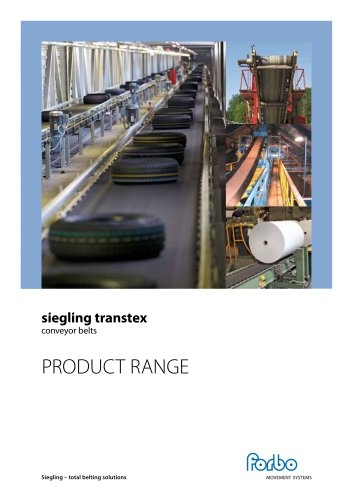 siegling transtex (2025)
12 Pages
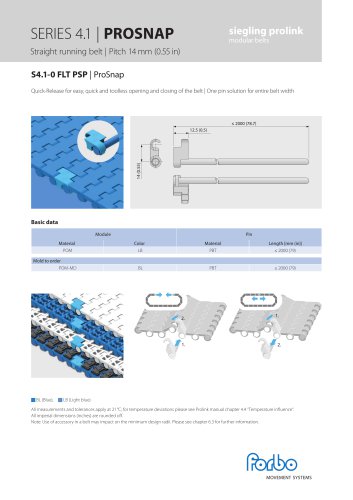 S4.1-0 FLT PSP
1 Page
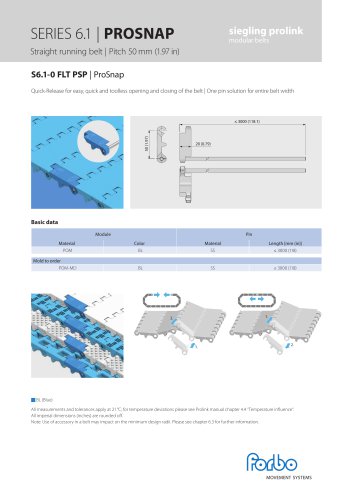 S6.1-0 FLT PSP
1 Page
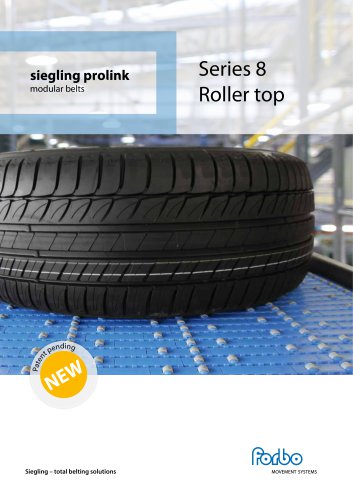 Series 8 Roller top 2025
2 Pages
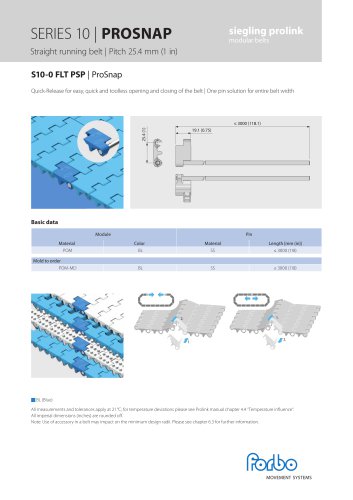 SERIES 10 | PROSNAP
1 Page
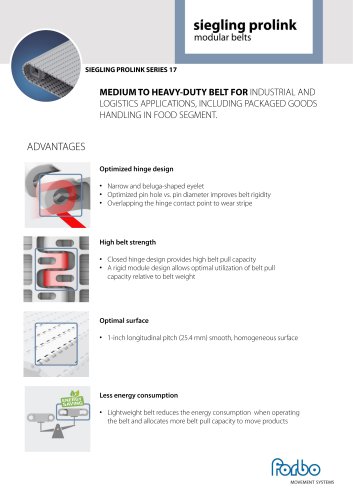 SIEGLING PROLINK SERIES 17
2 Pages
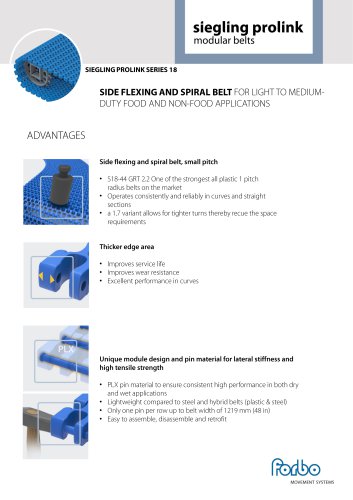 SIEGLING PROLINK SERIES 18
2 Pages
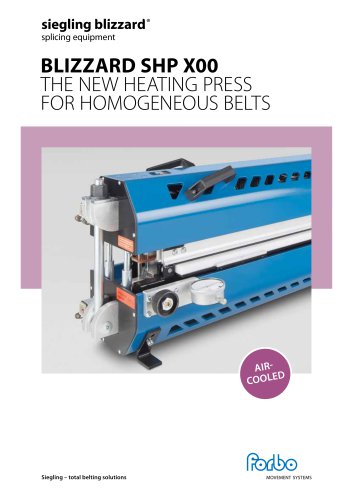 BLIZZARD SHP X00
8 Pages
 FLIGHTS AND SIDEWALLS
6 Pages
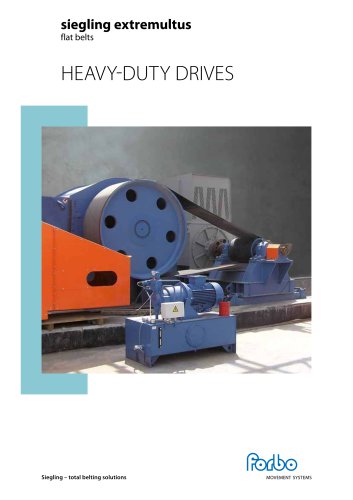 Heavy-duty drive 2025
4 Pages
 Compendium FLAT BELTS 2025
128 Pages
 TRANSILON ECOFIBER
2 Pages
 Series 11
10 Pages
 Series 10
14 Pages
 Series 9
11 Pages
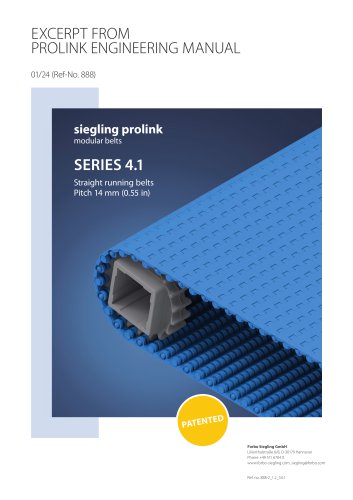 Series 4.1
10 Pages
 Series 5
24 Pages
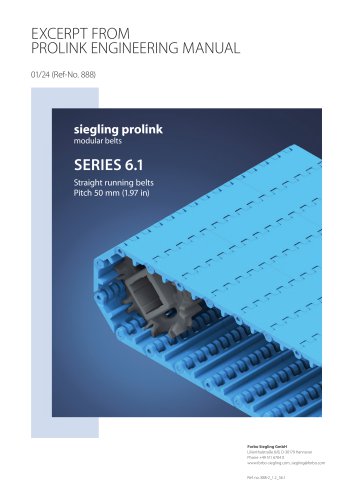 SERIES 6.1
19 Pages
 Series 7
13 Pages
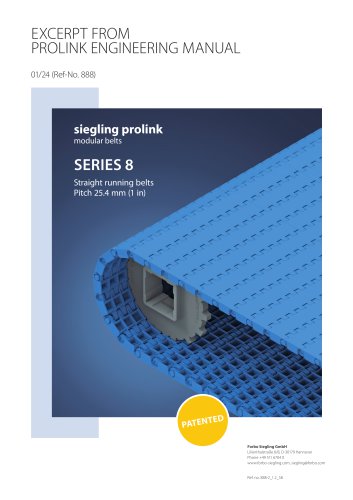 SERIES 8
19 Pages
 ECOFIBER
2 Pages
 AMP MISER
8 Pages
 Datasheet 900006
4 Pages
 Siegling Belting – Meshbelts
2 Pages
 timing belts
16 Pages
 Liver roller belts
2 Pages
 Heavy-duty drive
4 Pages
 Modular Belts
28 Pages
 Conveyor and processing belts
16 Pages
 Siegling total belting solutions
12 Pages
 Compendium FLAT BELTS
128 Pages
 Series 8 Roller top
2 Pages
 Marmoleum Tile 2.0 and 2.5mm
51 Pages
 MARMOLEUM STRIATO AND WALTON
48 Pages
 Marmoleum 2.0 and 2.5 mm
54 Pages
 Siegling Belting – Sports
4 Pages
 Siegling Belting – Automotive
12 Pages
 Siegling Belting – Wood
12 Pages
 Siegling Belting – Tobacco
8 Pages
 Siegling Belting – Airports
12 Pages
 Siegling Belting – Food
32 Pages
 Siegling Belting – Logistics
20 Pages
 Siegling Belting – Tire Industry
12 Pages
 Serie 14
5 Pages
 Serie 13
6 Pages
 Serie 8
16 Pages
 Serie 6.1
16 Pages
 Serie 4.1
10 Pages



Archived catalogs
 Series 3
10 Pages
 Series 2
12 Pages
 Prolink Engineering Manual
282 Pages
 Standard Product Range
16 Pages
 Series 1
11 Pages
 Round Belts
6 Pages
 siegling transtex
20 Pages
- Industrial press
- Rail conveyor
- Transport rail conveyor
- Belt conveyor
- Horizontal conveyor
- Forbo transmission belt
- Forbo conveyor belt
- Forbo industrial belt
- Forbo plastic conveyor belt
- Rubber strip
- Electric drive conveyor
- Inclined conveyor
- Work conveyor
- Forbo industrial conveyor belt
- Electric press
- Forbo flush grid conveyor belt
- Forbo industrial belt
- Modular conveyor
- Forbo plastic belt
- Forbo modular conveyor belt