
- Catalogs
- Focused Photonics Inc.
- FPI LDM 100(D) Laser Analyzer for Dust in process gas


- Company
- Products
- Catalogs
- News & Trends
- Exhibitions
FPI LDM 100(D) Laser Analyzer for Dust in process gas

FPI LDM 100(D) Laser Analyzer for Dust in process gas
The document describes a laser-based dust concentration measurement system. The laser beam passes through a stack or duct, reflecting off dust particles. The reflected light is detected by a photoelectric sensor, with the intensity of the reflected signal being proportional to the dust concentration. The formula used is 2Pr=Po*K1*D*K3, where Po is the laser diode output power, D is the dust concentration, K1 is the dust shutter attenuation, and K3 is the lens convergence gain.
LDM-100(D) Features and Benefits
The LDM-100(D) offers on-line continuous monitoring for various emission sources. It combines adaptive stabilization and dynamic adaptive phase-lock amplification techniques. The device is compact, easy to install, anti-lightning, highly adaptable, low cost, and requires less maintenance. It features very low zero drift and patented technology for on-line calibration.
Technical Data
- Technical Principle: Laser Back Scattered
- Installation Type: In-situ
- Measurement Range: 30~200, 0-1000 mg/m
- Zero Drift: ≤±2%F.S./d
- Span Drift: ≤±2%F.S./d
- Analog Output: (4-20)mA
- Communication: RS485
- Protection Class: IP66
- Response Time (T90): <10s
Catalog excerpts
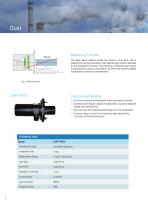
Measuring Principle Lense Opt-Sense Po: Detective laser diode output power. D: Dust concentration in stack. K1: Dust shutter attenuation, influenced by dust deposition. K2: Dust reflection coefficient, related to the particle structure of dust. K3: Lens convergence gain, regarded as constant. The laser beam passes across the stack or duct work and is reflected by the dust particles, the reflected light is then detected by the photoelectric sensor. The intensity of reflected laser signal is proportional to dust concentration, by which the resulting signal is analyzed to yield dust concentration. Features and Benefits ⊙ On-line continuous monitoring for various emission sources ⊙ Combined techniques: adaptive stabilization, dynamic adaptive phase-lock amplification ⊙ Very low zero drift, patented technology of on-line calibration ⊙ Compact, easy to install, anti-lightning, high adaptability, low cost and less maintenance TECHNICAL DATA Model Technical Principle Installation Type Measurement Range Zero Drift Span Drift Analog Output Protection Class Laser Back Scattered
Open the catalog to page 1All Focused Photonics Inc. catalogs and technical brochures
 Portable Methane Detector
2 Pages
 GC-MS/MS EXPEC-5231
4 Pages
 Gas Chromatography GC-2000
5 Pages
 Portable VOCs Analyzer
2 Pages
 Metal Analyzer
3 Pages
 Fixed gas detector
2 Pages
 LGA-3500
2 Pages
 VOC Monitoring System
2 Pages
 VOCs online monitoring product
11 Pages
 AQMS-700 CAPS NO2 Analyzer
2 Pages
 FPI ICs from KTL
5 Pages
 FPI IECEx Certificate
3 Pages
 FPI ATEX Certificate
2 Pages
 FPI ISO9001 Certificate
1 Page


Archived catalogs
 Thermal Camera
2 Pages


- Digital imager
- Temperature probe
- Visible imager
- Gas analyzer
- CMOS camera module
- Industrial camera module
- Concentration analyzer
- Monitoring analyzer
- Resistance temperature sensor
- Liquids analyzer
- Infrared imager
- Monitoring camera system
- Automatic analyser
- Calibration system
- Benchtop analyser
- Solids analyser
- Spectrometer
- Process analyzer
- Gas detector
- Portable analyzer