- Catalogs
- Fluxtrol, Inc.
- Temperature Prediction and Thermal Management for Composite Magnetic Controllers of Induction Coils

Temperature Prediction and Thermal Management for Composite Magnetic Controllers of Induction Coils

Temperature Prediction and Thermal Management for Composite Magnetic Controllers of Induction Coils
Temperature control in magnetic controllers within induction coils is essential for efficient design. This study uses Flux 2D simulations to predict and manage temperatures in copper and magnetic controllers, focusing on magnetic losses in concentrator materials. It examines the effects of coil design, frequency, material selection, and application technology, introducing new composite magnetic materials and temperature management methods.
Introduction
Magnetic flux control in induction coils enhances heat pattern control, efficiency, component protection, and reduces current demand. Soft magnetic composites (SMC) are effective for flux control, especially at middle and high frequencies, due to their machinability, temperature resistance, and high magnetic permeability. Proper application techniques are crucial to prevent coil failure from overheating.
Temperature Prediction
Temperature prediction involves modeling electromagnetic and thermal fields. While copper power is calculated using standard methods, power losses in magnetic concentrators require a developed method. A single-turn channel coil with a Fluxtrol concentrator demonstrates the calculation procedure, with power densities inputted into Flux 2D for thermal prediction.
Simulation Results
The study examines material properties, frequency, coil power, and cooling conditions on concentrator temperature. Optimal material orientation significantly reduces magnetic losses and concentrator temperature, emphasizing the importance of selecting appropriate coefficients for accurate loss predictions at different frequencies.
Thermal Management
Thermal management techniques include optimal material selection, coil design to avoid hot spots, reducing magnetic flux density, and additional cooling methods. New materials like Fluxtrol LRM and Fluxtrol 75 improve performance for specific applications. Proper design and material selection prevent concentrator deterioration from local contact with hot copper.
Selection of Glue Layer
The document emphasizes selecting appropriate glue for thermal management in magnetic controllers. Thermally conductive epoxy compounds are recommended for their high thermal conductivity, temperature resistance, and ductility. Compound 50-3100 from Epoxies, Etc. is suggested for heavy-loaded applications, with a gap of 0.15-0.25 mm. Silicone glue is an alternative for low-load applications due to its lower thermal conductivity.
Additional Cooling Techniques
Additional cooling is effective, especially for large magnetic concentrators. Cooling plates and internal cooling methods, such as water-cooled magnetic shunts, manage heat in applications like biomedical research and vacuum furnaces.
Internal Cooling Methods
Internal cooling involves water channels within the concentrator material, such as magnetic bridges for high-frequency tube welding, improving welding quality and reducing heat-affected zones.
Conclusions
Predicting the temperature of magnetic controllers is complex, requiring consideration of electromagnetic and thermal phenomena. Computer simulations are recommended for accurate temperature distribution predictions. The selection of glue and concentrator material, as well as their orientation, significantly impacts temperature control and coil lifespan. Internal cooling methods, such as water channels, are effective temperature control techniques.
References
The document cites studies and patents related to cooling conditions, inductor lifetime, magnetic flux control, and high-frequency welding.
Catalog excerpts

TEMPERATURE PREDICTION AND THERMAL MANAGEMENT FOR COMPOSITE MAGNETIC CONTROLLERS OF INDUCTION COILS V. Nemkov, R. Goldstein, J. Jackowski, N. Vyshinskaya, C. Yakey Fluxtrol, Inc., 1388 Atlantic Blvd, Auburn Hills, Michigan 48326, USA ABSTRACT. Temperature control of magnetic controllers (concentrators, cores, shields, shunts) is an essential part of the induction coil design. Prediction and study of the coil copper have been described in a presentation "Influence of Cooling Conditions on Induction Coil Copper Temperatures" (V. Nemkov, R. Goldstein) [1]. That study was made using Flux 2D computer simulation program. The present study is devoted to temperature prediction and control in both copper and magnetic controller. Computer simulation with programs Flux 2D was used for modeling of the whole coil head operating conditions. Flux 2D has no standard option to account for magnetic losses in the concentrator material and their influence on the concentrator temperature. Special procedure has been developed to solve this problem. A case study illustrates the calculation procedure and influence of the coil head design, frequency, controller material selection and application technology on the controller temperature. New composite magnetic materials and temperature management methods are also described. INTRODUCTION Magnetic flux control, i.e. modification of magnetic field intensity and distribution may be accomplished by variation of the coil turn shape and positioning, by insertion of non-magnetic shields (Faraday rings) and magnetic flux controllers (concentrators, cores, impeders, shields). Magnetic flux controllers are made of laminations, ferrites and magnetic composites. The use of magnetic controllers on induction coils can provide the following advantages: - accurately control heat pattern resulting in better part quality - improve the coil efficiency and power factor resulting in higher production or energy savings - protect machine or part components from unintended heating - better utilize power transferred to the part in local heating processes - reduce current demand to the coil improving performance of the whole system. In many applications controllers give more than one benefit. It is important to mention that the controller design, selection of material and application technique can strongly influence lifetime of heavy loaded induction coils. Soft magnetic composites (SMC) are well established materials for magnetic flux control in multiple induction technologies especially at middle and high frequencies [2] with Fluxtrol and Ferrotron materials dominating on the market. Main advantages of these materials are: - excellent machinability that allows the user to create controllers of different shape - with different material grades it is possible to cover the whole range of frequencies used in induction technique, from line frequency 50/60 Hz to 13.56 MHz - high enough temperature resistance (up to 300 C for short exposure time) - high magnetic permeability (up to 120) that is sufficient for all induction applications. Of course, using controllers requires special knowledge in application technique in order to prevent premature failure of the coil. The main failure modes of the heat treating coils are the copper cracking due to overheating in cyclic processes and the concentrator overheating.
Open the catalog to page 1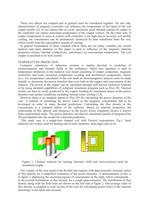
These two effects are coupled and in gnral must be considered together. On one side, characteristics of magnetic controller can influence the temperature of hot spots of the coil copper profile [3]. It was shown that in cyclic operations good thermal contact of copper to the controller can reduce maximum temperature of the copper corners. On the other side, if copper temperature in areas in contact with controller is too high due to incorrect coil profile cooling, the concentrator can be prematurely destroyed by heat transferred from the coil, which locally heat the concentrator instead of cooling....
Open the catalog to page 2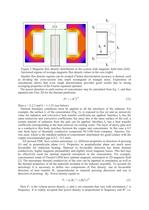
Il II Figure 2 Magnetic flux density distribution in the System with magnetic field lines (left). Sectioned regions of average magnetic flux density values in the core (right) Smaller flux density regions can be created if better discretization accuracy is desired, such as dividing the cross-section into small rectangular or triangle areas. Experience of calculations shows that even rough discretization provides good results due to strong averaging properties of the Fourier equation operator. The power densities in each section of concentrator may be calculated from Eq. 1, and then inputted into...
Open the catalog to page 3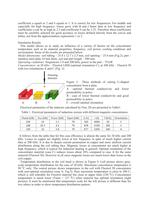
coefficient a equals to 2 and b equals to 1. It is correct for low frequencies. For middle and especially for high frequency, losses grow with B and f faster than at low frequency and coefficients a can be as high as 2.2 and coefficient b can be 1.25. Therefore these coefficients must be carefully selected for good accuracy or losses defined directly from the curves and tables, not from the approximation expressions 1 or 2. Simulation Results This model allows us to study an influence of a variety of factors on the concentrator temperature such as its material properties, frequency, coil power,...
Open the catalog to page 4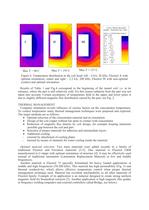
Color Shade Results Quantity : Temprature Deg. Celsius Time (s.) : 0.003E6" Phase (Deg): 0 .Scale / Color 20 / 31.25 31.25 / 42.5 42.5 / 53.75 53.75 / 65 65 / 76.25 76.25 / 87.5 87.5 / 98.75 98.75 / 110 110 / 121.25 121.25 / 132.5 132.5 / 143.75 143.75 / 155 155 / 166.25 166.25 / 177.5 177.5 / 188.75 188.75 / 200 III Max T = 90 C Max T = 193 C Max T = 127 C Figure 4. Temprature distribution in the coil head: left - 4 kA, 20 kHz, Fluxtrol A with optimal orientation; center and right - 2.2 kA, 200 kHz, Fluxtrol 50 with non-optimal (center) and optimal orientation Results of Table 1 and Fig.4 correspond...
Open the catalog to page 5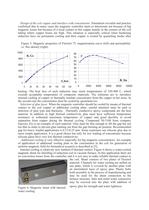
Design of the coil copper and interface with concentrator. Simulation revealed and practice confirmed that in many cases the magnetic controller starts to deteriorate not because of big magnetic losses but because of a local contact to hot copper mainly in the corners of the coil tubing where copper losses are high. This situation is especially critical when hardening inductors have no permanent cooling and their copper is cooled by quenching media after Figure 5. Magnetic properties of Fluxtrol 75: magnetization curve (left) and permeability vs. flux density (right) 0 20 40 60 80 100 120 140...
Open the catalog to page 6All Fluxtrol, Inc. catalogs and technical brochures
 Ferrotron 559H
2 Pages
 Fluxtrol 50
2 Pages
 Fluxtrol 25
2 Pages
 Fluxtrol Brochure
8 Pages
 Alphaform LF
1 Page
 FLUXTROL-A
1 Page
 Fluxtrol 100
1 Page
 Fluxtrol's AlphaForm
30 Pages
 fluxtrol Catalog
59 Pages