

FAN HEATERS LEO

FAN HEATERS LEO
LEO fan heaters are designed for indoor use in both large industrial spaces and smaller areas like workshops and garages. They feature a 3-speed fan and can be integrated with Building Management Systems (BMS) using a T-box or HMI controller. The casing is made from expanded polypropylene (EPP), providing durability and resistance to dirt.
The heaters include a 3-speed fan and a durable EPP casing, offering heating power from 0.7 to 121 kW. They can be mounted on walls or ceilings with a rotating console allowing 170° rotation.
Available in models S, L, and XL, LEO fan heaters have varying air flow capacities and heating powers. They operate on a 230V/50Hz power supply with a maximum operating pressure of 1.6 MPa. Sound pressure levels at 5m range from 42.1 to 67.5 dB(A).
Heaters can be installed perpendicularly or horizontally at various angles. Recommended installation distances vary by model, with maximum distances from 3.0 to 9.5 meters. Proper air circulation must be ensured, avoiding obstruction of air inlets and outlets.
Optional accessories include confusors and 4-side outlet grilles, enhancing air distribution but reducing nominal parameters by 10%. These are made from powder-painted metal and available for LEO L and XL models.
LEO heaters can be controlled manually or automatically with a 3-step regulator and thermostat. They are compatible with SYSTEM FLOWAIR for intelligent solutions and energy savings, allowing control of up to 31 units.
The document details air heating and ventilation systems, focusing on fan heaters. It includes air flow rates at different fan speeds and heating power at various temperatures, organized into two main steps with air flow volumes of 4100 m³/h and 2500 m³/h.
Several tests ensure the quality and efficiency of the fan heaters:
- Acoustic Pressure Level Test: Conducted in a renowned lab, adhering to international standards, to measure sound pressure levels.
- Efficiency Test: Performed in an air flow chamber to assess real efficiency, considering flow resistance.
- Heating Power Test: Measured at nine points for various temperatures, determining heating capacity from air and water sides.
- Sound Pressure Level Test: Conducted in an anechoic chamber under real working conditions.
The testing lab is accredited, and results are globally respected. FLOWAIR has developed quality labels based on these reports.
For inquiries, contact FLOWAIR at ul. Chwaszczyńska 135, 81-571 Gdynia, Poland, or via email at [email protected]. More information is available on their website www.flowair.com.
Catalog excerpts
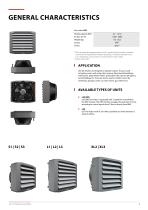
GENERAL CHARACTERISTICS Fan heater LEO Heating capacity [kW] Air flow [m³/h] Weight [kg] Casing Colour EPP is an expanded polypropylene, which is good thermal insulator, is resistant to dirt and has high ability of vibration damping. This features allowed to use it as a material for casing of the unit and lowered its total weight. (2) similar to RAL 9007 (1) APPLICATION LEO fan heaters are designed to operate indoors. They are used to heating rooms with a big cubic measure like industrial buildings, warehouses, departments stores, production halls, sports halls (gyms), sacral buildings etc. They...
Open the catalog to page 3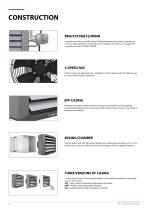
CONSTRUCTION BMS/SYSTEM FLOWAIR Connection of units to the BMS system (Building Management System) is possible via a T-box or HMI controller or via the DRV control module. LEO is also a unit adapted for integration with the SYSTEM FLOWAIR. 3-SPEED FAN LEO fan heaters are equipped with 3 speed fans. It’s the simplest and most effective way to control the fan heater’s operation. EPP CASING Mechanical strength, resistance to dirt, low weight and aesthetic look. By applying expanded polypropylene for casing construction, LEO fan heaters create a new quality in heating and ventilation. MIXING CHAMBER...
Open the catalog to page 4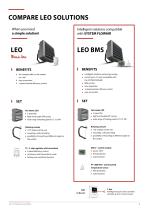
COMPARE LEO SOLUTIONS When you need a simple solution! Basic line Intelligent solutions compatible with SYSTEM FLOWAIR • the cheapest offer on the market (as a kit) • easy connection • 3-speed manual efficiency control • intelligent solutions and energy savings • control up to 31 units compatible with the SYSTEM FLOWAIR • BMS control • local regulation • 3-speed automatic efficiency control • easy connection SET Fan heater LEO • 3 speed fan • light and durable EPP casing • wide range of heating power 0,7-121 kW Fan heater LEO • 3 speed fan • light and durable EPP casing • wide range of heating...
Open the catalog to page 5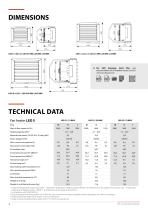
For CAD drawings, Revit files and documentation for all available versions of LEO visit www.flowair.com TECHNICAL DATA Fan heater LEO S Step Max. air flow stream [m /h] Nominal heat power (70/50/16oC, III-step) [kW] IP/Insulation class Sound pressure level 5m [dB(A)](2) Sound power level [dB(A)] Max. heating water temperature [oC] Weight of unit filled with water [kg] range of heating power at given parameters – I step of fan, temperature of heating medium 40/30oC, air temperature at the supply to the unit 20oC; max. – III step of fan, temperature of heating medium 120/90 oC, air temperature...
Open the catalog to page 6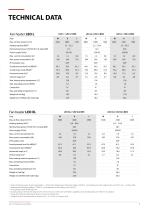
TECHNICAL DATA Fan heater LEO L Nominal heat power (70/50/16oC, III-step) [kW] IP/Insulation class Sound pressure level 5m [dB(A)](2) Sound power level [dB(A)](3) Vertical range [m](5) Max. heating water temperature [oC] Weight of unit filled with water [kg] Nominal heat power (70/50/16oC, III-step) [kW] IP/Insulation class Sound pressure level 5m [dB(A)](2) Sound power level [dB(A)](3) Max. heating water temperature [ C] Weight of unit filled with water [kg] range of heating power at given parameters – I step of fan, temperature of heating medium 40/30oC, air temperature at the supply to the...
Open the catalog to page 7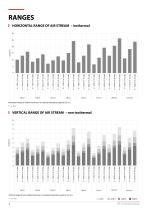
RANGES HORIZONTAL RANGE OF AIR STREAM – isothermal Horizontal range of isothermal stream at velocity boundary equal to 0,5 m/s. VERTICAL RANGE OF AIR STREAM – non-isothermal Vertical range of non-isothermal stream at velocity boundary equal to 0,5 m/s.
Open the catalog to page 8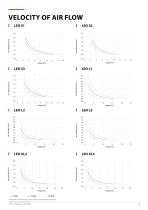
the above air flow velocity charts refer to the isothermal stream LEO • Air heating and ventilation
Open the catalog to page 9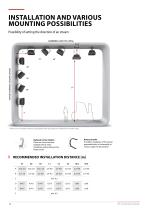
INSTALLATION AND VARIOUS MOUNTING POSSIBILITIES Possibility of setting the direction of air stream installation under the ceiling DxE vertical installation using the console When unit is mounted under the ceiling please note the proper non-isothermal air stream range. Rotary console It enables installation of the heater perpendicularly or horizontally at various angles to the partition. Optional corner holders There are corner brackets available which make installation and levelling of the heater easier. RECOMMENDED INSTALLATION DISTANCE [m] S1
Open the catalog to page 10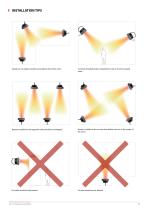
INSTALLATION TIPS Steady air circulation should be provided in the entire room. Correctly installed heaters should direct the air to the occupied zone. Heaters installed in the corners should direct the air to the center of the room. Heaters installed on the opposite walls should be overlapped. Air outlet should not be limited. Air inlet should not be limited.
Open the catalog to page 11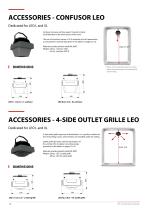
ACCESSORIES - CONFUSOR LEO Dedicated for LEO L and XL Confusor increases air flow speed. It results in faster air distribution to the lower zones of the room. The use of a confusor causes a 10 % reduction of unit’s parameters as compared to nominal data given in the tables on pages 23–25 Material: powder painted metal RAL 9007 Weight: 3,8 kg - confusor LEO L 6,2 kg - confusor LEO XL When unit is mounted under the ceiling please note the proper nonisothermal air stream range. ACCESSORIES - 4-SIDE OUTLET GRILLE LEO Dedicated for LEO L and XL 4-side outlet grille improves air distribution. It is...
Open the catalog to page 12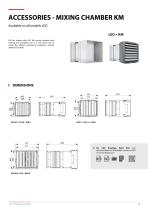
ACCESSORIES - MIXING CHAMBER KM Available to all models LEO LEO + KM LEO fan heaters with LEO KM mixing chamber form heating and ventilation unit. It is the easiest way to create the efficient mechanical ventilation without additional systems. 1095 For CAD drawings, Revit files and documentation for all available versions of LEO visit www.flowair.com
Open the catalog to page 13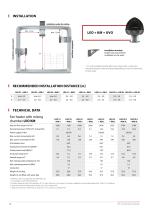
INSTALLATION installation under the ceiling LEO + KM + UVO installation using pins installation using brackets Installation brackets Enable easy and aesthetic installation on the walls. For units installed vertically. When mounting under a ceiling, the mounting height should be selected depending on the non-isothermal vertical range. RECOMMENDED INSTALLATION DISTANCE [m] LEO S1 + KM S TECHNICAL DATA Fan heater with mixing chamber LEO KM Max. air flow stream [m3/h](1) Nominal heat power (70/50/16 C, III step) [kW] o IP/Insulation class Sound pressure level 5m [dB(A)](2) Sound power level [dB(A)]...
Open the catalog to page 14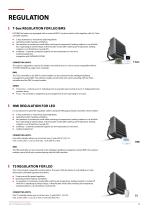
REGULATION T-box REGULATION FOR LEO BMS LEO BMS fan heaters are equipped with an external DRV V control module, which together with the T-box controller enables: 3-step automatic or manual fan speed regulation, operating modes: heating, ventilation, fan operation in continuous mode (after reaching set temperature, heating medium is cut off while fan is operating at selected step), or thermostatic mode (after reaching set temperature, heating medium is cut off and fan is turned off ), antifreeze – automatic protection against too low temperature in the room, weekly programmer, integration with...
Open the catalog to page 15All Flowair catalogs and technical brochures
 DESTRATIFICATOR LEO D
12 Pages
 Slim air curtain
15 Pages
 CATALOGUE CARD Slim
1 Page
 CARD ELIS G
3 Pages
 CARD EliS AX
3 Pages
 FAN HEATERS LEO EX
12 Pages
 PRODUCT BROCHURE
84 Pages
 CATALOGUE CARD ELIS A
4 Pages
 CATALOGUE CARD UVO H EC
4 Pages
 CATALOGUE CARD KM S | L | XL
8 Pages
 CATALOGUE CARD LEO COOL
4 Pages


Archived catalogs

- Propeller fan
- Air circulation fan
- Industrial fan
- Heat exchanger unit
- Plate heat exchanger
- Air curtain
- Industrial heat exchanger
- Industrial control system
- Horizontal air curtain
- Ambient air curtain
- Gas heater
- Automatic control system
- Rooftop fan
- Gas/gas heat exchanger
- Air handling unit
- Commercial air curtain
- Ceiling-mounted air curtain
- Air curtain with electric heating
- Air/air heat exchanger