

- Products
- Catalogs
- News & Trends
- Exhibitions
The original wood finishing system
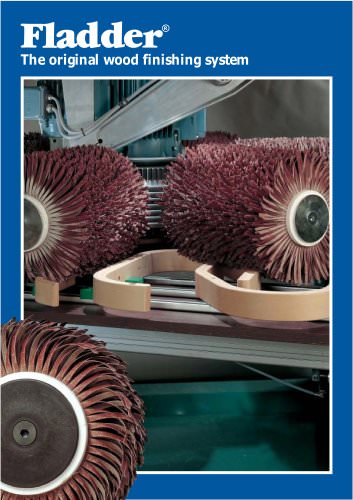
The original wood finishing system
The document discusses the challenges of achieving a smooth wooden surface after sealing due to the creation of fine fibres during traditional sanding processes. These fibres cause a rough texture post-sealing.
Traditional Sanding Issues
Traditional sanding methods, such as using a widebelt sander, apply pressure that severs wood fibres, resulting in a 'fuzzy' surface. This necessitates additional sanding after sealing, which is labor-intensive and wasteful.
FLADDER® Sanding System
The FLADDER® sanding system offers an innovative solution by using rotating speed rather than pressure to achieve a smoother finish. This method minimizes fibre creation and provides a more uniform surface.
Sanding Methods
- Figure 1: Simple counter-rotating spindles, which may not sand uniformly.
- Figure 2: Orbital movement with spindles rotating in the same direction, offering more uniform sanding but with directional limitations.
- Figure 3: Improved method with counter-rotating spindles for uniform sanding, used in FLADDER® systems.
- Figure 4: Advanced method with both orbital and oscillating movements, ensuring uniform sanding even in automatic lines.
Benefits of FLADDER® Finishing
- Reduces sealer/primer consumption by up to 50%.
- Minimizes fibre presence, reducing the need for additional sanding.
- Improves uniformity of the surface.
- Slightly rounds sharp edges, reducing the risk of sanding through the sealer.
- Enhances stain absorption for a more uniform appearance.
Conclusion
The FLADDER® sanding system provides significant improvements in wood finishing by reducing fibre creation, enhancing surface uniformity, and optimizing sealer use.
Catalog excerpts
R The original wood finishing system >
Open the catalog to page 1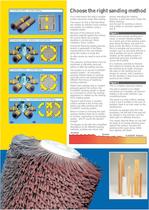
1. Parallel spindles - counter-rotating. > 2. Rotating spindles - rotating in same direction. 3. Rotating spindles - counter-rotating. > Ү 4. Rotating spindles - counter-rotating and oscillating. >
Open the catalog to page 2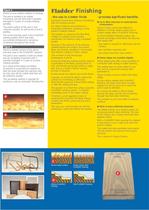
Figure 3 > R Shows a more perfect method of sanding: The part is sanded in an orbitalmovement, but this time with 6 spindles arranged in 3 pairs of counter-rotating spindles.The entire surface of the part is nowuniformly sanded, as well as the A and Bprofiles.This is the principle used in the FLADDER > Everybody knows the problems of denibbing after the sealing process.It is labour-intensive and produces aproduction bottleneck, resulting in a big waste of sealing material.The problem is caused by the fine fibrescreated by ordinary wood sanding procedures, for instance using a widebeltsander.Because...
Open the catalog to page 3All Fladder catalogs and technical brochures
 abrasive tools details
2 Pages

Archived catalogs
 Wood finishing system
3 Pages
- Surface treatment brush
- Polishing unit
- Metal brush
- Circular brush
- Deflashing machine
- Metal polishing machine
- Finishing machine
- Plastic brush
- Deburring brush
- Automatic polishing machine
- Metal parts deburring machine
- Brush deburring machine
- Automatic deburring machine
- Edge rounding deburring machine
- Finishing brush
- Finishing polishing machine
- Cylindrical brush
- Finishing deburring machine
- Abrasive brush
- Sheet metal deburring machine