


Power technology Isokinetic sampling

Power technology Isokinetic sampling
Introduction: Traditional methods for measuring gas-solid suspension flows are costly and unsuitable for industrial scales. This study introduces an isokinetic sampling probe that evaluates local concentration and suspension velocity simultaneously without calibration. Details on the probe's design and measurement procedure are provided.
Measurement Method: The method isolates gas-solid flow without disturbing the main stream, ensuring isokinetism. The probe includes a tip, filter element, nozzle, and jet vacuum pump. The procedure involves balancing the probe, extracting the flow, and measuring material and gas flow rates to determine local concentration and suspension velocity.
Measurements in Cyclone: The study characterizes inlet conditions and vortex in a cyclone with an 835 mm diameter using silica material. Inlet conditions show a concentration gradient due to pipe geometry. Vortex characterization reveals material circulation confined to the cyclone's bottom and direct escape from inlet to outlet. Efficiency curves show higher inlet solids concentration reduces material in suspension subjected to centrifugation.
Conclusion: The isokinetic sampling probe effectively measures local concentration and suspension velocity in cyclones. While less accurate than pressure probe methods for velocity, it provides valuable concentration data and can be used in hot conditions with precautions. Future on-site measurements in large cyclones at high temperatures are planned.
Specifications and Procedures: The document emphasizes selecting the appropriate tip for a microcyclone to maintain inlet velocity between 15 and 30 m/s for optimal efficiency. Microcyclone dimensions and separating unit depend on measuring conditions such as suspension velocity, solids concentration, gas temperature, and the nature of the gas and material.
Conclusions: The isokinetic sampling probe is effective for measuring concentrations up to 2 kg of material per kg of gas without prior calibration. The FCB isokinetic sampling probe demonstrates the suspension-type flow structure in a cyclone. Observations include non-uniform solids concentration and grain size discrimination with inlet height, direct material escape from inlet to outlet, and a dense phase of material moving down the wall in a spiral flux. These phenomena are quantifiable from the efficiency curve, and samples allow for grain size or chemical analysis.
List of Symbols: The document provides a list of symbols used, including local solids concentration (C), cyclone inlet mean concentration (C0), cyclone diameter (D), cyclone inlet vertical position (h), inlet height (H), external and internal flow static pressures (P1, P2), radial position (r), tangential velocity (Vt), and maximum tangential velocity in pure air (Vt max).
References: The document cites various studies and theses related to powder technology and fluidized bed technology, indicating a well-researched foundation for the findings presented.
Keywords: Isokinetic sampling probe, concentration measurement, air-solid flow, cyclone.
Catalog excerpts

The method enables the isolation of gas-solid flow from the main stream without disturbing the flow around the probe by ensuring isokinetism (the extraction velocity is equal to the velocity of the suspension at the measurement point). Probes used by Rhodes [6] and Aiguillon and al. [5], drawn in figures 1 and 2, are unable to obtain isokinetism. Velocity field characterization is required before concentration measurements. Figure 2 Figure 1 : Rhodes probes [6]. : Aiguillon and al. Probes [5]. 2.1. Equipment. > The probe is composed of a tip, placed in front of the flow, a filter element which...
Open the catalog to page 2
valves gas flow ratebalance of the probe liquid jet vaccum pump φ 5 mm gas+solidsolidgas compressed air microcyclone φ 36 mmnozzle probe tip wall sample container g as-solid flow Figure 3 : Probe design. 2.2. Operating mode. The probe tip has two pressure intakes (P1 and P2). The geometry of the tip used is described in figure 4. > toric join 7mm 12mm P1P2 Figure 4: Probe tip design. Pressure P1 represents the static pressure of the flow outside the probe, and P2 that of the inside flow. As the total pressure is the same for both flows, when static pressures P1 and P2 are equal, velocities of...
Open the catalog to page 3
y clone p ressure dro p fan fan filter coffe r > g asfinescoarses feed torch c coffe r b yp ass belt wei g he r wei g hted ho pp e r >
Open the catalog to page 5
C local solids concentration (kg/kg), C > cyclone inlet mean concentration (kg/kg), D cyclone diameter (mm), h cyclone inlet vertical position (mm), H inlet height (mm), P > 1 external flow static pressure, P > 2 internal flow static pressure, r radial position (mm), V > t tangential velocity (m/s), V > t max (without material) maximum tangential velocity in pure air. > [1] J.J.Nieuwland, R.Meijer, J.A.M.Kuipers and W.P.M.Van Swaaij, Powder Technology, 87 (1996). [2] U.Mann and E.J.Crosby, Ind. Eng. Chem. Proc., 16, (1977). [3] E.U.Hartge, Y.Li and J.Westher, Proc. 1 > st Int. Conf. Circulating...
Open the catalog to page 11All Fives catalogs and technical brochures
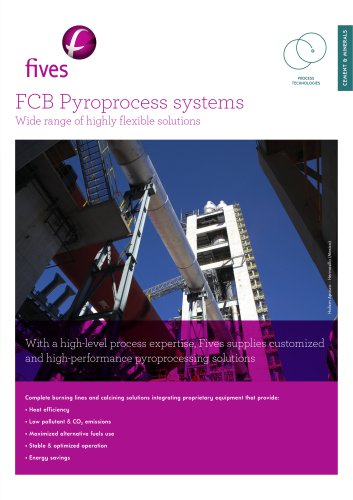 FCB Pyroprocess systems
6 Pages
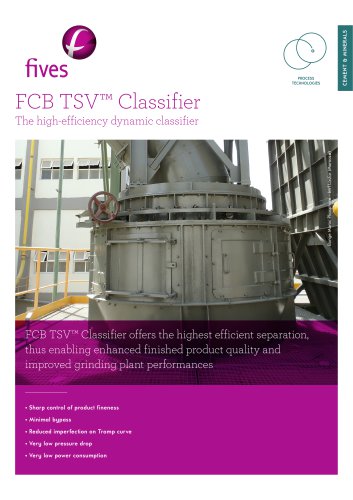 FCB TSV™
4 Pages
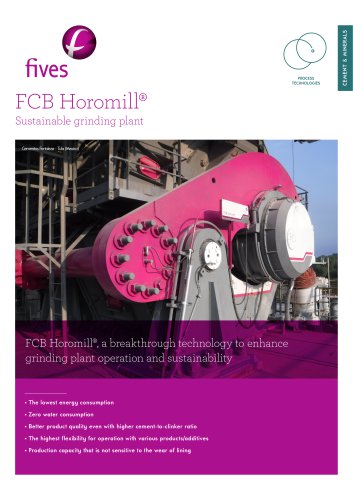 FCB Horomill®
4 Pages
 FCB VIF™
2 Pages
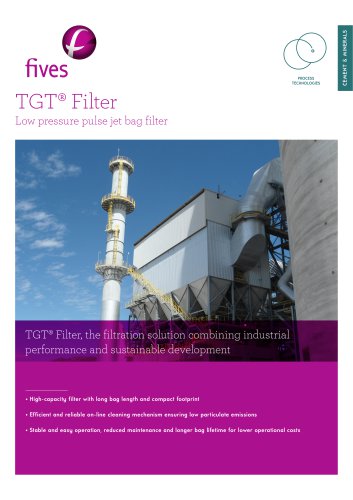 TGT®
TGT®2 Pages
Archived catalogs
 FIVES AT A GLANCE
16 Pages
 Hot and Cold Kiln Alignment
2 Pages
 Shell-Safe™ / Refra-Safe™
2 Pages
 On-site Machining
2 Pages
 FCB Nova-Gear®
2 Pages
 FCB Preheater
2 Pages
 Pillard Control Systems™
2 Pages
 Pillard Neutrinox™
2 Pages
 FCB Rhodax® 4D
4 Pages
 TGT® Filter
2 Pages
 Pillard Control System
2 Pages
 Pillard NeutriNOx
2 Pages
 Pillard NovaFlam®
2 Pages
 Pillard PrecaFlamTM
2 Pages
 Pillard RotaFlam®
2 Pages
 FCB TSV™ Classifier
2 Pages
 FCB B-mill
2 Pages
 FCB Horomill® grinding plant
2 Pages
 PRECAFLAM
2 Pages
 ROTAFLAM®
2 Pages
 NOVAFLAM®
2 Pages
 Horomill ®
6 Pages
 Rhodax ®
6 Pages
 Lowering emissions
4 Pages


- Kiln
- Chamber kiln
- Heat treatment kiln
- Grinding mill
- Crushing plant
- Stationary crushing plant
- Mobile crushing plant
- Combustion kiln
- Horizontal lump breaker
- Vertical pulverizer
- Impact crushing and screening plant
- Tunnel kiln
- Dust separator filter
- Compact pre-filter
- Primary crushing plant
- Gas separator filter
- Compressed air pre-filter
- Cutting mill
- Secondary crushing plant
- Bag filter