


High efficiency dynamic separator

High efficiency dynamic separator
The document discusses the importance of classifiers in separating powdery products into fine and coarse particles, crucial for ensuring product fineness in grinding plants. Classifiers operate on the principle of centrifugal force, with static classifiers using a cyclone effect and dynamic classifiers employing a rotating turbine. Advances in classifier technology have improved their ability to sort particles, reducing by-pass and enhancing efficiency.
The TSV® is a third-generation dynamic classifier developed by FCB, featuring a radial turbine for effective separation. It offers flexible installation options, such as air-swept, top-feeding, mixed, and volute systems, making it adaptable to various grinding setups. The design includes adjustable stator blades and patented turbine blade profiles to improve cutting precision and reduce wear.
The TSV® incorporates a vortex-breaking system to enhance fine particle evacuation and reduce energy consumption, preventing pressure loss and energy dissipation, which contributes to lower wear and increased efficiency.
The TSV®'s performance is assessed using sharing curves and reduced coordinates, which evaluate cutting quality and classifier efficiency. It shows lower imperfection and by-pass levels compared to earlier models, indicating superior particle discrimination.
The document highlights the impact of classifier performance on grinding plant efficiency, measured by Specific Energy (SE) and the FCB Index. The TSV® enables high-performance grinding circuits with low by-pass and good imperfection, optimizing energy consumption and output quality.
The TSV® classifier's performance is evaluated based on fineness criteria such as R40, R80, and d80. Energy gains vary depending on the fineness criterion, with significant improvements noted for larger particle diameters.
In the Martres-Tolosanne plant, the TSV® classifier significantly reduces rejects at 100µm compared to first-generation classifiers, improving performance relative to the FCB Index.
The Alba plant uses a TSV® classifier with a ball mill, achieving minimal by-pass and high recovery of fines. The Rosin-Rammler diagram indicates distinct slopes for different particle sizes, highlighting the classifier's selection performance.
The Port-La-Nouvelle plant demonstrates the TSV®'s effectiveness in producing CPA55 and HPR cements with high cumulative output in fines and low imperfections. The Trino plant shows similar results with a Horomill® setup.
The TSV® classifier reduces specific separation energy across different materials, with notable savings in tube mills and vertical mills for coal. The document provides specific energy consumption values for various grinding setups.
The TSV® classifier enhances grinding plant performance by improving energy efficiency and product quality, particularly in terms of particle size distribution and reduction of coarse particles in fines.
The document discusses the installation and advantages of the TSV® classifier in coal and cement industries, highlighting its energy efficiency and product quality improvements.
The TSV® classifier is noted for saving approximately 30% in energy for a given R80. It ensures regularity of the finished product, absence of coarse grains, and better grinding operation. The TSV2 model offers adjustable imperfection, allowing control over the grain size of the finished product while maintaining high grinding output.
The TSV2 model, developed by FCB, features a single turbine controlling two gaseous flows at different speeds, enabling two different cutting meshes. This innovation allows for a combination of output curves, enhancing the classifier's efficiency.
Tests on hard limestone with the TSV® and TSV2 models showed that TSV2 achieves greater imperfection with the same global by-pass as TSV®. The Rosin-Rammler diagram indicates a weaker distribution for TSV2, suggesting a larger grain size.
Over the past five years, the TSV® has demonstrated significant industrial development, adapting to various grinding circuits and showing high energy performance. The TSV2 model offers new possibilities for controlling the grain size curve without increasing by-pass.
The document references several studies and papers that provide additional insights into the modeling and optimization of grinding systems in cement production.
Catalog excerpts

TSV : The high-efficiency dynamic classifier and its latest developments FCB-CRCM Ph.Duhamel, A.Cordonnier and D.Lemaire FCB-Research Centre Cement and Mineral Industries CRCM > The use of classifiers on a powdery product with a given grain size allows the product to be divided into two parts: the first one made up of fine particles and the second one of coarser particles. However, depending on the quality of the classifier cut, the segregation of fine and coarse particles is more or less precise. One of the traditional classifier applications is found in grinding plants for which the ground product feeds the classifier which sends the coarse part to the grinding mill inlet. This enables regularity of the finished product to be obtained in accordance with specific criteria for fineness. The performance of a grinding plant depends of course on the grinding mill used with however a significant part depending on the classifiers capabilities. The principle of separation lies in the use of centrifugal force generated by way of a flow with vortex (cyclone and derivatives, etc.) for static classifiers or a rotating turbine for dynamic classifiers. The evolution in the technology of classifiers can be summarized briefly. The first classifiers of the ғstatic type separate the coarse particles from the fine particles by a cyclone effect although limited with regard to the admissible material load for inlet as well as separation efficiency. The next generation, called first generation dynamic classifiers, has a rotating plate to disperse particles with a small axial selection turbine. Air circulation is ensured by a centrifugal rotor which is placed in the upper part. The fine product is recovered by decantation in a double conic casing. By adding an external air circuit to suck in the gas output with the fine particles instead of the integrated rotor, we have come to second generation dynamic classifiers which are traditionally installed with peripheral cyclones. The third generation includes a radial turbine which ensures radial separation and no longer axial separation. Figure 1 : Static classifier Figure 2 : First generation > SRBII - fragmentation commitee Study day ԓDry screening and classification-28/3/1996 page 1 >
Open the catalog to page 1
TSV : The high-efficiency dynamic classifier and its latest developments FCB-CRCM Figure 3 : Second generation Figure 4 :Third generation The TSVή developed in 1990 by FCB, the technology of which will be explained in Part 2, is an advanced third generation classifier. The evolution of classifiers has followed a policy of improvement of their cutting ability, characterized by a better sorting of fine and coarse particles and a weaker by-pass. Furthermore, in Part 3, we will present the industrial results of the TSVs set up in different grinding plants (traditional or ventilated ball mills, vertical...
Open the catalog to page 2
TSV : The high-efficiency dynamic classifier and its latest developments FCB-CRCM air-swept TSVή: top feeding TSV: The matter is placed in suspension in the fluid flow and it all feeds TSVή from the bottom. This type of feed allows less space to be taken up and use in vertical grinding mills or air-swept ball mills. The matter arrives in bulk from the top of the classifier onto the roof of the turbine which disperses the material between the stator and rotor blades. As for the clean gas, feeds the TSV from the bottom. This configuration allows for a higher matter throughput. > REJECT Figure 5...
Open the catalog to page 3
TSV : The high-efficiency dynamic classifier and its latest developments FCB-CRCM The flow of gas is rectified by way of the adjustable stator blades, which allows the tangential speed of the gas to be adapted to the turbine rotation speed so as to obtain only a radial speed of the fluid of the turbine. Therefore, a drag speed which is directly centripetal and opposing the centrifugal force is obtained which limits wear of the blades by the absence of particle impact on the latter. A closing which is adapted to the blades causes pressure loss which is favourable to the proper homogeneity of the...
Open the catalog to page 4
TSV : The high-efficiency dynamic classifier and its latest developments FCB-CRCM (1-Stg)/2 (St+Stg)/2 FirstGeneration First Efficiency Second Generation Second Third Third Generation St Efficiency % 00.10.2 0.30.40.50.60.7 0.80.91 110100 s Stg Mesh Mesh m Size M = ln(10)=2.3tg՟= Ms Mc Pt.M/4 t g s= Pts .M/4 SRBII - fragmentation commitee Study day ߓDry screening and classification-28/3/1996 page
Open the catalog to page 7
TSV : The high-efficiency dynamic classifier and its latest developments FCB-CRCM The sizes which allow the slope of the sharing curve to be assessed are defined in reduced coordinates: - Imperfection I > =Ȓ ddd7525250. - Acuity > = > dd2575 - The slope of the straight line obtained through linearisation of the cutting area of the sharing curve in reduced coordinates expressed in a diagram semi-Log : > = Atan(-0.5/log(Acuity)) The evolution of the classifiers has followed a rationale of decreasing imperfection, global by-pass and the presence of outsized coarse particles in the finished product,...
Open the catalog to page 8
TSV : The high-efficiency dynamic classifier and its latest developments FCB-CRCM Feed t/h 220 140 Throughput gas m > 3 /h 69000 69000 Material load kg/m > 3 3.2 2.0 Recycled LoadL 7.1 4.6 R8m % 70.4 70 Dcut յm 33 33 Reduced imperfection 0.26 0.26 Global by-pass % 16 2 Pressure loss daPa 160 110 Turbine power kW 14 9 > The following table provides the average values of specific energy depending on the type of grinding plant. > Material Coal Raw materials from cement works Cement (~3000 Blaine and dcut=35 m Cement (~4000 Blaine and dcut=22 յm) ) Turbine kWh/t 0.15 0.15 0.25 1.1 Ventilation kWh/t...
Open the catalog to page 17
TSV : The high-efficiency dynamic classifier and its latest developments FCB-CRCM It has been observed that in plants equipped with the TSVή, the output obtained is practically always very close to 1 or even considerably higher than 1 for criteria in R90 or R100 thanks to the very small amount of imperfections obtained. For cement grinding plants, the average values correspond to a great number of industrial reports, part of which have already been published [1]. These ranges are quite large and vary from one designer to another. The following table indicates the substitution rates for vertical...
Open the catalog to page 18All Fives catalogs and technical brochures
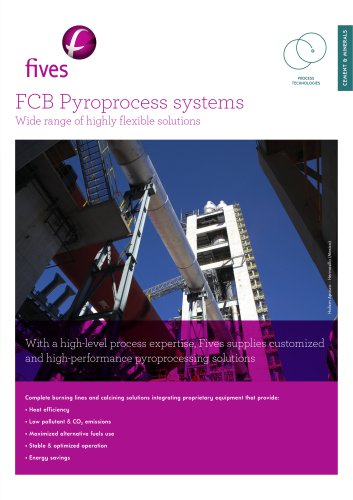 FCB Pyroprocess systems
6 Pages
 FCB TSV™
4 Pages
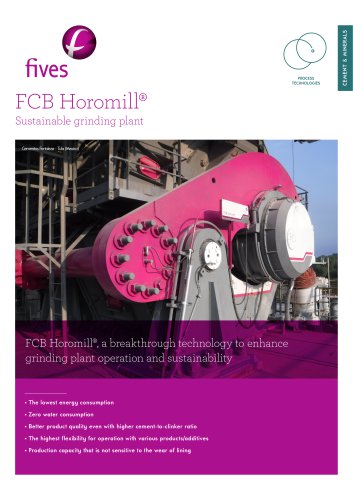 FCB Horomill®
4 Pages
 FCB VIF™
2 Pages
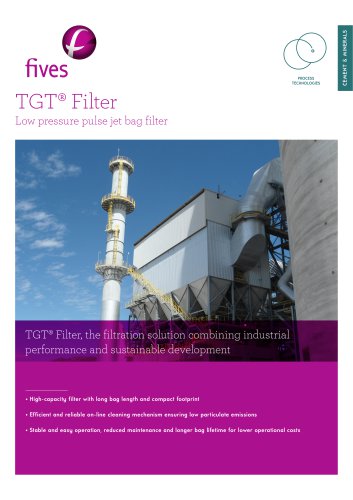 TGT®
TGT®2 Pages
Archived catalogs
 FIVES AT A GLANCE
16 Pages
 Hot and Cold Kiln Alignment
2 Pages
 Shell-Safe™ / Refra-Safe™
2 Pages
 On-site Machining
2 Pages
 FCB Nova-Gear®
2 Pages
 FCB Preheater
2 Pages
 Pillard Control Systems™
2 Pages
 Pillard Neutrinox™
2 Pages
 FCB Rhodax® 4D
4 Pages
 TGT® Filter
2 Pages
 Pillard Control System
2 Pages
 Pillard NeutriNOx
2 Pages
 Pillard NovaFlam®
2 Pages
 Pillard PrecaFlamTM
2 Pages
 Pillard RotaFlam®
2 Pages
 FCB TSV™ Classifier
2 Pages
 FCB B-mill
2 Pages
 FCB Horomill® grinding plant
2 Pages
 PRECAFLAM
2 Pages
 ROTAFLAM®
2 Pages
 NOVAFLAM®
2 Pages
 Horomill ®
6 Pages
 Rhodax ®
6 Pages
 Lowering emissions
4 Pages


- Kiln
- Chamber kiln
- Heat treatment kiln
- Crushing plant
- Stationary crushing plant
- Mobile crushing plant
- Combustion kiln
- Horizontal lump breaker
- Impact crushing and screening plant
- Tunnel kiln
- Dust separator filter
- Compact pre-filter
- Primary crushing plant
- Gas separator filter
- Compressed air pre-filter
- Cutting mill
- Secondary crushing plant
- Bag filter