
- Catalogs
- FISHER REGULATORS
- CS400 Series

CS400 Series

CS400 Series
The CS400 Series regulators are direct-operated, spring-loaded devices designed for pressure-reducing applications in commercial and industrial settings. They offer flexibility with various body sizes, end connections, and pressure settings, and can be converted from internal to external pressure registration. The series includes several overpressure protection options.
- Variety of body sizes and end connections.
- Fixed Factor/PFM accuracy capabilities.
- Field convertible for wide-open monitor construction.
- Available in gray cast iron, ductile iron, and steel.
- Standard tools required for maintenance.
- Internal Relief: Minimizes downstream pressure buildup.
- True-Monitor™ Protection: Provides a secondary monitoring regulator.
- Slam-Shut Protection: Shuts off gas in overpressure/underpressure conditions.
- Token Relief: Relieves minor overpressure due to thermal expansion or minor nicks.
- Pressure/temperature limits should not be exceeded.
- Passed Fisher® testing for lockup and relief start-to-discharge.
- Available configurations include various body sizes, materials, and pressure ratings.
- Inlet pressures: Emergency up to 175 psig, operating pressures vary.
- Outlet pressure ranges from 3.5-inches w.c. to 5.5 psig.
- Temperature capabilities from -20° to 150°F.
- Body: Gray cast iron, ductile iron, and steel.
- Diaphragm and disk: Nitrile (NBR).
- Various components made from aluminum, zinc-plated steel, and stainless steel.
The CS400 regulator adjusts gas flow based on downstream demand. If demand decreases, pressure increases, causing the valve disk to move closer to the orifice, reducing flow. Conversely, if demand increases, the valve disk moves away from the orifice, increasing flow. The CS400IR model includes an internal relief valve for overpressure protection, while the CS400IT and CS400ET models provide token relief for minor overpressure situations.
Regulators can be installed in any position, but the spring case vent should face downward. External registration requires a downstream sensing line. Proper venting is crucial to prevent hazards from escaping gas.
The integral monitor takes control if downstream pressure rises due to primary regulator failure. The Type VSX4 module shuts off gas flow if pressure exceeds setpoints. Resetting procedures are detailed in the respective instruction manuals.
The True-Monitor™ offers internal and external pressure registration options, matching the primary regulator's registration method. External registration requires additional sensing lines.
Tables provide natural gas regulating capacities at various pressures and settings. Conversion factors are provided for different gases. Relief sizing formulas are included for critical and subcritical flow conditions.
The document includes operational schematics and tables detailing setpoints, capacities, and relief sizing coefficients. These visual aids support the understanding of regulator configurations and capacities.
Multiple tables provide flow capacities in SCFH (Standard Cubic Feet per Hour) and Nm3/h (Normal Cubic Meters per Hour) for various setpoints, including 11-inches w.c. / 27 mbar, 7-inches w.c. / 17 mbar, 14-inches w.c. / 35 mbar, 1 psig / 69 mbar, and 2 psig / 138 mbar. Each table lists capacities for different orifice sizes and inlet pressures, highlighting the maximum operating inlet pressure for each configuration.
The document discusses accuracy levels for setpoints, including 1% ABS, 2% ABS, 10%, and 20% accuracy. Each accuracy level is associated with specific part numbers and color codes for easy identification.
The document outlines the orientation for the vent and body position for CS403 and CS404 types, which should be aligned similarly to the base type CS400 regulator. The vent of the integral monitor or slam shut will face the same direction as the primary regulator, and the spring barrel will also align with the primary regulator.
Figure 17 and Table 72 provide detailed dimensions for various body sizes and end connection styles, including NPT, Rp, CL125 FF, CL150 FF, and PN 16. The dimensions are given in both inches and millimeters.
The guide includes options for selecting the type of regulator, body size, material, end connection, outlet pressure range, orifice size, body orientation, and vent orientation. Specific models like CS400IN, CS403IN, and CS404IN are mentioned, along with material options such as cast iron, ductile iron, and steel.
The specification worksheet requires details on application, line size, gas type, temperature, and overpressure protection needs. It also asks for maximum and minimum inlet pressures, downstream pressure settings, and maximum flow requirements.
The document mentions certification options available for the CS400 series, including pressure factor measurement and slam-shut trip pressure settings for overpressure and underpressure scenarios.
Emerson Process Management provides contact details for various regions, including the USA, Asia-Pacific, Europe, and the Middle East, for further inquiries and support.
Catalog excerpts

Bulletin 71.1:CS400 January 2012 CS400 Series Commercial / Industrial Pressure Reducing Regulators TYPICal CS400 regulaTOr P1190 P1426 P1424 TYPICal CS404 regulaTOr WITh INTegral TYPe vSx4 SlaM-ShuT MOdule TYPICal CS403 regulaTOr WITh INTegral True-MONITOr™ regulaTOr Figure 1. Typical CS400 Pressure Reducing Regulator Features and Benefits • Wide Variety of Body Sizes and End Connections • Fixed Factor / PFM Accuracy Capabilities • Only Standard Tools Required for Pressure Adjustment and Orifice Removal • Easy to Maintain D103134X012 • Field Convertible from Internal Sensing to External Sensing for Wide-Open Monitor Construction • Available in Gray Cast Iron, Ductile Iron, and Steel Body Materials www.fisherregulators.com
Open the catalog to page 1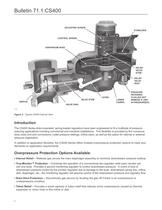
Bulletin 71.1:CS400 adJuSTINg SCreW STABILIZER CONTrOl SPrINg dIaPhragM head relIef valve STeM relIef valve SeaT OrIfICe valve STeM valve dISK lever lOWer CaSINg PreSSure reTaININg Plug (dO NOT reMOve If uNIT IS PRESSURIZED) P1003 Figure 2. Typical CS400 Internal View Introduction The CS400 Series direct-operated, spring-loaded regulators have been engineered to fit a multitude of pressurereducing applications including commercial and industrial installations. This flexibility is provided by the numerous body sizes and end connections, outlet pressure settings, orifice sizes, as well as the option...
Open the catalog to page 2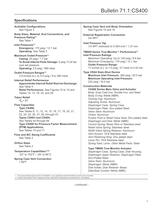
Bulletin 71.1:CS400 Specifications Available Configurations See Figure 3 Spring Case Vent and Body Orientation See Figures 15 and 16 Body Sizes, Material, End Connections, and Pressure Rating(1) See Table 1 External Registration Connection 3/4 NPT Inlet Pressure Tap 1/4 NPT restricted to 0.054-inch / 1.37 mm Inlet Pressures(1) Emergency: 175 psig / 12.1 bar Operating: See Table 2 Maximum Outlet Pressure(1) Casing: 25 psig / 1.7 bar To Avoid Internal Parts Damage: 5 psig / 0.34 bar over set pressure Operating: 5.5 psig / 380 mbar Outlet Pressure Ranges(1) 3.5-inches w.c. to 5.5 psig / 9 to 380...
Open the catalog to page 3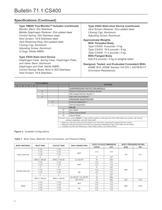
Specifications (Continued) Type TM600 True-Monitor™ Actuator (continued) Monitor Stem: 302 Stainless Middle Diaphragm Retainer: Zinc-plated steel Control Spring: 302 Stainless steel Vent Screen: 18-8 Stainless steel Vent Retaining Ring: Zinc-plated steel Adjusting Screw: Aluminum Type VSX4 Slam-shut Device Diaphragm Case, Spring Case, Diaphragm Plate, and Valve Stem: Aluminum Diaphragm and Disk: Nitrile (NBR) Control Spring: Music Wire or 302 Stainless Vent Screen: 18-8 Stainless Type VSX4 Slam-shut Device (continued) Vent Screen Retainer: Zinc-plated steel Adjusting Screw: Aluminum Approximate...
Open the catalog to page 4
Table 2. Inlet Pressure Ratings and Flow and Sizing Coefficients Table 3. Outlet Pressure Ranges Table 4. Approximate Internal Relief Valve Start-to-Discharge Pressure Above Setpoint Table 5. Type CS403 Overpressure Protection Benefits Vs. Backup Orifice Device
Open the catalog to page 5
Table 6. Type CS403 Regulator and Integral Monitor Outlet Pressure Ranges Table 7. Type CS404 Regulator and Slam-Shut OPSO Pressure Ranges Table 8. Type CS404 Regulator and Slam-shut OPSO and UPSO Pressure Ranges
Open the catalog to page 6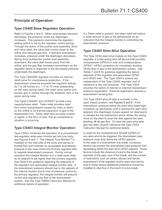
Bulletin 71.1:CS400 Principle of Operation Type CS400 Base Regulator Operation Refer to Figures 4 and 5. When downstream demand decreases, the pressure under the diaphragm increases. This pressure overcomes the regulator setting (which is set by the regulator control spring). Through the action of the pusher post assembly, lever, and valve stem, the valve disk moves closer to the orifice and reduces gas flow. If demand downstream increases, pressure under the diaphragm decreases. Spring force pushes the pusher post assembly downward, the valve disk moves away from the orifice, and the gas flow...
Open the catalog to page 7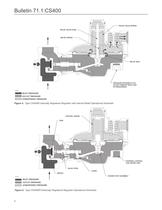
Bulletin 71.1:CS400 relief valve sPRING relief valve stem relief sPRING relief seat Pressure Retaining PLUG (DO NOt REMOVE WHILE UNIT IS PRESSURIZED) M1060 inlet pressure outlet pressure atmospheric pressure Figure 4. Type CS400IR Internally Registered Regulator with Internal Relief Operational Schematic control spring DISK RE External Control Line (Sense Line) E E valve stem ESSURE RE lever orifice pusher post assembly M1059 inlet pressure outlet pressure E atmospheric pressure Figure 5. Type CS400ER Externally Registered Regulator Operational Schematic 8
Open the catalog to page 8
CS400 Series January 2008 March 2009 Type CS403IT with True Monitor, Bulletin 71.1:CS400 Internal Pressure Registration, and Token Relief CONTrOl SPrINg adJuSTINg SCreW MONITOr dISK guIded STeM OPeNINg SPrINg exTerNal October 2008 MONITOr lever CONTrOl lINe Plug CONTrOl SPrINg dISK exTerNal CONTrOl lINe Plug (dO NOT reMOve WhIle uNIT IS PRESSURIZED) valve STeM valve STeM Type CS403ET with True Monitor, External Pressure Registration, and Token Relie OrIfICe lever INLET PRESSURE INTegral MONITOr OUTLET PRESSURE ATMOSPHERIC PRESSURE PrIMarY regulaTOr M1061 M1061 PuSher POST ASSEMBLY INleT PreSSure...
Open the catalog to page 9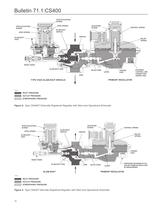
Bulletin 71.1:CS400 uPSO adJuSTINg SCreW uPSO SPrINg OPSO adJuSTINg SCreW adJuSTINg SCreW SlaM-ShuT OrIfICe OPSO SPrINg October 2008 SlaM-ShuT veNT CONTrOl SPrINg OrIfICe relIef SPrINg Type CS404ET with Slam-Shut Module, External Pressure Registration, and Token R RESET KNOB SlaM-ShuT dISK valve STeM lever exTerNal CONTrOl lINe CONNeCTION (SENSE LINE) PuSher POST dISK PrIMarY regulaTOr TYPe vSx4 SlaM-ShuT MOdule M1063 INleT PreSSure INLET PRESSURE OuTleT PreSSure OUTLET PRESSURE aTMOSPherIC PreSSure ATMOSPHERIC PRESSURE Figure 8. Type CS404ET Externally Registered Regulator with Slam-shut Operational...
Open the catalog to page 10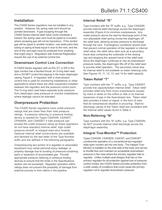
Bulletin 71.1:CS400 Installation Internal Relief “R” The CS400 Series regulators may be installed in any position. However, the spring case vent should be pointed downward. If gas escaping through the CS400 Series internal relief valve could constitute a hazard, the spring case vent must be piped to a location where escaping gas will not be hazardous. If the vented gas will be piped to another location, use obstruction-free tubing or piping at least equal in size to the vent, and the end of the vent pipe must be protected from anything that might clog it. Regulators with External Registration...
Open the catalog to page 11All FISHER REGULATORS catalogs and technical brochures
 Fisher™ 8590 High-Performance
16 Pages
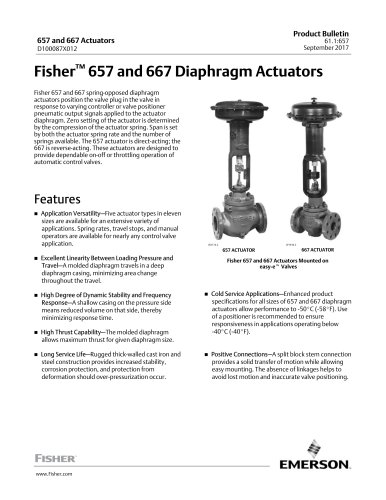 bulletin-fisher-657-and-667
16 Pages
Archived catalogs
 167D Series Switching Valves
8 Pages
 cs200 series
40 Pages
 Type HSR Pressure Regulators
20 Pages
 R622 series
8 Pages
 S200 series
32 Pages
 310A Pressure Reducing Regulator
16 Pages
 ACE97 Pad-Depad Valve
16 Pages
 627F Pressure Reducing Regulator
12 Pages
 630 Regulator
16 Pages
 EZR Pressure Reducing Regulator
36 Pages
 Fisher® 377 Trip Valve
20 Pages
 Fisher® CAV4 Control Valve
28 Pages
 Fisher® HP Series Control Valves
28 Pages
 Fisher® HPNS Control Valve
36 Pages
 Fisher® YD and YS Control Valves
24 Pages
 Fisher® EZ easy-e Control Valve
40 Pages
 Fisher® D and DA Valves
12 Pages
 MR95 and MR98
2 Pages
 1301F, 1301G
12 Pages
 Regulators Mini Catalog
24 Pages
 CS 200 series
2 Pages
 LP-31
LP-3196 Pages
 FPSO Industry Solution
2 Pages
 Smartprocess™ Heater
5 Pages
 DeltaV Smart Switches
28 Pages
 Ovation Security Center
4 Pages
 The Criticality of Cooling
5 Pages
 CSI 6500 Overview
12 Pages
 DeltaV Controller Firewall
11 Pages
 Air Application Map
1 Page
 H200 Series Relief Valves
4 Pages
 1305 Series Regulators
4 Pages
 Large ET and ED Valves
20 Pages
 easy-e Cryogenic Valves
12 Pages
 Fisher™ YD and YS Control Valves
24 Pages
 Type 630 Regulator
16 Pages
 Fisher™ 585C Piston Actuators
16 Pages
 Type 630R Relief Valve
8 Pages
 Type 92B Pressure Reducing Valve
16 Pages
 Industrial Regulators
2 Pages
 LP-Gas Technologies
118 Pages
 R Series
2 Pages
 Run with higher performing,
16 Pages
 ™ Control Valves and Instruments
16 Pages
 Pressure Equivalents
1 Page
 Pipe and Tubing Sizing
1 Page


- Manual valve
- FISHER control valve
- FISHER stainless steel valve
- Ball valve
- FISHER pneumatic valve
- Threaded valve
- Regulating valve
- Flange valve
- On/off valve
- Electric valve
- ISO valve
- Pressure gauge
- Level limit switch
- FISHER pressure regulator
- Gas valve
- Valve with handwheel
- FISHER pneumatically-operated valve
- Liquid level detector
- Butterfly valve