
- Catalogs
- FISHER REGULATORS
- Clean Coal Technology Industry Solu tion

Clean Coal Technology Industry Solu tion

Clean Coal Technology Industry Solu tion
Coal is a plentiful and cost-effective energy source, but it has limitations such as unsuitability for transportation and environmental pollution when burned. Clean coal technologies like coal gasification and liquefaction have been developed to mitigate these issues, making coal more energy-efficient and environmentally friendly.
- Coal Gasification: Converts coal into syngas, a cleaner energy form, by breaking it down into basic chemical constituents. Syngas can be used as fuel or for chemical production.
- Coal Liquefaction: Transforms solid coal into synthetic oil, supplementing natural petroleum sources. It involves direct or indirect processes, with the latter using gasification followed by the Fischer-Tropsch process.
Emerson Process Management, a leader in pressure control, offers Fisher® regulators for precise pressure management in clean coal processes. Their products include:
- Pressure Reducing Valves: Available in various sizes, with features like noise abatement and easy maintenance.
- Tank Blanketing Valves: Designed for economic pressure control, compact construction, and corrosion resistance.
- Relief/Backpressure Valves: Multi-purpose, with excellent fluid compatibility and stable regulation.
Emerson Process Management has global offices in the Middle East, Europe, Asia-Pacific, and the USA, providing support and information on their products.
Catalog excerpts

Clean Coal Technology Industry Solution Coal Plants Utilize Fisher® Regulators for Precise Pressure Control Clean Coal Technology Industry Overview Coal is an abundant, reliable, and inexpensive source of energy, but it does have some technical limitations. Coal is not suitable for use in some applications such as transportation and it produces a range of environmental pollutants when burned. In recent years, several clean coal technologies have been developed to help reduce the environmental pollution caused by burning coal and make coal more energy-efficient. Among these, coal gasification and coal liquefaction are the most popular technologies to date. requires coal to be in contact with hydrogen in the presence of a catalyst at high temperatures. Coal liquefaction can either be direct as described previously or indirect. Indirect coal liquefaction consists of two stages: gasification to produce coal gas and subsequent conversion of the gas to liquid via the Fischer-Tropsch process. Products derived from coal through these clean coal technologies can be used as fuel for transportation vehicles and electricity generation, and as raw materials to other valuable products. These recent developments in the clean coal industry can also help ease the burden of oil production and import. Common Clean Coal Technologies Emerson Process Management Solution Coal gasification is considered one of the most versatile and cleanest ways to convert coal into an alternative and cleaner form of energy. In gasification, coal is broken down to its basic chemical constituents rather than directly burned. The resulting syngas (a gas mixture made up of carbon monoxide, hydrogen, and other gaseous compounds) can be used as a fuel source or as an intermediate for the production of other chemicals. Emerson Process Management Regulator Technologies is the market leader in the field of pressure control with a history of over a hundred years. With more than 100 product families, Fisher® regulators are widely used to control various fluids, including gas, liquid, and steam. Coal liquefaction converts solid coal to synthetic oil to supplement natural sources of petroleum. This well-developed technology We take an active part in the clean coal industry by offering a variety of products and expert process solutions. Pressure Reducing and Tank Blanketing Valves are available for pressure controls for tanks and pressure vessels used in the coal gasification and liquefaction processes.
Open the catalog to page 1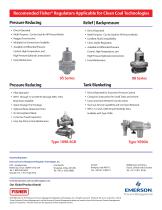
Recomended Fisher® Regulators Applicable for Clean Coal Technologies Pressure Reducing Relief / Backpressure • Multi-Purpose - Can be Used for All Process Media • Multi-Purpose - Can be Used for All Process Media • Excellent Fluid Compatibility • Multiple End Connections Available • Close, Stable Regulation • Available in Differential Pressure • Available in Differential Pressure Control, High Temperature, and Control, High Temperature, and High Pressure Optional Constructions High Pressure Optional Constructions Pressure Reducing Tank Blanketing • Direct-Operated for...
Open the catalog to page 2All FISHER REGULATORS catalogs and technical brochures
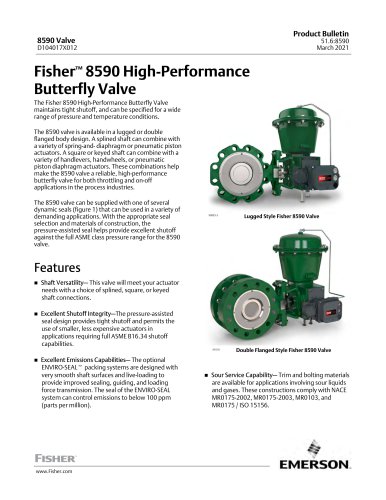 Fisher™ 8590 High-Performance
16 Pages
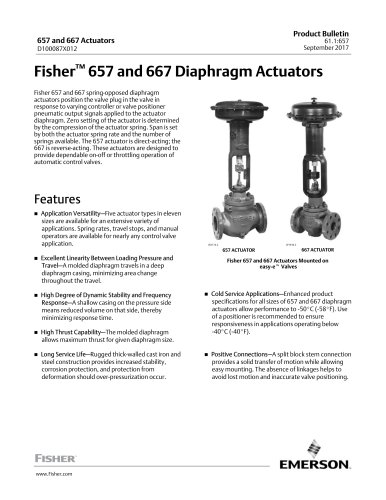 bulletin-fisher-657-and-667
16 Pages
Archived catalogs
 167D Series Switching Valves
8 Pages
 CS400 Series
60 Pages
 cs200 series
40 Pages
 Type HSR Pressure Regulators
20 Pages
 R622 series
8 Pages
 S200 series
32 Pages
 310A Pressure Reducing Regulator
16 Pages
 ACE97 Pad-Depad Valve
16 Pages
 627F Pressure Reducing Regulator
12 Pages
 630 Regulator
16 Pages
 EZR Pressure Reducing Regulator
36 Pages
 Fisher® 377 Trip Valve
20 Pages
 Fisher® CAV4 Control Valve
28 Pages
 Fisher® HP Series Control Valves
28 Pages
 Fisher® HPNS Control Valve
36 Pages
 Fisher® YD and YS Control Valves
24 Pages
 Fisher® EZ easy-e Control Valve
40 Pages
 Fisher® D and DA Valves
12 Pages
 MR95 and MR98
2 Pages
 1301F, 1301G
12 Pages
 Regulators Mini Catalog
24 Pages
 CS 200 series
2 Pages
 LP-31
LP-3196 Pages
 FPSO Industry Solution
2 Pages
 Smartprocess™ Heater
5 Pages
 DeltaV Smart Switches
28 Pages
 Ovation Security Center
4 Pages
 The Criticality of Cooling
5 Pages
 CSI 6500 Overview
12 Pages
 DeltaV Controller Firewall
11 Pages
 Air Application Map
1 Page
 H200 Series Relief Valves
4 Pages
 1305 Series Regulators
4 Pages
 Large ET and ED Valves
20 Pages
 easy-e Cryogenic Valves
12 Pages
 Fisher™ YD and YS Control Valves
24 Pages
 Type 630 Regulator
16 Pages
 Fisher™ 585C Piston Actuators
16 Pages
 Type 630R Relief Valve
8 Pages
 Type 92B Pressure Reducing Valve
16 Pages
 Industrial Regulators
2 Pages
 LP-Gas Technologies
118 Pages
 R Series
2 Pages
 Run with higher performing,
16 Pages
 ™ Control Valves and Instruments
16 Pages
 Pressure Equivalents
1 Page
 Pipe and Tubing Sizing
1 Page


- Manual valve
- FISHER stainless steel valve
- FISHER control valve
- Ball valve
- FISHER pneumatic valve
- Threaded valve
- Regulating valve
- Flange valve
- On/off valve
- Electric valve
- ISO valve
- Pressure gauge
- Level limit switch
- FISHER pressure regulator
- Gas valve
- Valve with handwheel
- FISHER pneumatically-operated valve
- Liquid level detector
- Butterfly valve