
- Catalogs
- FISHER REGULATORS
- 133 Series Self-Operated Regulators

133 Series Self-Operated Regulators

133 Series Self-Operated Regulators
The 133 Series direct-operated gas regulators are designed for industrial and commercial applications, providing accurate gas pressure control for maximum combustion efficiency. They feature a single port construction for bubble-tight shutoff and require an external downstream control line for operation.
- Wide pressure range capability with interchangeable springs.
- Suitable for monitoring applications with O-ring stem seals.
- Fast response and excellent shock characteristics due to a two-way stabilizer vent valve.
- Bubble-tight shutoff with single-port construction and large diaphragm area.
- Minimized spring and diaphragm effects with a boosting system.
- No seat-to-seat adjustment required due to balanced single-port design.
- Easy access to trim parts without disassembly of the actuator portion.
- Reusable pressure seals with O-rings.
- Resistance to piping stresses with available steel constructions.
- Type 133H: Inlet pressures up to 60 psig, outlet pressures from 1.5 to 10 psig.
- Type 133HP: Inlet pressures up to 150 psig, outlet pressures from 2 to 60 psig.
- Type 133L: Inlet pressures up to 60 psig, outlet pressures from 2 inches w.c. to 2 psig.
- Type 133Z Zero Governor: Inlet pressures up to 20 psig, outlet pressures from -1 to 4 inches w.c.
- Temperature capabilities: -20 to 150°F (-29 to 66°C).
- Flow capacities and wide-open flow coefficients are detailed in tables.
- Construction materials include cast iron, WCC steel, aluminum, and various polymers.
- Approximate shipping weights vary by type and connection style.
The regulator uses downstream pressure registered under the diaphragm as the operating medium. Increased demand lowers downstream pressure, allowing the spring to open the valve disk and supply more gas. Decreased demand increases downstream pressure, closing the valve disk and reducing gas supply.
The regulator can be installed in any position, typically with the actuator vertical. A downstream control line is required. Overpressure protection is necessary if inlet pressure exceeds outlet pressure ratings.
Flow capacities for various inlet and outlet pressures are provided in tables. Conversion factors for different gases are included.
The document provides detailed specifications and procedures for determining gas flow capacity using the flow coefficient Cg. It distinguishes between critical and non-critical pressure drops, providing formulas for each scenario.
The document explains the parameters involved in the calculations, including gas flow rate, absolute inlet pressure, regulating or wide-open gas sizing coefficient, specific gravity of the gas, absolute temperature of gas at inlet, flow coefficient, and pressure drop across the regulator.
Several tables are included, providing full-capacity and restricted-capacity flow rates for different types of stabilizer vent valves under various inlet and outlet pressure conditions.
The document includes capacity curves for full-capacity and restricted-capacity constructions, illustrating the relationship between inlet pressure, outlet pressure, and flow rate.
The document emphasizes the importance of setting outlet pressure at approximately 10% of the maximum capacity for the listed conditions to ensure optimal performance.
The document provides detailed specifications for the Type 133HP regulator, including outlet pressure ranges, control spring numbers, and colors.
The document outlines the ordering process, specifying the need to use the specifications section and complete the ordering guide.
The document includes a specification worksheet that requires information on application, line size, fluid type, specific gravity, temperature, and pressure requirements.
The document advises consulting local sales offices for product availability and emphasizes the responsibility of the purchaser for proper selection, use, and maintenance of the product.
The tables provide detailed flow capacities for different outlet pressure settings and inlet pressures. Figures illustrate the dimensions of various regulator types.
The document provides contact details for Emerson Process Management Regulator Technologies, Inc. across various regions.
Catalog excerpts

133 Series Direct-Operated Regulators Figure 1. 133 Series Direct-Operated Regulators Features • Wide Pressure Range Capability with Single Regulator—Type 133H may also use Type 133L springs, allowing pressure settings to be varied between 2 inches w.c. and 10 psig / 5 mbar and 0.69 bar by changing springs. • Types 133L, 133H, and 133HP Suitable for Monitoring Applications—O-ring stem seal on Types 133L, 133H, and 133HP isolates body pressure from controlled pressure. • Excellent Shock Characteristics and Fast Speed of Response—Due to two-way stabilizer vent valve, which vents the spring case more rapidly than conventional vents, lag in diaphragm and valve disk movement is minimized. • No Seat-to-Seat Adjustment Required—Balanced single-port design eliminates necessity for seat-toseat adjustments to achieve bubble-tight shutoff. • Easy Access to Trim Parts—Valve seat, disk, and cage easily removed with body remaining in line and without disassembly of actuator portion; orifice is not threaded in. • Reusable Pressure Seals—O-rings used for pressure seals, unlike gaskets, are not ordinarily damaged by disassembling the regulator. • Resistance to Piping Stresses—Steel constructions are available to help resist pipe stresses. • Bubble-Tight Shutoff—Single-port construction, large diaphragm area, and light-rate springs along with disk material and seat design provide low lock-up pressures. • Spring and Diaphragm Effects Minimized— Boosting system provides excellent performance over a wide range of flow conditions.
Open the catalog to page 1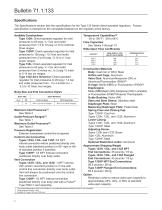
Bulletin 71.1:133 Specifications The Specifications section lists the specifications for the Type 133 Series direct-operated regulators. Factory specification is stamped on the nameplate fastened on the regulator at the factory. Available Constructions Type 133H: Direct-operated regulator for inlet pressures to 60 psig / 4.1 bar and outlet pressures from 1.5 to 10 psig / 0.10 to 0.69 bar, three ranges. Type 133HP: Direct-operated regulator for inlet pressures to 150 psig / 10.3 bar and outlet pressures from 2 to 60 psig / 0.14 to 4.1 bar, seven ranges. Type 133L: Direct-operated regulator for...
Open the catalog to page 2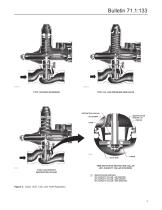
TYPE 133Z ZERO GOVERNOR TYPE 133L LOW-PRESSURE REGULATOR RESTRICTION COLLAR IDENTIFICATION GROOVE 1 ORIFICE VALVE DISK TRIM PARTS WITH RESTRICTION COLLAR (40% CAPACITY COLLAR IS SHOWN) TYPE 133H WITHOUT RESTRICTION COLLAR 1 IDENTIFICATION GROOVES: 25% CAPACITY COLLAR—NO GROOVES 40% CAPACITY COLLAR—ONE GROOVE 60% CAPACITY COLLAR—TWO GROOVES Figure 2. Types 133Z, 133L, and 133H Regulators
Open the catalog to page 3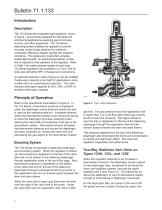
Bulletin 71.1:133 Introduction Description The 133 Series direct-operated gas regulators, shown in Figure 1 are primarily designed for industrial and commercial applications supplying gas to furnaces, burners, and other appliances. The 133 Series balancing system enables the regulator to provide accurate control of gas pressure for maximum combustion efficiency despite varying inlet pressure conditions. The single port construction provides bubble-tight shutoff. An external downstream control line is required for the operation of the regulator. Refer to Table 1 for outlet pressure ranges of each...
Open the catalog to page 4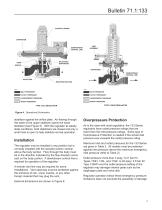
CONTROL SPRING INLET PRESSURE DOWNSTREAM OUTLET PRESSURE ATMOSPHERIC PRESSURE CONTROL LINE LOADING PRESSURE INTERMEDIATE PRESSURE PILOT SUPPLY PRESSURE VACUUM PRESSURE TANK PRESSURE VAPOR PRESSURE BALANCING RELIEF PRESSURE DIAPHRAGM BOOST PRESSURE STEM ORIFICE VENT ASSEMBLY DOWNSTREAM CONTROL LINE VALVE DISK REGISTRATION DISK INLET PRESSURE OUTLET PRESSURE ATMOSPHERIC PRESSURE BOOST PRESSURE INLET PRESSURE OUTLET PRESSURE INLET PRESSURE OUTLET PRESSURE ATMOSPHERIC PRESSURE ATMOSPHERIC PRESSURE BOOST PRESSURE BOOST PRESSURE Figure 4. Operational Schematics stabilizer against the orifice plate....
Open the catalog to page 5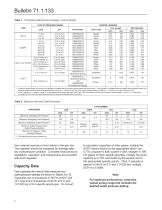
Bulletin 71.1:133 Table 1. 133 Series Outlet Pressure Ranges, Control Springs OUTLET PRESSURE RANGE TYPE CONTROL SPRINGS Part Number 2 to 4 inches w.c. 3.5 to 6 inches w.c. 5 to 9 inches w.c. 8.5 to 18 inches w.c. 14 to 28 inches w.c. 0.75 to 2 -1 to 1 inch w.c. Free Length Color Code Orange Yellow Blue Yellow Orange Silver Red Blue Green White Brown Red Black White Green Blue 1K633427012 (Extension Spring) and 1D892527022 (Compression Spring) Wire Diameter 1. Pressure ranges shown are correct if the regulator is installed with the actuator portion above the body portion. If the regulator...
Open the catalog to page 6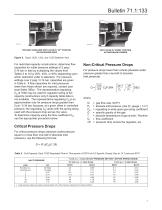
TWO-WAY STABILIZER VENT VALVE IN “UP” POSITION AS DIAPHRAGM RISES VENT VALVE IN “DOWN” POSITION AS DIAPHRAGM LOWERS Figure 5. Types 133H, 133L, and 133Z Stabilizer Vent For restricted-capacity constructions, determine flow capacities for outlet pressure settings of 2 psig / 0.14 bar or less by multiplying the values from Tables 3 to 10 by 25%, 40%, or 60% (depending upon which restriction collar is selected). For pressure settings over 2 psig / 0.14 bar, capacities are given in Table 6. If flow capacities for inlet pressures lower than those shown are required, contact your local Sales Office....
Open the catalog to page 7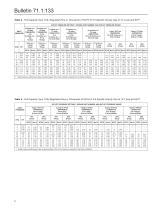
Bulletin 71.1:133 Table 4. Full-Capacity Type 133L Regulated Flow in Thousands of SCFH of 0.6 Specific Gravity Gas at 14.7 psia and 60°F OUTLET PRESSURE SETTING(1), SPRING PART NUMBER, AND OUTLET PRESSURE RANGE INLET PRESSURE 4 inches w.c. / 10 mbar 1D892527022 2 to 4 inches w.c. / 5 to 10 mbar 6 inches w.c. / 15 mbar 1D892627022 3.5 to 6 inches w.c. / 8.7 to 15 mbar 7 inches w.c. / 17 mbar 1D892727012 5 to 9 inches w.c. / 12 to 22 mbar 1 inch w.c. / 3 mbar Droop 1 inch w.c. / 3 mbar Droop 1 inch w.c. / 3 mbar Droop SCFH Nm3/h SCFH Nm3/h SCFH 14 inches w.c. / 35 mbar 1D893227032 8.5 to 18 inches...
Open the catalog to page 8
Bulletin 71.1:133 OUTLET PRESSURE, psig / bar OUTLET PRESSURE, inch w.c. / mbar CAPACITY AND REGULATION 2 inch / DN 50 TYPE 133Z SPRING COMPRESSION - 1D892527022 EXTENSION - 1K633427012 SETPOINT: INLET PRESSURE: 1 psig / 0.07 bar OUTLET PRESSURE: 1 inch w.c. / 2 mbar FLOW: 3000 SCFH / 80.4 Nm3/h 3/7 2/5 1/2 0/0 CAPACITY AND REGULATION 2 inch / DN 50 TYPE 133L SPRING 1D893327032 SETPOINT: INLET PRESSURE: 40 psig / 2.8 bar OUTLET PRESSURE: 1 psig / 0.07 bar FLOW: 11,000 SCFH / 295 Nm3/h 20 psig / 30 psig / 40 psig / 50 psig / 60 psig / 1.4 bar 2.1 bar 2.8 bar 3.4 bar 4.1 bar OUTLET PRESSURE,...
Open the catalog to page 9All FISHER REGULATORS catalogs and technical brochures
 Fisher™ 8590 High-Performance
16 Pages
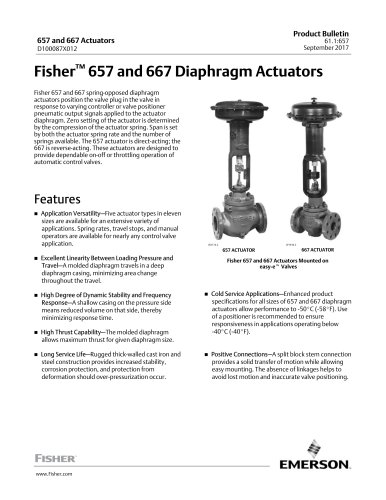 bulletin-fisher-657-and-667
16 Pages
Archived catalogs
 167D Series Switching Valves
8 Pages
 CS400 Series
60 Pages
 cs200 series
40 Pages
 Type HSR Pressure Regulators
20 Pages
 R622 series
8 Pages
 S200 series
32 Pages
 310A Pressure Reducing Regulator
16 Pages
 ACE97 Pad-Depad Valve
16 Pages
 627F Pressure Reducing Regulator
12 Pages
 630 Regulator
16 Pages
 EZR Pressure Reducing Regulator
36 Pages
 Fisher® 377 Trip Valve
20 Pages
 Fisher® CAV4 Control Valve
28 Pages
 Fisher® HP Series Control Valves
28 Pages
 Fisher® HPNS Control Valve
36 Pages
 Fisher® YD and YS Control Valves
24 Pages
 Fisher® EZ easy-e Control Valve
40 Pages
 Fisher® D and DA Valves
12 Pages
 MR95 and MR98
2 Pages
 1301F, 1301G
12 Pages
 Regulators Mini Catalog
24 Pages
 CS 200 series
2 Pages
 LP-31
LP-3196 Pages
 FPSO Industry Solution
2 Pages
 Smartprocess™ Heater
5 Pages
 DeltaV Smart Switches
28 Pages
 Ovation Security Center
4 Pages
 The Criticality of Cooling
5 Pages
 CSI 6500 Overview
12 Pages
 DeltaV Controller Firewall
11 Pages
 Air Application Map
1 Page
 H200 Series Relief Valves
4 Pages
 1305 Series Regulators
4 Pages
 Large ET and ED Valves
20 Pages
 easy-e Cryogenic Valves
12 Pages
 Fisher™ YD and YS Control Valves
24 Pages
 Type 630 Regulator
16 Pages
 Fisher™ 585C Piston Actuators
16 Pages
 Type 630R Relief Valve
8 Pages
 Type 92B Pressure Reducing Valve
16 Pages
 Industrial Regulators
2 Pages
 LP-Gas Technologies
118 Pages
 R Series
2 Pages
 Run with higher performing,
16 Pages
 ™ Control Valves and Instruments
16 Pages
 Pressure Equivalents
1 Page
 Pipe and Tubing Sizing
1 Page


- Manual valve
- FISHER control valve
- FISHER stainless steel valve
- Ball valve
- FISHER pneumatic valve
- Threaded valve
- Regulating valve
- Flange valve
- On/off valve
- Electric valve
- ISO valve
- Pressure gauge
- Level limit switch
- Gas valve
- Valve with handwheel
- FISHER pneumatically-operated valve
- Liquid level detector
- Butterfly valve