
- Catalogs
- Fischer Connectors
- Technical Specifications Volume 2


- Company
- Products
- Catalogs
- News & Trends
- Exhibitions
Technical Specifications Volume 2
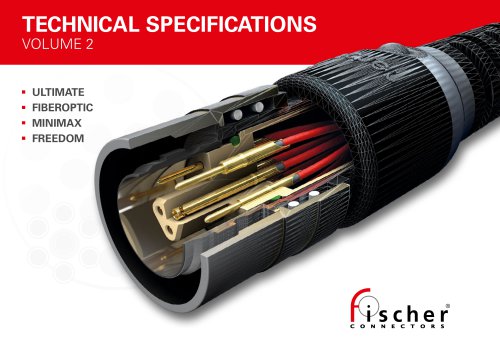
Technical Specifications Volume 2
This document provides technical specifications for Fischer Ultimate, Fiberoptic, Minimax, and Freedom series connectors, covering connector overviews, cross-product specifications, and cable assembly details.
Features include ruggedness, compactness, lightweight design, and high-speed data transfer. Connectors use locking push-pull and quick-release mechanisms, with materials like brass and stainless steel, offering sealing levels up to IP68/69.
Focuses on fiber optic and hybrid connectors, with adaptations for fiber optics, including optical termini and hybrid soldering options.
Designed for high-density miniaturization, supporting various contact numbers and current ratings, with sealing levels up to IP68.
Emphasizes easy integration and quick-release mechanisms, focusing on flexibility and ease of use.
Details the mating process, highlighting the push-pull automatic locking system and various locking mechanisms.
Explains the IP classification system, with products tested to IP68 and IP69 standards for environmental protection.
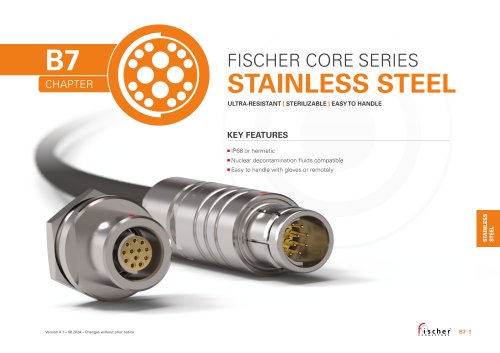
Materials include chromium-plated brass, aluminum, stainless steel, and various sealing materials, chosen for attributes like temperature and chemical resistance.
Outlines test voltage, operating voltage, and current rating specifications, with derating curves and recommendations for voltage and current limits.
Emphasizes connector design for optimizing parameters like return loss, insertion loss, crosstalk, and noise, focusing on impedance and crosstalk at the connector level.
Discusses the importance of impedance matching, highlighting factors like contact diameter and dielectric constant.
Optimized contact layouts reduce crosstalk noise levels.
Outlines types of signal distortion affecting data transmission quality.
Discusses high-speed data transmission protocols like USB, Ethernet, and audio/video standards.
Describes various contact types, including solder, PCB, crimp, fiber optic, and stamped contacts.
Details overmolded and cable bend reliefs, emphasizing their role in improving cable flex life and protection.
Connectors meet IP68/IP69 standards, capable of withstanding submersion and hermetic sealing for specific applications.
Operating temperature range is -55°C to +135°C, with corrosion resistance for 1,000 hours in a salt solution.
Rated for 10,000 mating cycles, with specific configurations limited to 500 cycles due to coax inserts.
Withstands shocks of 300g amplitude, ensuring no discontinuity greater than 1 µs.
Contact resistance varies by contact size, with insulation resistance exceeding 1010 Ω.
Supports various data transmission standards, with data rates ranging from 480 Mbit/s to 11 Gbit/s.
Details various body styles and technical dimensions for plugs and receptacles.
Includes sealing caps and tooling options for assembly and maintenance.
1. General Specifications: Detailed technical specifications for Fischer UltiMate 80 and Fischer FiberOptic Series connectors.
2. Environmental & Mechanical Data: Sealing performance, operating temperature range, corrosion resistance, endurance, vibration, and shock resistance.
3. Electrical Data: Contact resistance, shell resistance, insulation resistance, and shielding effectiveness.
4. Material & Surface Finish: Housing and nut materials, locking spring, contacts, insulator, and sealant materials.
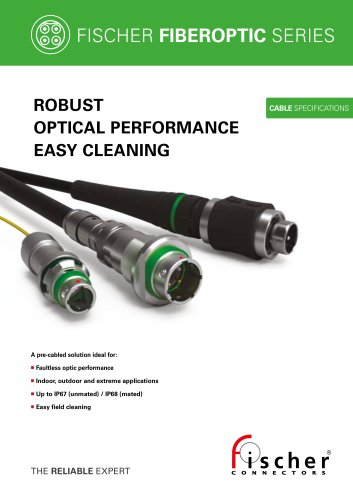
5. Fischer FiberOptic Series: Designed for robust optical performance, with protection up to IP67 (unmated) and IP68 (mated).
6. Configuration and Accessories: Various body styles and technical dimensions for plugs and receptacles.
7. Technical Dimensions: Detailed dimensions for different body styles and configurations.
Outlines materials used in the Fischer FiberOptic Series I-30, including Zirconia, LCP, PBT, PTFE, and TPE.
Features 2 contacts with a ground by shell, supporting a current of 10A and a rated voltage of 400V.
Specifies single-mode and multi-mode fiber types, with insertion and return loss details.
Options for cable assembly types and various connector types.
Specifications for indoor/outdoor cables, rodent-proof cables, and metal-armored cables.
Offers high-density miniaturization and high-speed data transfer capabilities, with IP68 sealing and high mating cycles.
Catalog excerpts
TECHNICAL SPECIFICATIONS VOLUME 2 ULTIMATE FIBEROPTIC MINIMAX FREEDOM
Open the catalog to page 1
TABLE OF CONTENTS GENERAL INFORMATION FISCHER FIBEROPTIC SERIES
Open the catalog to page 2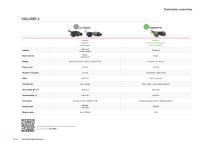
Connector overview OPTICAL PERFORMANCE EASY CLEANING Push-pull Quick-release Brass Aluminum Nickel Anthracite / Black (ULTIMATE 80) Chrome over Nickel Fiber optic / Low voltage (hybrid) Contact: Crimp / Solder / PCB Contact: Optical termini / Solder (hybrid) Sealing level Mating cycles Locking Shell material Plating Technical specifications for our Fischer Core Series can be found in VOLUME 1. Technical Specifications
Open the catalog to page 3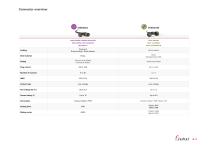
Connector overview HIGH-DENSITY MINIATURIZATION EASY MATING HIGH-SPEED DATA TRANSFER EASY CLEANING EASY INTEGRATION Push-pull Screw-locking / Quick-release Brass Stainless Steel 316L Chrome over Nickel Anthracite Nickel Anthracite Nickel Contact: Solder / PCB / Wires / ZIF Sealing level Mating cycles Locking Shell material Plating Plug ø [mm] Number of contacts AWG Contact type
Open the catalog to page 4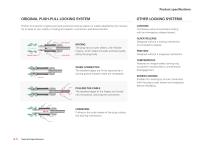
Product specifications ORIGINAL PUSH-PULL LOCKING SYSTEM OTHER LOCKING SYSTEMS Fischer Connectors’ original push-pull automatic locking system is widely adopted by the industry for its ease of use, safety of mating and speed in connection and disconnection. LANYARD Combines push-pull automatic locking with an emergency release lanyard. outer sleeve Receptacle Receptacle flexible fingers Receptacle Receptacle outer sleeve outer outer sleeve sleeve Plug Plug flexible fingers plug body flexible flexible fingers fingers groove groove MATING The plug has an outer sleeve, with flexible fingers, which...
Open the catalog to page 5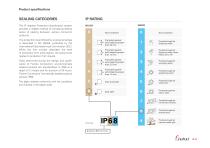
Product specifications SEALING CATEGORIES The IP (Ingress Protection) classification system provides a reliable method of comparing relative levels of sealing between various connector products. The protection level offered by a typical envelope is described in IEC 60529, published by the International Electrotechnical Commission (IEC). While the first number describes the level of protection from solid objects, the second one relates to protection from liquids. The digits indicate conformity with the conditions summarized in the tables aside. Protected against solid objects greater than 50 mm...
Open the catalog to page 6
Product specifications O-rings COMMONLY USED SEALING LEVELS IP50 indoor unexposed applications IP68 watertight sealing Hermetic sealing Each requires different sealing levels and, therefore, different connector solutions. IP50 INDOOR / UNEXPOSED APPLICATIONS Typically for indoor or industrial applications, the required sealing level is IP50, since the device needs to be protected against dust but not exposed to water. The IP50 rating can be improved with additional accessories like boots or protective sleeves. IP68 WATERTIGHT SEALING Typically for applications requiring outdoor use where they...
Open the catalog to page 7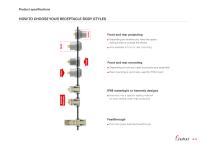
Product specifications HOW TO CHOOSE YOUR RECEPTACLE BODY STYLES Front and rear projecting Depending on whether you need the space saving inside or outside the device Also available in front or rear mounting Front and rear mounting Depending on how you need to process your assembly Rear mounting is commonly used for PCB mount SEALING MATERIAL IP68 watertight or hermetic designs Hermetic has a specific sealing material for best sealing under high pressures Feedthrough Hermetic panel bulkhead feedthrough
Open the catalog to page 8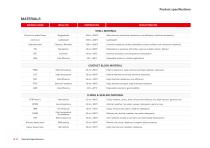
Product specifications MATERIALS MATERIAL NAME MAIN ATTRIBUTES SHELL MATERIAL Chromium-plated brass Salt mist and mechanical resistance, cost efficiency, electrical conductivity Stainless steel Cleaning / Radiation Corrosion resistance, surface cleanability, nuclear radiation and mechanical resistance Sterilization in autoclave, EtO, Cidex, gamma radiation, Steris®, Sterrad® Electrical insulation, low temperature manipulation Cost efficiency Disposable solutions, medical applications CONTACT BLOCK MATERIAL PEEK High temperature High temperature, high chemical and high radiation resistance High...
Open the catalog to page 9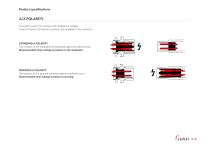
Product specifications A/Z POLARITY To protect users from contact with dangerous voltage, most of Fischer Connectors’ products are available in two versions : STANDARD A POLARITY The contacts of the receptacle are protected against accidental touch. Recommended when voltage is present on the receptacle. INVERTED Z POLARITY The contacts of the plug are protected against accidental touch. Recommended when voltage is present on the plug.
Open the catalog to page 10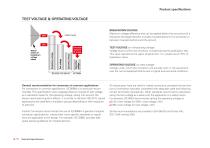
Product specifications TEST VOLTAGE & OPERATING VOLTAGE Operating voltage Operating voltage Creepage distance & airgap Test voltage Typical scatter of breakdown voltage values Breakdown voltage BREAKDOWN VOLTAGE Maximum voltage difference that can be applied before the occurrence of a disruptive discharge between mutually insulated portions of a connector or between insulated portions and the ground. TEST VOLTAGE (or withstanding voltage) Voltage level at which the connector is tested during the qualification test. This value represents the upper physical limit. It is usually set at 75% of breakdown...
Open the catalog to page 11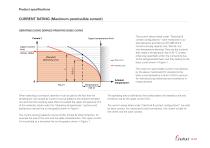
Product specifications CURRENT RATING (Maximum permissible current) DERATING CURVE DERIVED FROM THE BASIC CURVE Current l Upper temperature limit Upper current limit (wires, cable) (Derated) Operating area Basic curve The current values listed under “Electrical & contact configurations” were measured in our test laboratory according to IEC 60512-5-2: Current-carrying capacity test, Test 5b: Current-temperature derating. They are the currents that create a temperature rise of 40 °C (unless otherwise specified) within the connectors due to the self-generated heat, and they belong to the basic curve...
Open the catalog to page 12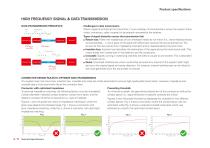
Product specifications HIGH FREQUENCY SIGNAL & DATA TRANSMISSION INPUT Challenges in data transmission When a signal is emitted at the transmitter, it must undergo minimal distortion across the system (transmitter, connectors, cable, receiver) to be properly recovered at the receiver. DATA TRANSMISSION PRINCIPLES Types of signal distortion across the transmission link: Return loss: When the impedances of two interfaced media do not match (i.e., transmitter/connector, connector/cable, ...), some parts of the signal will reflect back towards the source and be lost. The amount of this loss comes...
Open the catalog to page 13All Fischer Connectors catalogs and technical brochures
 Fischer Core Series Brass
178 Pages
 Fischer Core Series Plastic
20 Pages
 Fischer Core Series Broadcast
29 Pages
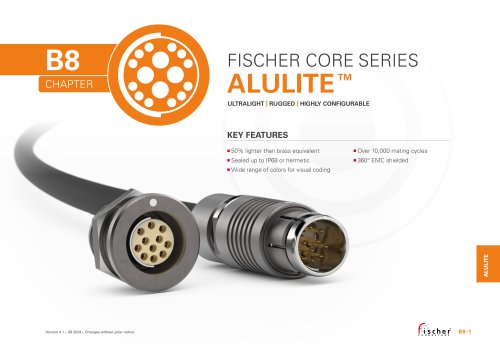 Fischer Core Series Alulite™
32 Pages
 Connectors Overview
2 Pages
 Cable Assembly Solutions
4 Pages
 Fischer Rugged Flash Drives
4 Pages
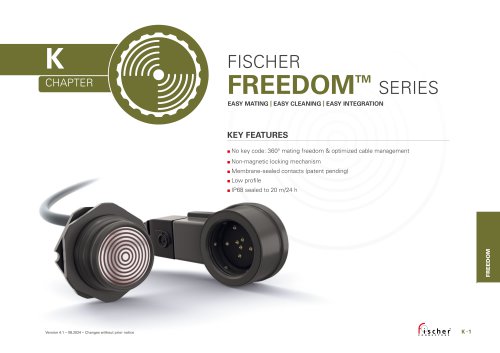 Fischer Freedom™ Series
18 Pages
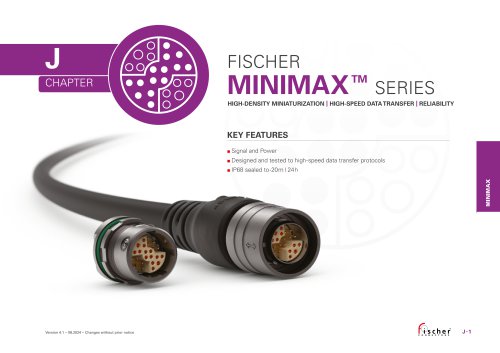 Fischer MiniMax™ Series
27 Pages
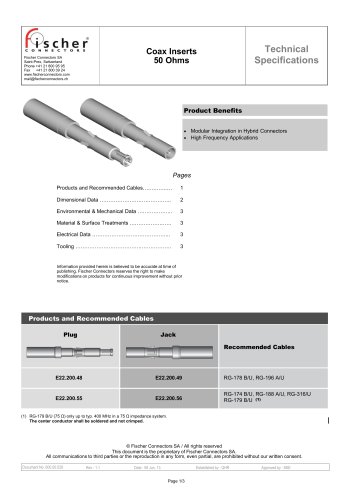 Coax Inserts 50 Ohms
3 Pages
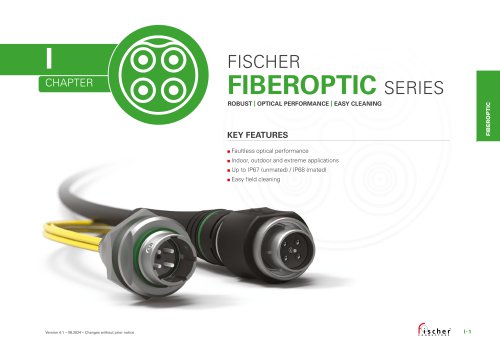 Fischer FiberOptic Series
32 Pages
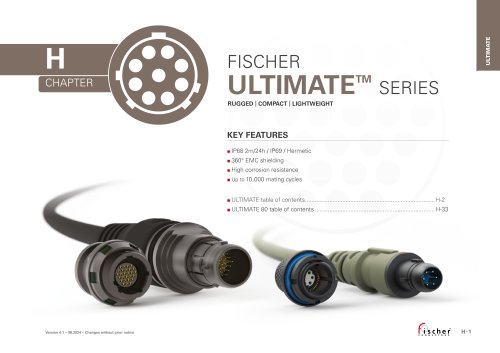 Fischer UltiMate™ Series
45 Pages
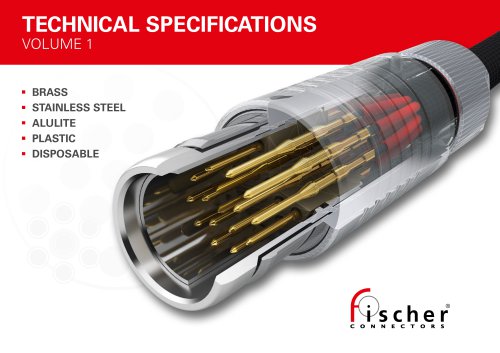 Technical Specifications Volume 1
293 Pages
- Fischer data connector
- Fischer electrical power supply connector
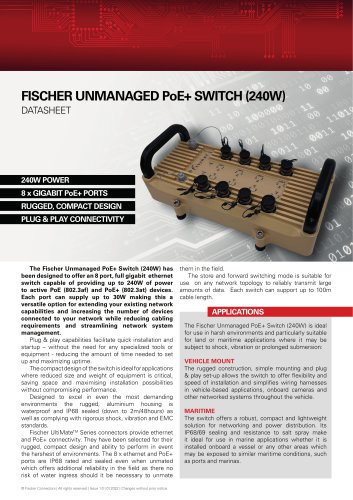
- Ethernet switch
- Fischer metal connector
- Fischer circular connector
- Polymer connector
- Screw-in connector
- Fischer industrial connector
- Gigabit Ethernet ethernet switch
- IP67 connector
- Unmanaged switch
- Current connector
- Fischer cable connector
- Cable assembly
- PoE network switch
- Rugged network switch
- Fischer brass connector
- Fischer voltage connector
- IEC connector