
- Catalogs
- Firwin Corp.
- Removable Insulation Blankets Overview


Removable Insulation Blankets Overview

Removable Insulation Blankets Overview
Removable insulation blankets are essential for insulating engine parts, exhaust piping, and industrial machinery. They are particularly useful in applications involving diesel engines, such as power generation and marine vehicles, to manage heat effectively.
Benefits
- Protect personnel from heat exposure.
- Reduce ambient heat levels.
- Shield heat-sensitive components.
- Maintain optimal exhaust temperatures.
- Facilitate maintenance and inspection.
Construction
These blankets are typically constructed in three layers:
- Outer Layer: Made of silicone-impregnated fiberglass or aluminized fiberglass, with temperature limits of 500°F to 1000°F, serving as a protective cover.
- Middle Layer: Composed of fiberglass insulation media, usually 1 inch thick, but adjustable based on application needs.
- Inner Layer: Stainless steel mesh, with temperature limits up to 1800°F, containing the insulation media.
Installation
Installation involves wrapping the blanket around the part to be insulated and securing it with lacing wire. Other fastening methods include snaps, straps, springs, and Velcro.
Heat Performance
The outer cover temperature depends on the insulation material's heat rating and thickness. Charts indicate how touch temperatures vary with different materials and thicknesses, highlighting safe touch limits and performance comparisons.
For more information, contact Firwin Corp. at 1.877.FIRWIN7 or visit their websites.
Catalog excerpts

Removable Insulation Blankets Overview Insulation Blanket Overview Removable Insulation Blankets are used to insulate engine parts, exhaust piping and components, and industrial process piping and machinery. In particular, applications which use diesel engines, such as power generation, off highway & on-highway vehicles, and marine often require insulation blankets to manage the heat that these engines generate. Benefits of Removable Insulation Blankets • Protect Personnel • Lower Ambient Heat • Shield Heat Sensitive Components • Maintain Exhaust Temperatures • Allow for Maintenance and Inspection Firwin Corp. Toll free: 1.877.FIRWIN7 • Toll Free Fax: 1.855.635.5344 • Email: firwin@firwin.com Find Out More at: www.firwin.com • www.fir
Open the catalog to page 1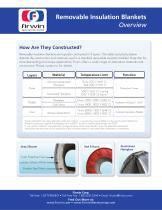
Removable Insulation Blankets Overview How Are They Constructed? Removable insulation blankets are typically constructed in 3 layers.1 The table and photos below illustrate the construction and materials used in a standard removable insulation blanket. Note that for more demanding and unique applications, Firwin offers a wide range of alternative materials and construction. Please contact us for details. Material Temperature Limit Silicone Impregnated Fiberglass Protective Cover Middle Inner Aluminized Fiberglass Insulation Media (1 Inch) 3 Contains Insulation Media Certain applications may require...
Open the catalog to page 2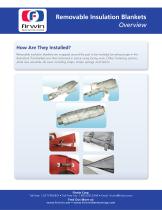
Removable Insulation Blankets Overview How Are They Installed? Removable insulation blankets are wrapped around the part to be insulated (an exhaust pipe in this illustration). The blankets are then fastened in place using lacing wire. Other fastening options, while less versatile, do exist, including snaps, straps, springs, and Velcro. Firwin Corp. Toll free: 1.877.FIRWIN7 • Toll Free Fax: 1.855.635.5344 • Email: firwin@firwin.com Find Out More at: www.firwin.com • www.firwinthermow
Open the catalog to page 3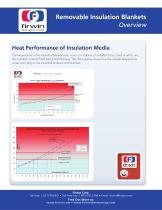
Removable Insulation Blankets Overview Heat Performance of Insulation Media The temperature of the insulation blanket outer cover is a function of multiple factors, chief of which are the insulation material heat rating and thickness. The charts below shows how the outside temperature varies according to the insulation material and thickness. TYPICAL TOUCH TEMPERATURES 1" & 2" COMPARISON (80°F Ambient. No wind. Flat Surface) Fiberglass/Mineral Wool temp. limit (1200°F) Safe touch limit (203°F) Safe extended touch limit Heat Performance Comparision by Insulation Material TYPICAL TOUCH TEMPERATURES...
Open the catalog to page 4All Firwin Corp. catalogs and technical brochures
 Catalysts and SCRs
6 Pages


- Protection sleeve
- Bendable sleeve
- Protective coating
- Braided sleeve
- Pipe sleeve
- Fiberglass sleeve
- Composite sleeve
- Plastic tape
- Thermal insulation tape
- Rubber sleeve
- Rubber tape
- Exhaust insulation blanket
- Fiberglass tape
- Motor insulation blanket
- Silicone rubber sleeve
- Acoustic barrier
- Fiberglass insulation blanket
- Composite coating