
- Catalogs
- Firestone Industrial
- Picker & Gripper Design Guide WP1

Picker & Gripper Design Guide WP1

Picker & Gripper Design Guide WP1
The document introduces AirPicker™ and AirGripper™ end-effectors, designed to enhance robotic and mechanical handling systems by combining pneumatic pressure control with rubber's physical attributes. These end-effectors provide a gentle yet secure grip, suitable for various manufacturing operations.
- Conform to Any Shape: The inflatable rubber construction allows handling of multiple shapes with one model.
- Multiple Sizes Handled: Can accommodate various part sizes with significant expansion capabilities.
- Delicate Handling: Pressure control allows for gentle handling of delicate objects.
- High Load Capacity: Wide contact area increases load capacity compared to mechanical grippers.
- Non-marring Contact: Soft rubber and air prevent surface damage to glass and plastic objects.
- Wide Size Range: Can handle a broad range of object sizes.
- No Lubrication Required: Absence of moving parts eliminates the need for lubrication.
- Low Cost: Generally more affordable than mechanical grippers.
- Long Life in Dusty Environments: Durable design without seals or bearings.
- Pressure: Do not exceed maximum recommended working pressure, which varies by material and reinforcement.
- Media: Air or nitrogen is recommended for inflation.
- Temperature: Operating temperature ranges differ for neoprene and silicone materials.
- Contact Surface: Preferably smooth and dry to optimize grip and avoid abrasion.
- Working Diameter: Adhere to specified diameter ranges to prevent damage.
- Preconditioning: Necessary to break pick cords for optimal performance.
- Contaminates: Chemical compatibility varies; refer to the chart for guidance.
- Storage: Store in a dark, dry area at room temperature.
The chart provides guidance on the compatibility of neoprene and silicone with various chemicals, indicating which are highly compatible.
Details on load capacity, coefficient of friction, life expectancy, and other performance metrics are provided, emphasizing the importance of adhering to recommended specifications for optimal performance.
Information on the materials used in the construction of end-effectors, including body, rubber bladder material, and fabric reinforcement.
Descriptions of various models and their specific features, such as high load capacity and low radial displacement.
Available accessories include nose cones, protective sleeves, and a rebuild program to extend the life of the end-effectors.
Guidelines for determining the required pressure for handling heavy and light loads, ensuring the correct end-effector is chosen for specific applications.
Examples of practical applications for AirPicker™ and AirGripper™ end-effectors in various industries.
A comprehensive guide to assist in selecting the appropriate end-effector model based on specific needs and requirements.
Includes detailed design parameters for picking inside and gripping outside objects, ensuring proper application and use.
The document discusses the load capacity of Firestone AirPicker™ and AirGripper™ end-effectors, which is influenced by pressure, contact area, and the coefficient of friction. The frictional force allows objects to be held securely. Increasing pressure, contact area, or the static coefficient of friction enhances load capacity. The document provides detailed load curves and explains how these factors affect performance.
The coefficient of friction is crucial for the gripping force of end-effectors. A higher coefficient results in greater load capacity. The document emphasizes handling dry objects to maintain high load capacity, as wet surfaces reduce friction.
Factors affecting the life of end-effectors include inflation pressure, temperature, and the object's characteristics. Neoprene end-effectors have a longer life cycle compared to silicone, which is less durable but tolerates higher temperatures.
The construction of AirPicker™ and AirGripper™ end-effectors involves a fabric-reinforced rubber bladder attached to a metal body. Materials used include stainless steel, plated steel, and aluminum, depending on the size and application requirements.
Design aspects such as diameter vs. pressure, cycle rate, and body tolerances are discussed. The document provides guidelines for maximizing the life and performance of end-effectors, including recommendations for operating conditions and material selection.
- Body Material: Stainless steel is used for its corrosion resistance and strength without adding significant weight. Sizes P006-P009 feature a single air passage and threaded body for mounting.
- Rubber Bladder Material: Neoprene is standard for its excellent resilience and abrasion resistance, while silicone is used for high-temperature applications despite its poor abrasion resistance.
- Fabric Reinforcement: Radial fabric reinforcement increases pressure capabilities, while bias fabric provides stronger bladders but limits diameter range.
- Special order models are available for applications beyond standard capabilities, including high load capacity and low rotational displacement models.
- Fabric reinforced AirGripper™ end-effectors handle higher pressures but have a reduced diameter range.
- Protective sleeves are offered to extend the life of the rubber bladder and provide support during inflation.
- Key parameters for selecting an end-effector include the diameter and depth of the contact area and the load of the workpiece.
- Additional factors include surface texture, environmental temperature, chemical compatibility, and mounting dimensions.
- The selection process involves using a guide to match the end-effector to the workpiece's diameter and load requirements, considering pressure and load capacity curves.
The end-effectors are used in various applications such as handling and packaging bottles, lifting engine cylinder liners, gripping TV tubes, and transferring hot test tubes.
Catalog excerpts

ENGINEERING MANUAL & DESIGN GUIDE World's Number 1 ggjj FIRESTONE INDUSTRIAL PRODUCTS COMPANY
Open the catalog to page 1
Body. . . . . . . . . . . . . . . . . . . . . . . . . . . . . . . . . . 13 Rubber Bladder Material. . . . . . . . . . . . . . . . . . 14 Fabric Reinforcement. . . . . . . . . . . . . . . . . . . . . 14 Conform To Any Shape. . . . . . . . . . . . . . . . . . . . Multiple Sizes Handled with One End Effector Delicate Handling. . . . . . . . . . . . . . . . . . . . . . . . . Wide Size Range. . . . . . . . . . . . . . . . . . . . . . . . . High Load Capacity. . . . . . . . . . . . . . . . . . . . . . . Non-marring Contact. . . . . . . . . . . . . . . . . . . . . . No Lubrication Required. . . . ....
Open the catalog to page 2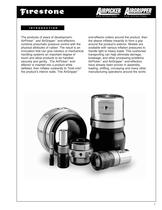
T he products of years of development, AirPicker™ and AirGripper™ end-effectors combine pneumatic pressure control with the physical attributes of rubber. The result is an innovation that can give robotics or mechanical handling systems an important degree of touch and allow products to be handled securely and gently. The AirPicker™ endeffector is inserted into a product while deflated, then inflates outwardly to “hold onto” the product’s interior walls. The AirGripper™ end-effector collars around the product, then the sleeve inflates inwardly to form a grip around the product’s exterior. Models...
Open the catalog to page 3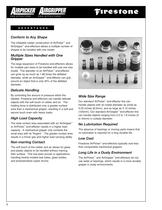
Conform to Any Shape The inflatable rubber construction of AirPicker™ and AirGripper™ end-effectors allows a multiple number of shapes to be handled with one model. Multiple Sizes Handled with One Gripper The large expansion of Firestone end-effectors allows for multiple part sizes to be handled with just one size model. The diameter of an AirPicker™ end-effector can grow by as much as 1.86 times the deflated diameter, while an AirGripper™ end-effector can grip around an object that is only 40% of the deflated diameter. Delicate Handling By controlling the amount of pressure within the bladder,...
Open the catalog to page 4
Maximum Recommended Working Pressure Contact Surface P010 – 025 with standard radial fabric P reinforced neoprene 70PSI The preferred contact surface for AirPicker™ and AirGripper™ end-effectors is smooth and dry. A dry surface is preferred to optimize the load carrying capacity of end-effectors. Wet surfaces will decrease the grip that an end-effector has on a handled object. A smooth surface is preferred to avoid abrasion. Threads, burrs, or sharp contact areas will hasten wear and decrease the useful life of the rubber bladder. Protective neoprene sleeves for AirPicker™ end-effectors are available...
Open the catalog to page 5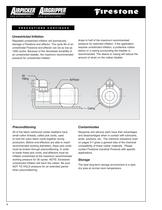
Unrestricted Inflation Repeated unrestricted inflation will prematurely damage a Firestone end effector. The cycle life of an unrestricted Firestone end-effector can be as low as 1000 cycles. Because of the decreased durability of an unrestricted bladder, the maximum recommended pressure for unrestricted inflation drops to half of the maximum recommended pressure for restricted inflation. If the application requires unrestricted inflation, a protective rubber sleeve or a casing surrounding the bladder is recommended. The sleeve or casing will reduce the amount of strain on the rubber bladder....
Open the catalog to page 6
Acetic Acid, 5% Acetic Acid, 30% Acetic Anhydride Aero Lubriplate Alum-NH3CrK Aluminum Brimide Aluminum Chloride Aluminum Fluoride Aluminum Nitrate Aluminum Phosphate Aluminum Salts Aluminum Sulfate Ammonia Anhydrous Ammonia Gas, Cold Ammonia Gas, Hot Ammonium Carbonate Ammonium Chloride Ammonium Hydroxide (Concentrated) Ammonium Nitrite Ammonium Persulfate Solutions Ammonium Persulfate 10% Ammonium Phosphate Ammonium Phosphate Mono-Basic Ammonium Phosphate Dibasic Ammonium Phosphate Tribasic Ammonium Salts Ammonium Sulfate Ammonium Sulfide Amyl Alcohol Amyl Borate Anhydrous Ammonia Aroclor 1260...
Open the catalog to page 7
c h e m ical co m patibilit y c h art continued Formic Acid Freon 12 Freon 13 Freon 13B1 Freon 14 Freon 22 Freon 31 Freon 32 Freon 113 Freon 114 Freon 114B2 Freon 115 Freon 142B Freon 152a Freon 218 Freon C316 Freon C318 Freon 502 Freon TF Freon TA Freon TC Freon T-P35 Freon PCA Fuel Oil, Acidic Fuel Oil, #6 Fyrquel 90, 100, 150, 220, 300, 500 Gelatin Glucose Glycerine-Glycerol Glycols Green Sulphate Liquor Gulf FRG-Fluids Gulf FRP-Fluids Hannifin Lube A Heavy Water Hellum N-Hexaldehyde High Viscosity Lube, U4 High Viscosity Lube, H2 Hydrogen Gas, Cold Hydrogen Gas, Hot Hydrogen Peroxide (1)...
Open the catalog to page 8
c h e m ical co m patibilit y c h art continued Sodium Bicarbonate (Baking Soda) Sodium Bisulfite Sodium Borate Sodium Carbonate Sodium Chloride Sodium Cyanide Sodium Phosphate (Mono) Sodium Phosphate (Tribasic) Sodium Salts Sodium Silicate Sodium Sulphate Sodium Sulphide Sodium Sulfite Sodium Thiosulfate Soybean Oil Spry Stannous Chloride Sucrose Solutions Sulfur Sulfur Hexafluoride Neoprene Silicone TT-S-735, Type IV Tannic Acid 10% Tartaric Acid Triethanol Amine Ucon Lubricant LB-65 Ucon Lubricant LB-135 Ucon Lubricant LB-285 Ucon Lubricant LB-300 Ucon Lubricant LB-625 Ucon Lubricant LB-1145...
Open the catalog to page 9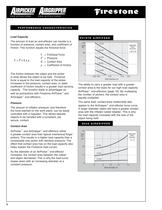
perfor m ance c h aracteristics The amount of load an end-effector can handle is a function of pressure, contact area, and coefficient of friction. This function equals the frictional force. = Frictional Force = Pressure = Contact Area = Coefficient of friction The friction between the object and the picker is what allows the object to be held. Frictional force is equal to the load capacity of the picker. Increases in the pressure, contact area, or static coefficient of friction results in a greater load carrying capacity. This function leads to advantages as well as precautions with Firestone...
Open the catalog to page 10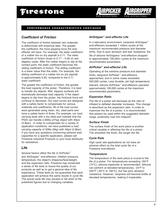
perfor m ance c h aracteristics continued AirGripper™ end-effector Life The coefficient of friction between two materials is determined with empirical data. The greater the coefficient, the more gripping force the endeffector will have. For example, the static coefficient of a rubber tire on dry asphalt is 0.71. The static coefficient of friction drops to 0.17 – 0.06 on wet, slippery roads. After the rubber begins to slip at the contact point, the static coefficient becomes the sliding coefficient of friction. The sliding coefficient is a lower value than the static. For example, the sliding...
Open the catalog to page 11All Firestone Industrial catalogs and technical brochures
 Date Codes Sheet
2 Pages
 Corporate Brochure
2 Pages
 Air Spring Maintenance
4 Pages
 Marshmellow Brochure MM
4 Pages
 DR Series Flyer DRS_A4
2 Pages
 Airstroke Airmount brochure
12 Pages
 Airide Design Guide Design Guide
84 Pages
 Airail Springs Design Guide Rail
52 Pages
 Aftermarket LoadShare
28 Pages
 Aftermarket BUS_014
50 Pages
 Aftermarket Catalog Mexico MXCAT
251 Pages
 Airstroke Airmount brochure ASAM
12 Pages
 Marshmellow Brochure
60 Pages
 Airstroke/Airmount Brochure
12 Pages


- Actuator
- Linear actuator
- Double-acting cylinder
- Pneumatic cylinder
- Spring
- Anti-vibration mount
- Pneumatic actuator
- Compression spring
- Anti-vibration damper
- Double-acting actuator
- Cylindrical anti-vibration mount
- Rubber anti-vibration mount
- Rubber absorber
- Pneumatic buffer
- Rodless actuator
- Waterproof actuator
- Air spring
- Elastomer spring
- Suspension spring