
- Catalogs
- Firestone Industrial
- Airstroke Airmount brochure ASAM

Airstroke Airmount brochure ASAM

Airstroke Airmount brochure ASAM
Airstroke actuators are used as alternatives to pneumatic or hydraulic cylinders in applications such as presses, conveyors, and clamping devices. They also serve in actuation and isolation roles for protective boots, connectors, and shock absorbers.
Airmount isolators are used for vibration isolation in equipment like lasers and industrial machinery, based on Airide spring technology.
Airstroke actuators support loads up to 100,000 pounds with strokes up to 14 inches, operating in temperatures from -35°F to 135°F. They are made from elastomeric bellows with metal end closures and come in single, double, and triple convolutions.
- Cost-effective and durable.
- Available in a wide size range (2.2 to 37 inches in diameter).
- No maintenance required due to lack of internal rods or seals.
- Friction-free operation and flexible media use.
- Handles angular motion up to 30 degrees and side loads.
- Compact design compared to conventional cylinders.
Consider stroke capability, force requirements, and end closure options. Ensure proper installation with positive stops and adequate clearance to prevent damage.
Guidance is necessary when connecting multiple actuators. Fail-safe devices are recommended to prevent damage or injury. Airstroke actuators can handle small vacuums with limitations.
Offer superior vibration isolation with natural frequencies as low as 1 Hertz, maintaining constant efficiency and effective noise reduction. They support loads from 100 to over 85,000 pounds.
Effective isolation requires the natural frequency of the system to be less than one-third of the disturbing frequency.
Analyzed a fan and motor system weighing 6000 lbs, recommending #224 Airmount isolators for better isolation.
- Choose isolators based on load capacity.
- Determine isolation effectiveness using charts.
- Use specified design heights for optimal performance.
- Consult the Engineering Manual for pressure requirements.
Align the center of gravity with isolators for stability. Install safety stops to prevent excessive movement.
Three control methods are outlined for maintaining system stability and accuracy.
Provide clearance around isolators and use positive stops for safety.
Set stops at ±1/2 inch from design height to accommodate movement.
Airmount isolators should not lift equipment due to lateral instability at lower heights.
Consult Firestone before using these parts as isolators due to lateral instability.
Resonance occurs when forced frequency matches natural frequency, leading to amplified movement.
Movement amplitude depends on mass ratios and speed. Damping can reduce amplitude.
Consult Firestone for operations below 40 psig due to instability.
Adding a reservoir can lower natural frequency, enhancing isolation.
The damping ratio is approximately 0.03, negligible in calculations.
Describes various air springs and applications like web tensioning and forming presses.
Information is a general guide and should be used with professional assistance. No warranties are provided.
Catalog excerpts
The first successful application of airsprings for vibration isolation occurred during the late nineteen thirties. Airsprings were developed by Firestone to fill a need for a more efficient suspension system for highway trucks, trailers, and buses. Airide™ springs, as they were named, provided the means for a suspension that reduced the amount of road shock and vibration transmitted into the vehicle. Billions of miles of actual use have proven the dependability and effectiveness of the air suspension concept using Airide springs by Firestone. Airmount isolators and Airstroke actuators are a further...
Open the catalog to page 2
™ AIRSTROKE ACTUATORS Style Number Minimum Height (inches) Maximum Stroke (inches) 80 PSI Force* at Stroke of 1 Inch 3 Inches Maximum Stroke (pounds) (pounds) (pounds) Advantages of: SHAPED SLEEVE 1M1A-0 1M1A-1 2M1A 2M2A 1.5 1.5 2.5 1.2 1.4 2.0 3.4 1.0 450 490 470 10.8 410 400 375 360 10.8 SINGLE CONVOLUTION 16 16ST 131 110 116 116-1 115 19 19-.75 113 113-1 153-2 119** 121** 126** 138-1.5 148-1 1.9 1.8 2.0 2.0 2.0 2.0 2.0 2.0 2.0 2.0 2.0 2.5 2.0 2.0 2.0 2.0 2.5 1.4 1.5 2.1 3.1 3.1 4.2 3.1 3.5 3.9 3.8 4.6 4.8 4.2 3.6 4.4 5.3 4.8 960 930 1,350 2,090 2,690 2,980 3,550 6,720 7,040 9,900 10,860 13,135...
Open the catalog to page 4
Airstroke Actuator Selection Procedure ™ Refer to the selection guide on page 4 for Airstroke actuator force and stroke capabilities. This information is intended to give a general guide to part capabilities. Before selecting the correct Airstroke actuator you need to know certain attributes of your application. Once this data is known, the selection is relatively easy. For more detailed information please obtain a copy of Firestone’s Engineering Manual and Design Guide. generally decreases as height increases. If you have less than 100 psi available, divide the force by 100 and multiply by your...
Open the catalog to page 5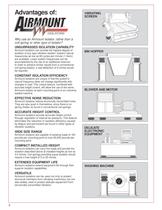
Advantages of: VIBRATING SCREEN Why use an Airmount isolator, rather than a coil spring or other type of isolator? UNSURPASSED ISOLATION CAPABILITY Airmount isolators can provide the highest degree of isolation of any type vibration isolator. System natural frequencies as low as 60 cycles per minute (1 Hertz) are available. Lower system frequencies can be accomplished by the use of an additional reservoir. In order to achieve similar results from a conventional coil spring isolator, a real deflection of 9 inches would be required. BIN HOPPER CONSTANT ISOLATION EFFICIENCY Airmount isolators are...
Open the catalog to page 6
Airmount Isolator Basics ™ A detailed discussion of vibration isolation is beyond the scope of this brochure, but the general theory and terms bear some explanation. In any vibration isolation application, there will be some source of vibration, or disturbance, that generates concern. This disturbance may be coming from the environment. An example would be a coordinate measuring machine in a metal stamping plant whose floor vibrations make delicate measurement impossible. The disturbance may also be generated by a device that affects the surroundings. An example of this could be a vibrating screen...
Open the catalog to page 7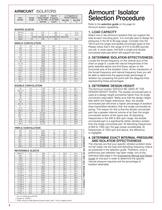
™ Airmount Isolator Selection Procedure AIRMOUNT ISOLATORS Style Number Design Height Load (at Natural Design Height) Frequency at 100 PSIG (@ 80 PSIG) (pounds) fn(cpm) ™ % of Isolation at Forced Frequency 400 CPM 800 CPM % % Refer to the selection guide on this page for Airmount isolator capabilities. SHAPED SLEEVE 1M1A-0 1M1A-1 2M1A 2M2A 2.5 570 220 3.0 593 162 90.0 DO NOT USE 2M1A AS AN AIRMOUNT ISOLATOR 2.0 198 232 1. LOAD CAPACITY 91.8 95.5 Select one or two Airmount isolators that can support the load at each mounting point. It is normally best to design for pressures in the 60 to 80 psig...
Open the catalog to page 8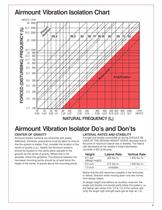
Airmount Vibration Isolation Chart 41.7 2500 33.2 2000 P Is erc ol e at nt io n 99.9 99.5 99 98 97 96 95 90 80 70 60 25 1500 16.7 15 13.3 11.7 10 1000 900 800 700 600 8.3 500 Re so na nc e FORCED (DISTURBING) FREQUENCY (ff) HERTZ CPM 50 3000 6.7 400 5.0 300 Amplification 4.2 250 3.3 200 2.5 150 1.7 100 30 0.50 40 50 60 0.67 0.83 1.0 80 100 1.33 1.67 150 2.50 200 3.33 300 5.00 400 500 600 800 1000 6.67 8.33 10.0 13.3 16.7 CPM HERTZ NATURAL FREQUENCY (fn) Airmount Vibration Isolator Do’s and Don’ts CENTER OF GRAVITY LATERAL RATES AND STABILITY Airmount isolator systems are inherently soft (easily...
Open the catalog to page 9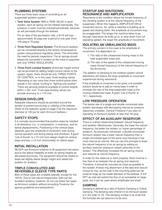
PLUMBING SYSTEMS There are three basic ways of controlling an air suspended isolation system: 1. Tank Valve System–With a TANK VALVE in each isolator, each air spring can be inflated individually. The pressure in each must be checked periodically, because air will permeate through the bellows. For an idea of the permeation rate, a #116 will lose approximately 30 psig over a period of one year (from 100 psig to 70 psig). 2. Three Point Regulated System–The Airmount isolators can be connected directly to the factory compressed air system using pressure regulating valves. This eliminates the need...
Open the catalog to page 10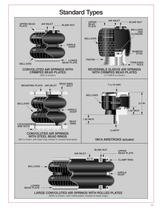
Standard Types AIR INLET UPPER BEAD PLATE AIR INLET UPPER BEAD PLATE BLIND NUT BLIND NUT BELLOWS END CLOSURE BELLOWS GIRDLE HOOP BUMPER STUD PISTON LOWER BEAD PLATE BELLOWS THREADED HOLE CONVOLUTED AIR SPRINGS WITH CRIMPED BEAD PLATES REVERSIBLE SLEEVE AIR SPRINGS WITH CRIMPED BEAD PLATES (#22 is shown) (1T15M-6 is shown) MOUNTING PLATE AIR INLET BEAD RING BOLT 5/16-18 UNC BELLOWS 3.0 IN. BELLOWS GIRDLE HOOP BEAD RING LOCKWASHERS AND NUTS 1.50 INCH 1.00 INCH 1/8-NPTF CONVOLUTED AIR SPRINGS WITH STEEL BEAD RINGS (#22 is shown, with bead rings instead of crimped bead plate) 1M1A AIRSTROKE actuator...
Open the catalog to page 11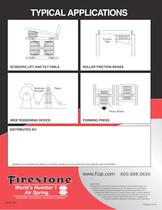
TYPICAL APPLICATIONS Friction Pad SCISSORS LIFT AND TILT TABLE Airstroke Actuator ROLLER FRICTION BRAKE Paper Press Platen WEB TENSIONING DEVICE FORMING PRESS DISTRIBUTED BY: Request our Engineering Manual & Design Guide for more extensive and specific part information. www.fsip.com 800.888.0650 PLEASE NOTE: The information contained in this publication is intended to provide a general guide to the characteristics and applications of these products. The material, herein, was developed through engineering design and development, testing and actual applications and is believed to be reliable and...
Open the catalog to page 12All Firestone Industrial catalogs and technical brochures
 Date Codes Sheet
2 Pages
 Corporate Brochure
2 Pages
 Air Spring Maintenance
4 Pages
 Marshmellow Brochure MM
4 Pages
 DR Series Flyer DRS_A4
2 Pages
 Airstroke Airmount brochure
12 Pages
 Airide Design Guide Design Guide
84 Pages
 Airail Springs Design Guide Rail
52 Pages
 Aftermarket LoadShare
28 Pages
 Aftermarket BUS_014
50 Pages
 Aftermarket Catalog Mexico MXCAT
251 Pages
 Marshmellow Brochure
60 Pages
 Airstroke/Airmount Brochure
12 Pages


- Linear actuator
- Double-acting cylinder
- Pneumatic cylinder
- Anti-vibration mount
- Pneumatic actuator
- Compression spring
- Anti-vibration damper
- Double-acting actuator
- Cylindrical anti-vibration mount
- Rubber anti-vibration mount
- Rubber absorber
- Pneumatic buffer
- Rodless actuator
- Waterproof actuator
- Elastomer spring
- Suspension spring