
- Catalogs
- Firestone Industrial
- Airide Design Guide Design Guide

Airide Design Guide Design Guide

Airide Design Guide Design Guide
This document serves as a comprehensive guide to Firestone's Air Springs, covering their characteristics, applications, historical context, technical specifications, and detailed descriptions of components and processes related to air springs and suspensions.
Firestone's experimentation with pneumatic springs began in the 1930s. Despite initial challenges due to the prevalence of cost-effective steel springs, air springs gained popularity in the 1950s, particularly in bus applications, and later expanded to trucks, trailers, and industrial uses.
Pressure and Process Terms: Key terms include absolute pressure, adiabatic process, atmospheric pressure, gauge pressure, and polytropic process, which are crucial for understanding air spring dynamics.
Air Spring Component Terms: Important components include the bead, bead plate, bead ring, bumper, clamp ring, flexible member, lower end closure, piston, and upper end cap, each playing a vital role in air spring function and assembly.
Firestone air springs are made with a flexible rubber and fabric member containing compressed air. The standard two-ply version includes an inner liner, two fabric-reinforced plies, and an outer cover, with some models available in four-ply construction for higher pressure applications.
This section describes the components of reversible sleeve style air springs, such as the mounting stud, combination stud, bead plate, flexible member, bumper, end closure, piston, and piston bolt, which are essential for assembly and function.
The service assembly consists of the flexible member with cured-in end closure and bead plate, available as a separate unit for cost-effective replacement in truck and trailer suspensions.
Various mounting options are available, requiring specification of both the style number and the complete Assembly Order Number (AON). Installation instructions stress the importance of using appropriate materials and techniques for proper function and longevity.
The document outlines data entry processes for air springs, including design height, design load, and pressure. It specifies using a constant pressure curve and provides instructions for calculating parameters such as air spring effective area, absolute pressure, gauge pressure, and dynamic load, using a dynamic load vs. height plot for results.
Firestone air springs are warranted against material defects and workmanship issues. The document advises examining old air springs for failure causes before installing new ones, as many failures stem from suspension issues rather than product defects.
Common air spring failures include off-center bumper contact, loose girdle hoop, bottoming out, and over-extension, with possible causes such as worn bushings, improper installation, broken shock absorbers, and defective leveling valves.
A checklist for periodic maintenance includes inspecting the air spring's outer diameter, ensuring sufficient clearance, checking ride height, and inspecting leveling valves and shock absorbers to prevent premature failures.
Approved cleaning methods include using soap and water or alcohols, while non-approved methods include organic solvents and abrasives, ensuring the longevity of air springs.
The document briefly recounts Firestone's development of pneumatic springs from the 1930s, highlighting their evolution from experimental stages to widespread use in buses, trucks, trailers, and industrial applications.
Catalog excerpts
PLEASE NOTE The information contained in this publication is intended to provide a general guide to the characteristics and applications of these products. The material, herein, was through engineering design and development, testing and actual applications and is believed to be reliable and accurate. However, Firestone makes no warranty, express or implied, of this information. Anyone making use of this material does so at his own risk and assumes all liability resulting from such use. It is suggested that competent professional assistance be employed for specific applications. 1 Advantages...
Open the catalog to page 2
HISTORY In the early 1930's, the Firestone Tire and Rubber Company began experiments to develop the potential of pneumatic springs. Between 1935 and 1939, several makes of U.S. automobiles were equipped with air springs and extensively tested to prove the potential of automotive air suspension systems. They were never put into production, however, because significant developments in steel spring design gave an improved ride at much lower cost than the air spring system at that time. In 1938, the country's largest manufacturer of motor coaches became interested in using air springs on a new design...
Open the catalog to page 3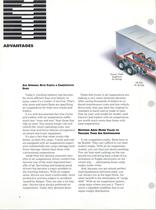
AIR SPRINGS GIVE FLEETS A COMPETITIVE Primary Trailer Lift Axle Today's trucking industry has become far more efficient than ever before. In many cases it's a matter of survival. That's why more and more fleets are specifying air suspensions for their new trucks and It is a well documented fact that trucks and trailers with air suspensions suffer much less "wear and tear" than those that ride on steel. This means longer cab and vehicle life, lower operating costs, less down time and fewer failures of expensive on-board electronic equipment. It's also a fact that when trucks ride better, so does...
Open the catalog to page 4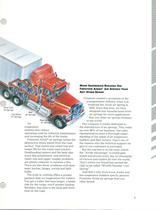
Drive Axle systems also reduce operating costs by reducing maintenance and increasing the life of the trailer. Firestone Airide® air springs isolate the destructive shock inputs from the road surface. That means less wheel hop and longer life for the trailer (and tractor). Deadheading tankers and flat beds take much less punishment, and electrical, reefer unit and upper coupler problems are greatly reduced, to mention a few. There are also fewer problems with door seals, latches, hinges, wiring and light The truth is, nothing offers a greater payback than air suspensions for trailers. You get...
Open the catalog to page 5
TERMS AIR SPRINGS & SUSPENSIONS PRESSURE 8 PROCESS TERMS Absolute Pressure. The pressure in a vessel located in a complete vacuum. Usually determined by adding 14.7 to the gauge pressure. Absolute pressure gauge pressure + atmospheric pressure. perature, change with heat transfer to the air spring structure. To account for this, air spring dynamic operation is calculated by the use of what is known as the polytropic exponent (n). n 1.38 is the 9enerally accepted value for air springs. AIR SPRING COMPONENT TERMS Adiabatic Process. All the calculation variables, volume, pressure, and temperature,...
Open the catalog to page 6
Bumper. Usually, these are made of rubber, plastic, or rubber and fabric materials. They are used to support the vehicle when there is no air in the air springs, when the vehicle is not in use, or when there is a system failure on the road. They will also, to some degree, cushion the shock of very severe axle force inputs to prevent damage to both the Airide(R) spring assembly and to the vehicle. Clamp Ring. A metal band placed near the end of a beadless flexible member. It is swaged tightly in place to secure the beadless flexible member to the upper end cap and piston. Flexible Member. The...
Open the catalog to page 7
Compression Stroke (Jounce). The reduction in heioht from the normal desion heioht of the sprino as it cycles in dynamic operation. Curb Load. The normal minimum static load the air spring is expected to support. It is a zero payload condition, but includes that portion of the unloaded vehicle that is supported by the axle. It is this axle load divided by the number of air springs working with the axle and adjusted according to any lever arm ratio incorporated in the suspension. Design Load. This is the normal maximum static load the air spring suspension is expected to support. It is the rated...
Open the catalog to page 8
SUSPENSION RELATED TERMS Height Sensor. An electronic device that senses the position of a suspension or other mechanical device. The output signal from this device is sent to a control circuit which then exhausts or adds air to the air spring through a solenoid valve. Leveling Valve. A pneumatic valve that senses the distance between the vehicle frame and the axle via a mechanical linkage which adds or exhausts air pressure to maintain a constant vehicle height. Sprung Mass Natural Frequency. The speed of vertical oscillations of the suspended vehicle sprung mass. Can be expressed in cycles...
Open the catalog to page 9
OUTER COVER INNER LINER FLEXIBLE MEMBER CONSTRUCTION An air spring is a carefully designed rubber and fabric flexible member which contains a column of compressed air. The flexible member itself does not provide force or support load; these functions are Firestone air springs are highly engi- neered elastomeric flexible members with specifically designed metal end closures. The standard two-ply version is made up of four layers: • Inner Liner. An inner liner of calendered rubber. reinforced rubber with the cords at a specific bias angle. • Second Ply. A second ply of fabric- reinforced rubber...
Open the catalog to page 10
Although the two-ply air spring is standard, many of our air springs are also available in fourJply rated construction for use at higher pressures. Each air spring's flexible member is identified by a style number, which is molded in during the curing (vulcanization) process. Examples would be 16, 22, 313, 1T15M-6, etc. Ths identfies only the rubber/fabric flexible member.., not the complete assembly.
Open the catalog to page 11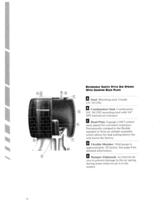
IEVERSIBLE SLEEVE STYLE AIR SPRING WITH CRIMPED BEAD PLATE Stud. Mounting stud. Usually 1/2"-13 UNC. Combination Stud. Combination UNF mounting stud with NPT internal air entrance. 3/4"-16 9 gauge Bead Plate. corrosion(.49") carbon resistance. for steel, plated Permanently crimped to the flexible member to form an airtight assembly which allows for leak testing before the unit leaves the factory. Flexible Member. Wall gauge is .25 inches. See page 9 for detailed information. Bumper (Optional). An internal device to prevent damage to the air spring during times when no air is in the system.
Open the catalog to page 12All Firestone Industrial catalogs and technical brochures
 Date Codes Sheet
2 Pages
 Corporate Brochure
2 Pages
 Air Spring Maintenance
4 Pages
 Marshmellow Brochure MM
4 Pages
 DR Series Flyer DRS_A4
2 Pages
 Airstroke Airmount brochure
12 Pages
 Airail Springs Design Guide Rail
52 Pages
 Aftermarket LoadShare
28 Pages
 Aftermarket BUS_014
50 Pages
 Aftermarket Catalog Mexico MXCAT
251 Pages
 Airstroke Airmount brochure ASAM
12 Pages
 Marshmellow Brochure
60 Pages
 Airstroke/Airmount Brochure
12 Pages


- Cylinder
- Actuator
- Linear actuator
- Double-acting cylinder
- Pneumatic cylinder
- Anti-vibration mount
- Pneumatic actuator
- Compression spring
- Anti-vibration damper
- Double-acting actuator
- Cylindrical anti-vibration mount
- Rubber anti-vibration mount
- Rubber absorber
- Pneumatic buffer
- Rodless actuator
- Waterproof actuator
- Elastomer spring
- Suspension spring