
- Catalogs
- FIP - Formatura Iniezione Polimeri
- Manual valves in PVC-U


- Company
- Products
- Catalogs
- News & Trends
- Exhibitions
Manual valves in PVC-U
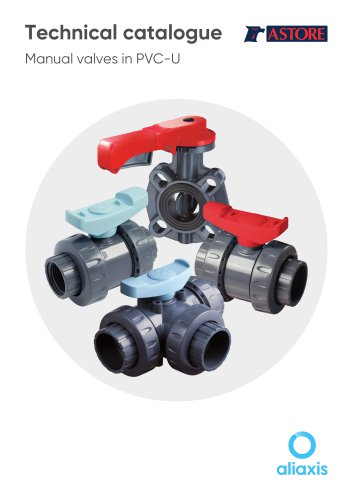
Manual valves in PVC-U
Developed in 1930, PVC-U (unplasticized polyvinyl chloride) is a high-performance resin known for its thermal stability and chemical resistance up to 60°C. It is versatile, economical, and suitable for transporting corrosive fluids and water. Key characteristics include good chemical resistance, thermal stability, mechanical strength, and resistance to aging.
- Density: 1.38 g/cm³ (ISO 1183)
- Modulus of Elasticity: 3200 MPa (ISO 527)
- IZOD Impact Strength: 50 J/m (ASTM D256)
- Ultimate Elongation: 50% (ISO 527)
- Shore Hardness: 80 (ISO 868)
- Tensile Strength: 50 MPa (ISO 527)
- VICAT Softening Point: 76°C (ISO 306)
- Heat Distortion Temperature: 86°C (ASTM D648)
- Thermal Conductivity: 0.16 W/(m°C) (ASTM C177)
- Coefficient of Linear Thermal Expansion: 8 x 10⁻⁵ m/(m°C) (ASTM D696)
- Limiting Oxygen Index: 45% (ASTM D2863)
Production complies with ISO 14001 and ISO 9001. Standards include BS 4346-1, EN 10226, EN ISO 1452, EN ISO 15493, EN 12201, ISO 7-1, ISO 228-1, ISO 727, ISO 4427-3, and ISO 17885.
- ACS France: Suitability for drinking water
- WRAS UK: Suitability for potable water transport
Solvent welding involves joining PVC-U pipes and fittings using adhesives that dissolve the PVC-U polymer. Key steps include cutting and chamfering the pipe, cleaning surfaces with Cleaner-Primer, applying solvent cement, and ensuring proper insertion and drying times. Minimum setting times vary based on ambient temperature and pressure requirements.
- Ensure proper fit and use of Cleaner and Solvent Cement.
- Use protective gear and ensure adequate ventilation.
- Avoid ignition sources due to flammable solvents.
- Follow manufacturer instructions for solvent cement use.
Defects can arise from improper solvent cement consistency, incorrect application, or impurities. These can lead to joint separation, leaks, or mechanical stress transmission.
Details on flanged joint installation are provided to ensure correct assembly and performance.
1. Insert the backing ring onto the pipe before installing the stub.
2. Ensure the fixed flange's drilling aligns with the counter flange.
3. Consider the face-to-face distance of components for counter flange positioning.
4. Insert a flat gasket between stubs, except for butterfly valves, ensuring sealing surfaces are not excessively separated.
5. Proceed with solvent or welding of flanges following FIP instructions.
6. Insert bolts, washers, and nuts.
7. After cooling, tighten bolts in a cross-wise order.
8. Use a torque wrench to reach specified tightening torque values.
Torque values for nuts and bolts are provided for PVC-U or PVC-C flanges with EPDM/FKM/NBR gaskets during pressure tests.
Specifications for bolt lengths are provided for flanged butterfly valves and joints using backing rings.
1. Apply PTFE sealing tape on the male thread, avoiding obstruction of the through-hole.
2. Wind the tape clockwise, keeping it taut.
3. Ensure tape adheres fully to the thread.
4. Increase PTFE layer thickness as needed.
5. Connect sealed male end to female end manually.
6. Ensure PTFE layer remains intact during screwing.
7. Use a strap wrench to complete screwing.
8. Avoid over-tightening to prevent damage.
Use non-sintered PTFE sealing tape. Avoid using threaded joints in critical applications, high pressures, or systems subject to mechanical/thermal stresses.
Thermal resistance, low surface roughness, chemical resistance, abrasion resistance, insulating properties, and easy joining with solvent weld sockets are highlighted.
Available in ISO metric and BS standard versions, with options for other international standards. Features include fixed ball support and radial disassembly.
Construction: True union grey PVC spheric ball valve.
Size range: DN 10 ÷ 100.
Nominal pressure: PN16 for DN 10÷50, PN10 for DN 65÷100.
Temperature range: 0 °C ÷ 60 °C.
Valve material: PVC-U.
Seal material: EPDM, FKM (O-Ring); PTFE (ball seats).
Control options: Manual control.
Detailed dimensions and component lists are provided for various models of true union ball valves, including exploded views and material specifications.
- Types: The document describes several models of single union ball valves, including those with BSP female threaded sockets, ISO metric plain solvent weld sockets, and compression fittings.
- Materials: Valves are constructed from grey PVC-U with EPDM seals and PE ball seats.
- Pressure and Temperature: Nominal pressure ratings vary from PN6 to PN16, with a temperature range of 0°C to 60°C.
- Control: Manual control options are available for all models.
- Dimensions: Detailed dimensions are provided for each model, including size range, length, and weight.
- Types: The document details grey PVC butterfly valves with options for manual control via handle or gear box.
- Materials: Constructed from grey PVC-U with zinc-plated steel shafts and EPDM liners.
- Pressure and Temperature: Nominal pressure ratings range from PN4 to PN16, with a temperature range of 0°C to 60°C.
- Control Options: Manual control is available, with specific models offering gear box control for larger sizes.
- Dimensions: Comprehensive dimensions are provided, including torque requirements and number of holes for installation.
- Exploded Views: The document includes exploded views of valve components, detailing materials and quantities for each part.
- Actuation Kits: Various electrical and pneumatical actuation kits are available for butterfly valves, with specifications for different voltage and action types.
- Gear Box Kits: Gear box kits are available for specific butterfly valve models, including necessary components for installation.
This document provides detailed specifications and components for various types of valves, including anti-friction rings, discs, gaskets, washers, screws, protection caps, and more. Each component is listed with its material and quantity.
The Astore 230 is a true union spring check valve available in ISO metric and BS standard versions. It features a stainless steel AISI 316 spring and EPDM seals. The valve is designed for one-directional flow and can be installed horizontally or vertically. It supports a size range of DN 10 to 100, with nominal pressures of PN16 for DN 10-50 and PN10 for DN 65-100 at 20°C. The temperature range is 0°C to 60°C.
The Astore CROV is a clapet check valve designed for installation between collars and flanges, allowing flow in one direction. It supports a size range of DN 40 to 300, with a nominal pressure of PN5 bar at 20°C. The valve is constructed from grey PVC with EPDM seals.
The Astore 210 is a true union foot ball valve, available in ISO metric and BS standard versions. It is designed for vertical installation and allows one-directional flow. The valve supports a size range of DN 10 to 100, with nominal pressures of PN16 for DN 10-50 and PN10 for DN 65-100 at 20°C. The temperature range is 0°C to 60°C.
The Astore 220 is a true union air release ball valve, designed for vertical installation to eject air from the system. It supports a size range of DN 10 to 50, with a nominal pressure of PN16 at 20°C. The valve is constructed from grey PVC with EPDM seals.
Each valve type includes detailed dimensions and specifications, including size, pressure ratings, and material compositions. The document provides exploded views for assembly reference, listing each component with its material and quantity.
Catalog excerpts
Technical catalogue Manual valves in PVC-U
Open the catalog to page 1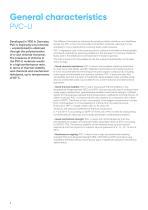
Developed in 1930 in Germany, PVC-U (rigid polyvinyl chloride - unplasticized) is obtained through the polymerization of a vinyl chloride monomer. The presence of chlorine in the PVC-U molecule results in a high performance resin, in terms of thermal stability and chemical and mechanical resistance, up to temperatures of 60° C. The different formulations obtained by adding suitable additives and stabilizers render the PVC-U the most versatile of all plastic materials, allowing it to be adapted to many applications involving fluids under pressure. PVC-U represents one of the more economic solutions...
Open the catalog to page 2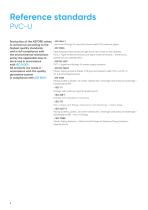
Production of the ASTORE valves is carried out according to the highest quality standards and in full compliance with the environmental restrictions set by the applicable laws in force and in accordance with ISO 14001. All products are made in accordance with the quality guarantee system in compliance with ISO 9001. • BS 4346-1 Joints and fittings for use with solvent weld PVC pressure pipes Pipe threads where pressure tight joints are made on the threads. Part 2: Taper external threads and taper internal threads - Dimensions, tolerances and designation PVC-U pipes and fittings for water supply...
Open the catalog to page 4
• ACS France (Attestation de conformite Sanitaire) Suitability of PVC-U and PVC-C for drinking water APPROVED PRODUCT CERTIFICATION MARK • WRAS (Water regulations advisory scheme - UK) Suitability of PVC-U for transporting potable water
Open the catalog to page 5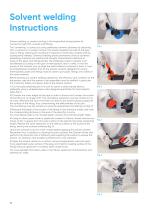
Solvent welding Instructions Solvent welding, or cement jointing, is the longitudinal joining system for connecting rigid PVC-U pipes and fittings. The "cementing" is carried out using adhesives/cements obtained by dissolving PVC-U polymer in a solvent mixture. This solvent liquefies the walls of the pipe and/or fitting, allowing the constituent material to chemically combine and be subsequently welded. Chemical welding allows permanent joints be achieved possessing chemical and mechanical strength characteristics identical to those of the pipes and fittings joined. The adhesives/solvent cements...
Open the catalog to page 6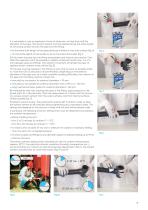
It is advisable to use an applicator/brush of dimension not less than half the diameter of the pipe. The solvent cement must be applied along the entire length of the joining surface of both the pipe and the fitting: • for the entire joint length of the pipe previously marked on the outer surface (fig. 6) • for the entire depth of the socket as far as the internal shoulder (fig.7) 6) Fully insert the pipe into the fitting immediately and without any rotation. Only after this operation will it be possible to slightly rotate both ends (max. 1/4 of a turn between pipe and fitting). This rotation...
Open the catalog to page 7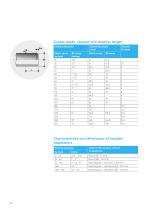
Characteristics and dimensions of brushes-applicators External diameter
Open the catalog to page 8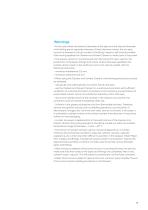
• In the case where the external diameter of the pipe and the internal diameter of the fitting are at opposite extremes of their tolerance values, the dry pipe cannot be inserted in the dry socket of the fitting. Insertion will only be possible after having applied the Cleaner and Solvent Cement to both parts to be joined. • The solvent cement is manufactured from the same PVC resin used for the production of the pipes, fittings and valves. Unless otherwise specified, the solvent cement used on the surfaces to join must also be usable with the following tolerances: • When using the Cleaner and...
Open the catalog to page 9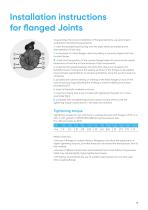
To guarantee the correct installation of flanged elements, we recommend youperform the following operations: 1. insert the possible backing ring onto the pipe, before proceeding with theinstallation of the stub; 2. in the event of a fixed flange, check the drilling is correctly aligned with the counter flange; 3. check that the position of the counter flange takes into account the overall dimensions of the face to face distance of the components; 4. insert the flat gasket between the stubs (this step is not necessary for butterflyvalves), making sure the sealing surfaces of the flanges to be...
Open the catalog to page 11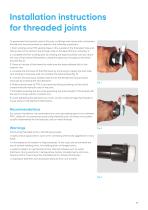
To guarantee the hydraulic seal of the joint on fittings and valves with a threaded female end, we recommend you perform the following operations: 1. Start winding some PTFE sealing tape on the outside of the threaded male end, taking care not to obstruct the through-hole on the pipe, fitting or valve (fig. 1); 2. Complete the first winding layer by winding the tape clockwise until you reach the root of the thread. Remember to keep the tape taut throughout the entire process (fig. 2); 3. Press on the tips of the thread to make sure the tape adheres fully to the support clip; 4. Increase the thickness...
Open the catalog to page 13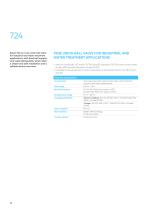
Astore 724 is a true union ball valve for industrial and water treatment applications, with fixed ball support and radial disassembly, which allow a simple and safe installation and a reliable service over time. TRUE UNION BALL VALVE FOR INDUSTRIAL AND WATER TREATMENT APPLICATIONS• Versions available: ISO metric (1V724) and BS standard (3V724) plain solvent weld socket, BSP female threaded socket (1V725).• Available to be produced in other international standards (ASTM, JIS, NPT) upon request. Technical specifications
Open the catalog to page 16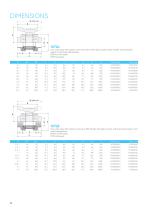
True union grey PVC spheric ball valve, ISO metric plain solvent weld socket, with fixed ball support and radial disassembly. EPDM or FKM seals. PTFE ball seats. D EPDM code True union grey PVC spheric ball valve, BSP female threaded socket, with fixed ball support and radial disassembly. EPDM or FKM seals. PTFE ball seats. EPDM code
Open the catalog to page 18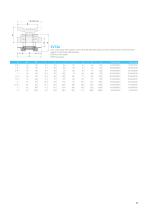
3V724 True union grey PVC spheric ball valve, BS Standard plain solvent weld socket, with fixed ball support and radial disassembly. PTFE ball seats. Z C E H B g EPDM code FKM code
Open the catalog to page 19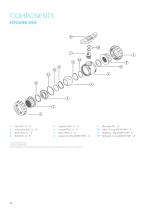
8 Socket O-Ring (EPDM/FKM - 2) 11 Radial O-ring (EPDM/FKM - 1) 122Ball seat O-ring (EPDM/FKM - 2) Inside brackets are indicated the material and the quantity supplied for each component.
Open the catalog to page 20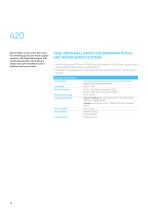
Astore 420 is a true union ball valve for swimming pools and water supply systems, with fixed ball support and radial disassembly, which allow a simple and safe installation and a reliable service over time. TRUE UNION BALL VALVE FOR SWIMMING POOLS AND WATER SUPPLY SYSTEMS• Versions available: ISO metric (1V420) and BS standard (3V420) plain solvent weld socket, BSP female threaded socket (1V421).• Available to be produced in other international standards (ASTM, JIS, NPT) upon request. Technical specifications
Open the catalog to page 22All FIP - Formatura Iniezione Polimeri catalogs and technical brochures
 CK/CP DN 12÷15
17 Pages
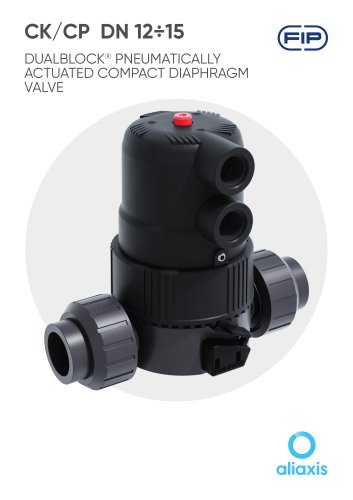 CK/CP DN 12÷15
17 Pages
 PIPE ISO-UNI
10 Pages
 FLS
FLS228 Pages
 PP-H
PP-H254 Pages
 PVC-U
PVC-U460 Pages
 PVC-U Fittings
114 Pages
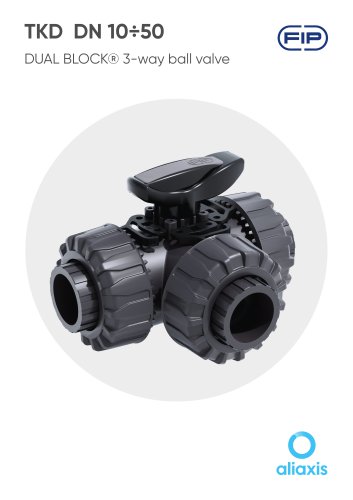 TKD DN 10÷50
19 Pages
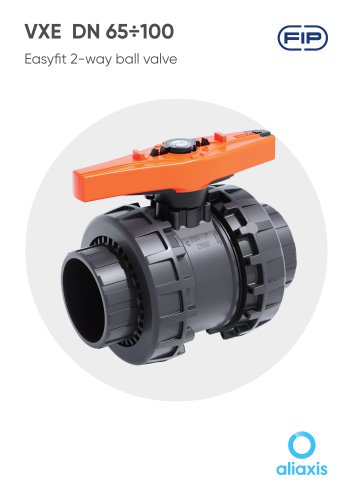 VXE DN 65÷100
13 Pages
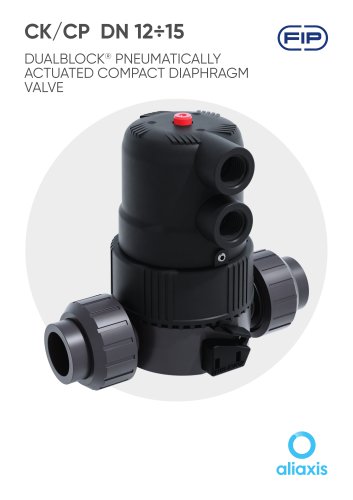 CK/CP DN 12÷15
17 Pages
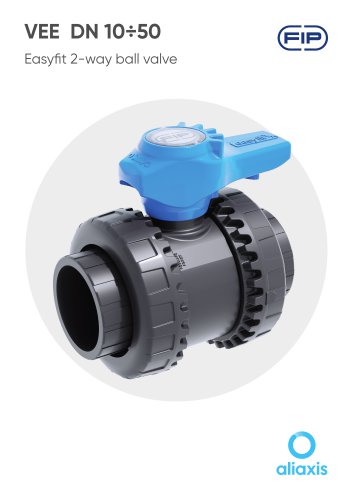 VEE DN 10÷50
15 Pages
Archived catalogs
 PVC-U PRESSURE PIPE
6 Pages
 SXE-SSE 2024
13 Pages
 SXE-SSE DN 10÷50
17 Pages
 VM/RM DN 8÷15
6 Pages
 DK DN
DK DN16 Pages
 VXE EASYFIT DN 65-100
20 Pages
 VEE EASYFIT DN 65-100
16 Pages
 Corporate presentations
12 Pages
 VKD DN 10÷50
16 Pages
 FE DN 40÷200
14 Pages
 Swimming Pool&Spa Solutions
28 Pages
 Chemical Industry Solutions
28 Pages
 Water Treatment solutions
28 Pages
 DK DN 15÷65
16 Pages
 DK/CP DN 15÷20
20 Pages
 SXE-SSE
24 Pages
 VKD Dual Block
6 Pages
 VEE Easyfit Promotional Brochure
16 Pages
 FKOV/FM D355 - D400 ISO-DIN
2 Pages
 VXE Easyfit Promotional Brochur
16 Pages
 PVC-U Manual Valves
246 Pages
 New VKD Ball Valve Dual Block
14 Pages
 PP-H (100) System
198 Pages
 C-PVC TemperFIP 100 System
165 Pages
 PVDF System
141 Pages
 Variable Area Flowmeters
14 Pages
 MAGNUM System and Clamp Saddles
12 Pages
 DK DIALOCK 2017
12 Pages

