
- Catalogs
- FIP - Formatura Iniezione Polimeri
- Manual valves, fittings, compression fittings, clamp saddles 2024


- Company
- Products
- Catalogs
- News & Trends
- Exhibitions
Manual valves, fittings, compression fittings, clamp saddles 2024
1 /195Pages

Manual valves, fittings, compression fittings, clamp saddles 2024
1 /195Pages
Catalog excerpts

Technical catalogue Manual valves, fittings, compression fittings, clamp saddles Pressure piping fluids conveying
Open the catalog to page 1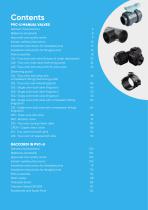
Contents PVC-U MANUAL VALVES General characteristics Reference standards Approvals and quality marks Solvent welding instructions Installation instructions for threaded joints Installation instructions for flanged joints Main properties 724- True union ball valve (Industry & water treatments) 420- True union ball valve (Swimming pools) 426- True union ball valve with PE union ends (Swimming pools) 334- True union ball valve with compression fittings (Swimming pools) 322- True union ball valve (Irrigation) 302- Single union ball valve (Irrigation) 303- Single union ball valve (Irrigation) 304-...
Open the catalog to page 3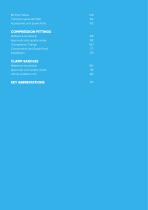
Transition Series BS/BSP Accessories and Spare Parts COMPRESSION FITTINGS Reference standards Approvals and quality marks Compression Fittings Components and Spare Parts CLAMP SADDLES Reference standards Approvals and quality marks
Open the catalog to page 4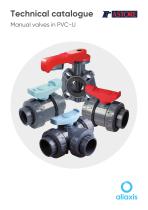
Technical catalogue Manual valves in PVC-U
Open the catalog to page 5
General characteristics PVC-U Developed in 1930 in Germany, PVC-U (rigid polyvinyl chloride - unplasticized) is obtained through the polymerization of a vinyl chloride monomer. The presence of chlorine in the PVC-U molecule results in a high performance resin, in terms of thermal stability and chemical and mechanical resistance, up to temperatures of 60° C. The different formulations obtained by adding suitable additives and stabilizers render the PVC-U the most versatile of all plastic materials, allowing it to be adapted to many applications involving fluids under pressure. PVC-U represents...
Open the catalog to page 6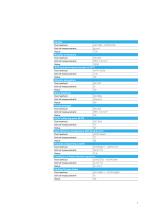
Density Test method ISO 1183 - ASTM D792 Unit of measurement g/cm3 Value 1,38 Modulus of elasticity Test method ISO 527 Unit of measurement MPa = N/mm2 Value 3200 IZOD notched impact strength at 23°C Test method ASTM D256 Unit of measurement J/m Value 50 Ultimate elongation Test method ISO 527 Unit of measurement % Value 50 Shore hardness Test method ISO 868 Unit of measurement Shore D Value 80 Tensile strength Test method ISO 527 Unit of measurement MPa = N/mm2 Value 50 VICAT softening point (B/50) Test method ISO 306 Unit of measurement °C Value 76 Heat distortion temperature HDT (0.46 N/mm2)...
Open the catalog to page 7
Reference standards PVC-U Production of the ASTORE valves is carried out according to the highest quality standards and in full compliance with the environmental restrictions set by the applicable laws in force and in accordance with ISO 14001. All products are made in accordance with the quality guarantee system in compliance with ISO 9001. l BS 4346-1 Joints and fittings for use with solvent weld PVC pressure pipes l Pipe threads where pressure tight joints are made on the threads. Part 2: Taper external threads and taper internal threads - Dimensions, tolerances and designation l EN ISO 1452...
Open the catalog to page 8
Approvals and quality marks l ACS France (Attestation de conformité Sanitaire) Suitability of PVC-U and PVC-C for drinking water l WRAS (Water regulations advisory scheme - UK) Suitability of PVC-U for transporting potable water l OQC by NSF ASTORE products are OQC certified, Certificate of Controlled Origin by NSF. NSF with the brand OQC (Origin and Quality controlled) also declare the suitability of the products for transporting potable water. For the detailed list of certified products please refer to OQC on the www.nsf.org site
Open the catalog to page 9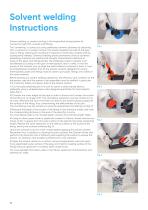
Solvent welding Instructions Solvent welding, or cement jointing, is the longitudinal joining system for connecting rigid PVC-U pipes and fittings. The "cementing" is carried out using adhesives/cements obtained by dissolving PVC-U polymer in a solvent mixture. This solvent liquefies the walls of the pipe and/or fitting, allowing the constituent material to chemically combine and be subsequently welded. Chemical welding allows permanent joints be achieved possessing chemical and mechanical strength characteristics identical to those of the pipes and fittings joined. The adhesives/solvent cements...
Open the catalog to page 10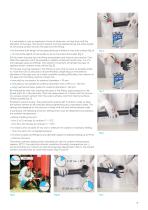
It is advisable to use an applicator/brush of dimension not less than half the diameter of the pipe. The solvent cement must be applied along the entire length of the joining surface of both the pipe and the fitting: l l for the entire joint length of the pipe previously marked on the outer surface (fig. 6) for the entire depth of the socket as far as the internal shoulder (fig.7) 6) Fully insert the pipe into the fitting immediately and without any rotation. Only after this operation will it be possible to slightly rotate both ends (max. 1/4 of a turn between pipe and fitting). This rotation...
Open the catalog to page 11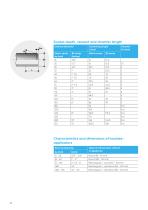
Socket depth, cement and chamfer length External diameter Metric series Characteristics and dimensions of brushesapplicators External diameter Type and dimensions of Brush or Applicator
Open the catalog to page 12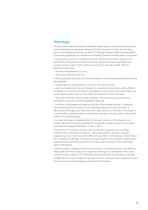
Warnings l In the case where the external diameter of the pipe and the internal diameter of the fitting are at opposite extremes of their tolerance values, the dry pipe cannot be inserted in the dry socket of the fitting. Insertion will only be possible after having applied the Cleaner and Solvent Cement to both parts to be joined. l The solvent cement is manufactured from the same PVC resin used for the production of the pipes, fittings and valves. Unless otherwise specified, the solvent cement used on the surfaces to join must also be usable with the following tolerances: - maximum interference...
Open the catalog to page 13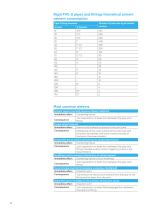
Rigid PVC-U pipes and fittings theoretical solvent cement consumption Pipe/Fitting diameter d (mm) Number of joints per kg of solvent cement Most common defects Solvent cement too fluid (incorrect diluent addition) Immediate effect Cementing failure Consequence Joint separation or leaks from between the pipe and fitting Excess solvent cement Immediate effect Internal and external runs beyond the joint zone Consequence Weakening of the outer surface of the joint area and formation of bubbles with micro-cracks/sources of fracture in the base material Excessively dense solvent cement due to evaporated...
Open the catalog to page 14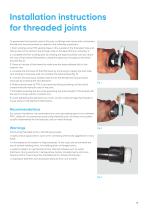
Installation instructions for threaded joints ISTRUZIONI ISTRUZIONI ISTRUZIONI PER INSTALLAZIONE PER INSTALLAZIONE PER INSTALLAZIONE DI GIUNZIONI DI GIUNZIONI DIFILETTATE GIUNZIONI FILETTATE FILETTATE To guarantee the hydraulic seal of the joint on fittings and valves with a threaded Fig. 1 1 Fig. female end, we recommend you perform the following operations: 1. Start winding some PTFE sealing tape on the outside of the threaded male end, taking care not to obstruct the through-hole on the pipe, fitting or valve (fig. 1); 2. Complete the first winding layer by winding the tape clockwise until...
Open the catalog to page 15All FIP - Formatura Iniezione Polimeri catalogs and technical brochures
 SXE-SSE 2024
13 Pages
 PVC-U PRESSURE PIPE
6 Pages
 FITTINGS PVC-U
134 Pages
 FS - FC
16 Pages
 S1 - S2
12 Pages
 Water Treatment solutions
28 Pages
 Chemical Industry Solutions
28 Pages
 Swimming Pool&Spa Solutions
28 Pages
 PVC-U Fittings
114 Pages
 FE DN 40÷200
14 Pages
 VKD DN 10÷50
16 Pages
 Corporate presentations
12 Pages
 TKD Dual Block
14 Pages
 VEE EASYFIT DN 10-50
16 Pages
 VEE EASYFIT DN 65-100
16 Pages
 VXE EASYFIT DN 10-50
16 Pages
 VXE EASYFIT DN 65-100
20 Pages
 DK DN
DK DN16 Pages
 DK CP
DK CP45 Pages
 VM/RM DN 8÷15
6 Pages
 SXE-SSE DN 10÷50
17 Pages
 DK DN 15÷65
16 Pages
 DK/CP DN 15÷20
20 Pages

Archived catalogs
 SXE-SSE
24 Pages
 VKD Dual Block
6 Pages
 VEE Easyfit Promotional Brochure
16 Pages
 FKOV/FM D355 - D400 ISO-DIN
2 Pages
 VXE Easyfit Promotional Brochur
16 Pages
 PVC-U Manual Valves
246 Pages
 New VKD Ball Valve Dual Block
14 Pages
 PP-H (100) System
198 Pages
 C-PVC TemperFIP 100 System
165 Pages
 PVDF System
141 Pages
 Variable Area Flowmeters
14 Pages
 MAGNUM System and Clamp Saddles
12 Pages
 DK DIALOCK 2017
12 Pages


- Liebherr control valve
- Liebherr flow meter
- Liebherr stainless steel valve
- Liebherr hydraulic fitting
- Liebherr water valve
- Liebherr screw-in fitting
- Volume flow monitor
- Liebherr pneumatic valve
- Liquid flow monitor
- Liebherr solenoid valve
- Liebherr threaded valve
- Liebherr metal fitting
- Liebherr regulating valve
- Liebherr liquid filter
- Liebherr flange valve