

M, MH
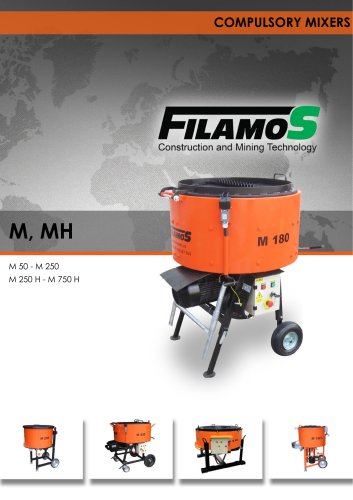
M, MH
Field of Application
Compulsory mixers are specialized machines designed for mixing wet, moist, and dry mixtures used in construction, metallurgy, foundry industries, and other industrial applications. Their key advantage is rapid and thorough mixing—4 to 5 times faster than traditional drum mixers—resulting in high-quality final mixtures. Additional benefits include robust construction for demanding environments, minimal maintenance, enhanced safety features, and customizable modifications.
Working Principle
The mixers operate using high-speed rotating mixing arms inside a static mixing tank. These arms simultaneously stir and scrape the mixture from the tank’s sides and bottom. The mixing arms are adjustable in height and sideways and can be fitted with rubber spatulas. Basic models use a three-arm fork that rotates to ensure thorough mixing. For heavy refractory mixtures, specialized raking or mixer blades are used.
Machine Description - M Series
The M series mixers feature an upper cover with a separating comb to prevent spillage, a discharge segment operated manually or hydraulically, and a mixing unit tailored to the mixture type. The mixing tank can have replaceable linings made from standard or abrasion-resistant HARDOX steel. The frame is height-adjustable and equipped with wheels for models M50 to M250. Safety is ensured by a position switch that cuts power if the cover opens during operation, and a no-voltage release prevents automatic restart after power failure.
Control is via a control box with start, stop, and emergency stop buttons. The mixers use worm or helical bevel gearboxes, with electric motors ranging from 1.5 kW to 5.5 kW depending on model size. Mixing speeds range around 36-51 rpm, with torque from 227 to 1459 Nm. Tank volumes range from 74 to 330 liters, with theoretical usable volumes adjusted based on material type (e.g., 60% for refractory concrete, 70% for powdery dry materials).
Key Parameters - M Series
- Tank diameters: 580 to 1000 mm
- Tank heights: 280 to 420 mm
- Weight: 96 to 390 kg (varies with lining and output)
- Max grain size: 4 to 8 mm
- Power: 1.5 kW to 5.5 kW
Machine Description - MH Series
The MH series is designed for larger capacity and heavier-duty mixing. It includes an upper cover with a separating comb (optionally hydraulic), a discharge segment (manual or hydraulic), and a mixing tank with replaceable linings from standard or HARDOX abrasion-proof steel. The frame is stationary, robust, and designed for forklift handling, with lifting eyes for crane use.
Control is via a control box with emergency stop and optional frequency inverter for variable stirrer speed. Models with motor outputs of 5.5 kW and above include a soft starter for smooth startup. Safety features mirror the M series, including position switches and no-voltage release.
Key Parameters - MH Series
- Tank volumes: 487 to 1053 liters
- Theoretical usable volumes: 246 to 678 liters
- Tank diameters: 1100 to 1600 mm
- Tank heights: 520 to 1520 mm
- Weight: 605 to 1340 kg (depending on lining and output)
- Power: 7.5 kW to 22 kW
- Mixing speeds: 27 to 36 rpm
- Torque: 1990 to 7246 Nm
- Max grain size: 32 mm
Filling and Discharge
Mixtures are loaded through a screened cover equipped with a separating comb to prevent spillage and contamination. For dusty or thin mixtures, an optional cover sheet metal can be added to prevent leaks. Discharge is performed by rotating a movable segment at the tank bottom, either manually or hydraulically (optional surcharge).
Safety and Controls
Both series include position switches that cut power if the cover is opened during operation and prevent starting with an open cover. The no-voltage release feature prevents automatic restart after power outages. Emergency stop buttons with locking are standard. Control boxes provide start, stop, and emergency functions, with optional frequency inverters for speed control in some models.
Mixing Blades and Linings
Mixing blades vary by mixture type: standard mixing blades I and II, raking blades for heavy refractory mixtures, and specialized blades for certain materials. Tanks can be lined with standard steel or abrasion-resistant HARDOX plates to extend durability, especially when mixing abrasive materials.
Recommendations and Usage Notes
- Select mixer size based on required volume and power, considering material characteristics such as stickiness, liquidity, and abrasiveness.
- Theoretical usable volume varies by material type: refractory concrete (~60%), powdery dry materials (~70%), transport concrete (~70%), and liquid materials (~90%).
- Power and torque must be matched to mixture density and volume for optimal mixing performance.
- Custom modifications are available to meet specific customer requirements.
Summary Tables and Data Highlights
Tables provide detailed specifications for each model, including motor power, gearbox type, mixing capacity by material type, rotation speed, torque, voltage, current supply, tank dimensions, and weight. These data assist in selecting the appropriate mixer model for specific industrial applications.
Catalog excerpts
COMPULSORY MIXERS Použití stroje 3 Míchačky s nuceným oběhem slouží k míchání mokrých a zavlhlých směsí ve stavebnictví, v hutnickém a slévárenském průmyslu, k průmyslovému míchání hmot apod. Jejich hlavní předností je dokonalé promíchání jednotlivých složek směsi ve velmi krátkém čase (rychlost míchání je 4-5krát vyšší než u klasické bubnové míchačky), čímž je dosaženo vysoké kvality výsledné směsi. 3 Míchačka s nuceným oběhem funguje na principu míchacích ramen rotujících vysokou rychlostí kolem vnitřní osy statické míchací nádrže. Míchání je prováděno několika rameny, která zároveň zajišťují stírání směsi z boku i celého dna míchací nádoby. Míchací ramena jsou nastavitelná jak výškově tak do stran a mohou být vybavena pryžovými stěrkami. V základním provedení tvoří jedno z ramen tříramenná vidlice, jejíž samovolný krouživý pohyb zajišťuje kvalitní promíchání směsi (viz. míchací lopatky I / míchací lopatky II). U těžkých žárobetonových směsí se pro dokonalé promíchání směsi používají míchací lopatky I nebo speciálně upravené hrabací lopatky. 3 Plnění směsi se provádí přes síto ve víku míchačky, které je opatřeno trhacím hřebenem pro pytlované směsi. Konstrukce víka dokonale zabraňuje vytékání materiálu po bocích nádrže. V případě potřeby je možno víko míchačky opatřit krycím plechem zabraňujícím úniku materiálu u řidších či prašných směsí. 3 Vypouštění namíchaného materiálu se provádí pootočením posuvného segmentu na dně nádoby. 3 MÍCHADLA (v návaznosti na charakter směsi volitelné 4 NÁDOBA může být pro míchání abrazivních materiálů opatřena vyměnitelným vyložením ze standardního nebo otěruvzdorného materiálu. 4 MANIPULAČNÍ MADLO 4 M řada - standardní konstrukce s pojezdovými koly 4 KONCOVÝ SPÍNAČ - odpojí běžící stroj od elektrické energie v případě otevření víka při provozu 4 VÝŠKOVĚ STAVITELNÉ PODPĚRY 4 HORNÍ VÍKO S TRHACÍM HŘEBENEM lze řešit na přání zákazníka speciální úpravou 4 VÝPUST MÍCHAČKY je standardně řešena manuálně, za příplatek lze materiál vypouštět přes hydraulický mechanismus 4 ROZVADĚČ - Standardní provedení stroje je s konstantním počtem otáček, za příplatek
Open the catalog to page 1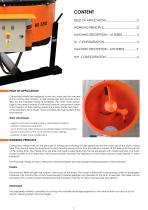
FIELD OF APPLICATION Compulsory mixers are designed to mix wet, moist and dry mixtures in the construction industry, in the metallurgic and foundry industries, for the industrial mixing of materials, etc. Their main advantage is the perfect mixing of individual mixture components within a short period of time (mixing speed is 4-5 times faster than that of the standard drum mixer), which provides the high quality of the final mixture. Other advantages: - rugged construction enabling work in demanding conditions - minimal maintenance operation - use of enhanced safety features (no-voltage trigger,...
Open the catalog to page 2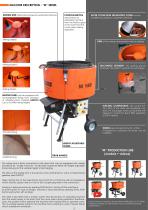
MACHINE DESCRIPTION - “M” SERIES MIXING UNIT (alternatives based on estimated mixture) POSITION SWITCH disconnects an operating machine from the mains supply in the event that the cover opens during operation. UPPER COVER WITH SEPARATING COMB can be modified according to customers demand HEM of the mixing tank prevents mixture spillage DISCHARGE SEGMENT with guiding groove (manual in standard / hydraulic for surcharge) Raking blades MIXING TANK can be equipped with exchangeable linings from standard or abrasion-proof material HARDOX (up to its utility mixing height). ELECTRIC CONTROLBOX with...
Open the catalog to page 3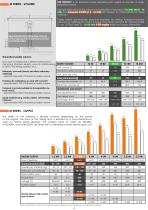
THE DENSITY is an important value describing the weight of one liter of finally prepared mixture The right alternative of the mixer is a combination of necessary VOLUME (M 50 - M 250) and adequate POWER (1,5 - 5,5 kW) with respect to characteristics of mixed material Tables below demonstrate practical example for mixing Transport-concrete (density e.g. 2.200 kg/m3, that is 2,2 kg/l). For proper mixing of 80 l mixture (Table 1), ca. 176 kg (Table 2) - M125 with 3 kW engine might be a good alternative Theoretical usable volume: Each type of material has a different behaviour by mixing (e.g. stickiness,...
Open the catalog to page 4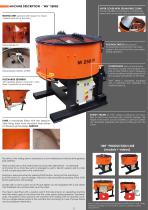
MACHINE DESCRIPTION - “MH” SERIES UPPER COVER WITH SEPARATING COMB can be modified according to customers demand and can be also operated hydraulically MIXING UNIT (optional with respect to mixed material and size of the tank) POSITION SWITCH disconnects an operating machine from the mains supply in the event that the cover opens during operation. CONTROLBOX with control buttons machine is usually with standard numbers of stirrer rotation (rpm), frequency invertor enabling variable speed of stirrer is possibly being fitted on demand. DISCHARGE SEGMENT “MH” Series is standardly equipped with a...
Open the catalog to page 5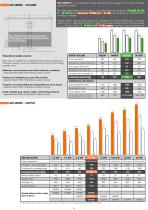
THE DENSITY is an important value describing the weight of one liter of finally prepared mixture The right alternative of the mixer is a combination of necessary VOLUME (M 250 H - M 750 H) and adequate POWER (7,5 - 22 kW) with respect to characteristics of mixed material Tables below demonstrate practical example for mixing Refractory concrete (density e.g. 1.900 kg/m3, that is 1,9 kg/l). For proper mixing of 250 l mixture (Table 1), ca. 476 kg (Table 2) - M 550 H with 11 kW engine might be a good alternative Each type of material has a different behaviour by mixing (e.g. stickiness, liquidity,...
Open the catalog to page 6
Archived catalogs
- Pump
- Industrial pump
- Pump with electric motor
- Stationary pump
- Seawater pump
- Self-priming pump
- Dynamic agitator
- Compact pump
- Metering pump
- Drilling rig
- Materials handling pump
- High-pressure pump
- Rotary drilling rig
- Construction blender
- Pump for the construction industry
- Spray pump
- Injection pump
- Hydraulic motor pump
- Spraying machine
- Mobile concrete mixer