100Y Poster
100Y Poster
Festool, originally known as Festo, has a rich history of innovation in the power tool industry, driven by a commitment to quality and user-oriented design. Founded in 1925 by Gottlieb Stoll and Albert Fezer, the company has consistently introduced groundbreaking tools that have transformed craftsmanship.
Key Innovations and Products
- Hand-held Power Tools: In response to the changing needs of tradespeople, Festool focused on developing innovative hand-held power tools that are portable and efficient, particularly for use on building sites.
- ROTEX RO 1 Sander (1979): This tool combined three functions in one, revolutionizing sanding and polishing tasks.
- OF 1 Router (1980s): Set new standards in precision for woodworking, alongside the first pendulum jigsaws.
- DOMINO Jointing Machine (2006): Simplified milling and dowel insertion in wooden joints, offering precision and stability.
- Guide Rails (1962): Introduced for precise, straight cuts, evolving into the FS/2 guide rail system.
- Systainer System: A versatile packaging solution that protects tools and enhances mobility.
- Plunge-cut Saws: Known for their cutting performance and durability, these saws have been a staple since 1980.
- Dust Extraction (1966): Pioneered with the RTT-S orbital sander, improving safety and cleanliness.
- ExoActive Exoskeleton (2023): A cutting-edge tool providing additional strength for various construction tasks.
Company Evolution
Festool has undergone several transformations, including a name change from Festo to Festool in 2000. The company remains committed to its core values of pragmatism and quality, with a focus on developing innovative tools and systems.
Production and Growth
The Neidlingen plant, a key production site since 1951, has been recognized for its outstanding production processes. Festool continues to expand, with a new plant in Weilheim designed for energy-efficient manufacturing.
Commitment to Safety and Health
Festool has been a leader in product safety, with innovations like the TKS 80 table saw featuring SawStop AIM technology and the KickbackStop function for plunge-cut saws.
Conclusion
Festool's history is marked by a dedication to craftsmanship and innovation, ensuring that their tools make everyday work easier, more productive, and safer. As they celebrate 100 years, Festool continues to look towards the future with a commitment to excellence.
Catalog excerpts
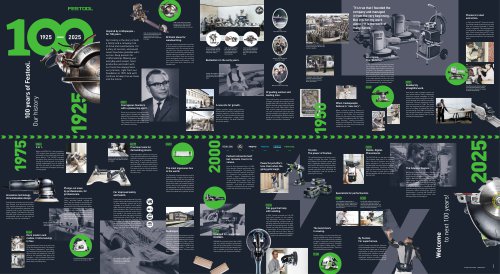
“It’s true that I founded the company and managed it from the very beginning. But it is not my work alone – it is the work of many hands.” 1930: It looks hefty from today’s perspective, but back then was considered very neat: The first mobile SB126 portable circular saw. Brilliant ideas for woodworking. From the outset, the pioneers from Fezer & Stoll wanted to make work easier for craftspeople. How? For example by saving them from having to lug the heavy timber to the machine for processing, but instead making it possible for the tool to come to the timber. Even the very first tools developed during the founding years were flexible and versatile – and you could take them wherever you needed them. 1932: Precision in a large format: the ZUM 140 chain mortiser for slot-milling and groove-cutting. The success of the company is the success of everyone. We work and celebrate together. 1948: The AE 85 pendulum cover saw was considered the flagship among saws due to its impressive saw blade. 1938: The MTD and KTD disc sanders were the first sanding machines with patented integral dust extraction. 1940s Wilfried, Kurt, Gerda Stoll (from left to right) Bestsellers in the early years. The BD 125 portable circular saw from the year 1938 was popular amongst carpenters and joiners alike. In 1951, the first Rutscher was launched. The original, with a protected name, is only available from Festool, then known as Festo. The Rutscher replaced the time-consuming task of working with the hand sanding block and paved the way for mechanical fine sanding. It is the start of an unprecedented success story that continues to this day: As a compact cordless orbital sander for various trades. “Roadshow” in the 1950s: Close customer contact has always been intensively cultivated at Festo, now Festool. 1950s Wilfried and Kurt Stoll (right) Of guiding women and leading men. 1925 Courageous founders with a pioneering spirit. A new site for growth. Festo’s product range was growing. Demand was increasing. Production was reaching capacity. A new building was needed, just a few hundred metres away from the headquarters – bigger, better and more modern. The ideal conditions for further growth. Driven by a mixture of courage and pioneering spirit, Gottlieb Stoll, along with Albert Fezer, founded the company Fezer & Stoll in Esslingen am Neckar in 1925. Albert Fezer left at the start of the 1930s. Their names live on in the brands Festo and Festool to this day. 1984 Precision tools for demanding joiners. When the ROTEX RO 1 was launched in 1979, experts were amazed: Combining three tools in one sander had never been done before. The ROTEX masters everything from coarse to fine sanding through to polishing and is a favourite among tradespeople from all walks of life. Over the years, the all-rounder has been continuously developed, becoming a living legend. The OF 1 router in the 1980s was an archetype for many different successor models. Plunge-cut saws by professionals, for professionals. Innovative technology. Unmistakeable design. 1980 saw the first in a series of successful Festo – and later Festool – plunge-cut saws. Over the decades, the plunge-cut saw family has grown and flourished – driven by the aim of offering an even better solution to craftspeople with every new generation. All of the saws have one thing in common: When it comes to cutting performance, weight, handling and precision, they are simply outstanding and almost indestructible. Professionals consider tools from Festo, later Festool, to be technically brilliant, user-friendly and ergonomic. In the late 1970s, this outstanding reputation was matched with a new, unmistakeable product design: The Mauritius blue and Festo(ol) green colours are immediately recognisable. And to this day they are much more than just a trademark. Plunge-cut saws and guide rails have been inseparable for more than 40 years. For improved safety and health. Festool reinvents itself but remains true to its values. The most ingenuous box in the world. The Systainer revolutionised the world of craftsmanship. It began with an idea to develop packaging that not only protected the product, but could also be reused. The result was a stable, yet versatile Systainer system, which is now enjoyed by millions of tradespeople. The Systainer has become the ultimate benchmark: Everything that makes you mobile has a Systainer format. Fezer & Stoll became Festo. In 2000, Festo became Festool and found a new home in Wendlingen. The essence of Festool is and will continue to be what our products have always demonstrated. Legacy: Pragmatism and absolute quality awareness – with the “made in Germany” label. Drive: The development of innovative tools and systems – with and for customers. Products: Innovative and user-oriented, robust and extremely long-lasting. Powerful yet effortless. Even when the going gets tough. When it comes to sawing, Festool, or Festo as it was back then, is ahead of the game. In the 1950s, the machines became increasingly compact and easier to handle. The legendary AAU 50 “Sägehexe” (literally, “sawing sorceress”) weighs just 4 kilograms. This means that customers can now work precisely and safely with one hand. Neidlingen The Neidlingen plant has been one of the company’s most important production sites since 1951. Expanded and comprehensively modernised in 1986, it won an award for “Outstanding Production Processes” in 2002 and again in 2005 for the “Best Assembly System”. It was even given the highest honour, “Factory of the Year”, in 2008. The rapid development of battery technology changed the trade. Cordless tools deliver the necessary power with the Li-HighPower battery packs. Today, the Festool 18V system comprises powerful products, perfectly designed for manual operation and optimised for each application. And the portfolio is growing all the time. The TKS 80 registers contact with human skin via a sensor and stops the saw blade in less than five milliseconds. The CSC SYS 50 is a real game changer. The cordless table saw is so compact that it fits into a Systainer and can be taken anywhere. It is the world’s first portable table saw with digital height and angle adjustment. Functions and settings can be modified using the Festool app. This app is a great asset to make the best possible use of tools, not just for the CSC SYS. 2006 Invented for connection. DOMINO. DOMINO first saw the light of day in 2006 and very quickly became synonymous with a truly unique product. The jointing machine makes milling and dowel insertion in wooden joints much easier and more precise, with impressive stability. In 2009, Festool launched the LHS 225 long-reach sander on the market. The adjustable vacuum suction is a ground-breaking innovation that significantly reduces the strain on the arms and back during sanding work. In 2020, Festool was ready for the next advance in technology: A circumferential LED light ring that acts like a built-in spotlight was added to the sanding head of the enhanced PLANEX. The CONTURO 65 edge bander is a specialist for furniture edging worthy of being called “perfect”. What’s more, the CONTURO is portable and can be used anywhere. The ISC 240 cordless insulation saw revolutionised cutting insulating materials and rigid foam panels. It is extremely flexible and even insulates against escalating workloads. The benchmark in sawing. Festool plunge-cut saws have been setting the standard for saws for decades. The TS 60 K has redefined this standard yet again. It saws like a hot knife through butter, combining precision, flexibility and the highest cutting quality – whilst also offering enhanced safety. Thanks to the KickbackStop function. 2012 The first AXF 45 plunge-cut saw was launched on the market in 1980. 2023 Mobile. Digital. Phenomenal. 18 volts. The power of Festool. 2009 Tall guys that help with sanding. The efficient, clean extraction system is not just used by painters, carpenters and joiners, but even for sanding in vehicle manufacturing. How do you make a straight, precise cut over several metres? Every craftsperson knows the answer nowadays. In 1962, Festool, then Festo, brought the first generation of guide rails to market, a sensation at the time. This was replaced by the new aluminium version in 1980. Two years later, the integrated splinter guard in the form of a rubber lip allowed for splinter-free sawing. Since 2003, the FS/2 guide rail has been produced in countless variants for the most diverse jobs. It’s now considered indispensable. When tradespeople believe in “saw-cery”. Festool was an early advocate of greater product safety and health protection with its dust extraction system and is still regarded as a pioneer in the industry today. Numerous patents and technologies contribute to this. These include the active vibration protection on the eccentric sanders, the quick-acting safety brake on the saws and planers and later the introduction of the TKS 80 – the first table saw with electronic SawStop AIM technology in Europe. Festool has developed an intelligent KickbackStop function for the latest generation of cordless plunge-cut saws and cordless drills. 1975 More modern and mobile. Craftsmanship in flux. The building boom came to an end in the 1970s. But change was afoot. The needs of the “modern tradesperson” were changing. Stationary machines were increasingly seen as heavy and expensive. From this point on, the company really plays to its strengths – with innovative hand-held power tools that make work much easier, particularly on building sites. Rounding edges, milling cut-outs, profiling, grooving: Milling is the unofficial supreme discipline of woodworking. Every tenth of a millimetre counts. When the OF 1 router was launched in the mid-1980s, it did more than just set new standards in terms of precision. The same is true of the first pendulum jigsaws, which were released around the same time. Festo had become a successful family company, managed by company founder Gottlieb Stoll and his two sons Kurt and Wilfried, and later greatly aided by Gottlieb Stoll’s son-in-law Peter Maier. Berta Stoll, as wife, mother and business partner, was a significant figure who was actively involved in the company. The fact that her granddaughter, Barbara Austel, would go on to play a formative role at Festool is no surprise in retrospect. By Festool. For superheroes. In 2023, Festool launched the ExoActive active exoskeleton with an 18-volt battery. It not only looks space-age, it also gives superheroes an extra bit of strength for their building work. Whether dry mortarless construction or painting, sanding or installation, whether on walls or ceilings – ExoActive actively lends a helping hand. The future of Festool. Wendlingen is the beating heart of Festool. Around 80 percent of Festool machines are produced in Germany. The new Festool plant in Weilheim is a commitment to the region where the company has had deep roots for 100 years. Together with Neidlingen, it was named “Factory of the Year” in 2024 and is designed to manufacture our products energy-efficiently without wasting resources, while meeting the highest requirements – proving that Festool still has its sights firmly on the future, even 100 years after its foundation. 100 years of Festool. Our history Our history is the story of both a family and a company, full of drive and inventiveness. It’s a story of success, and would never have been possible without our deep passion for craftsmanship. Making your everyday work easier, more productive and safer with our tools has always been our promise, right from our foundation in 1925. And we’ll continue to keep it as we move into the future. 1936: The first portable one-man chainsaw was produced for heavy manual work on site, which needed at least four strong hands in the past. 1930s Berta Stoll at the wheel In 1966, the Festo RTT-S was the world’s first orbital sander that did not just catch dust, but actively extracted it. Exactly where it originates. This development is a milestone for customers and the company. Since the day that the RTT-S was launched, no new hand-held machine has been produced without a dust extraction device
Open the catalog to page 1All Festool catalogs and technical brochures
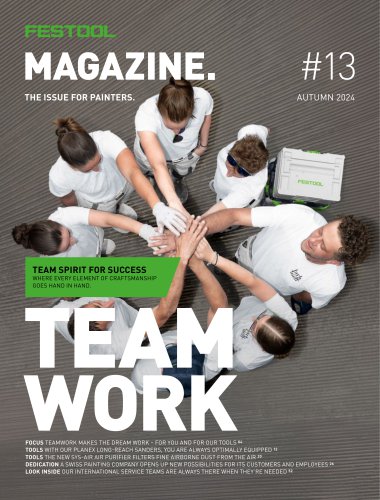
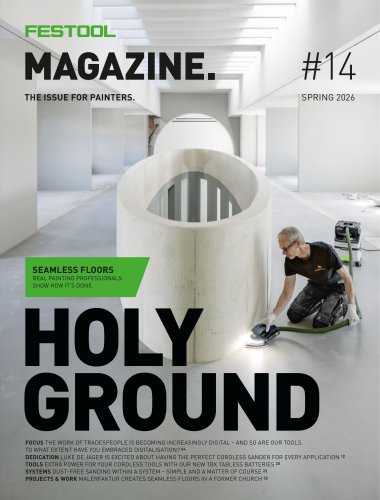 THE ISSUE FOR PAINTERS
44 Pages
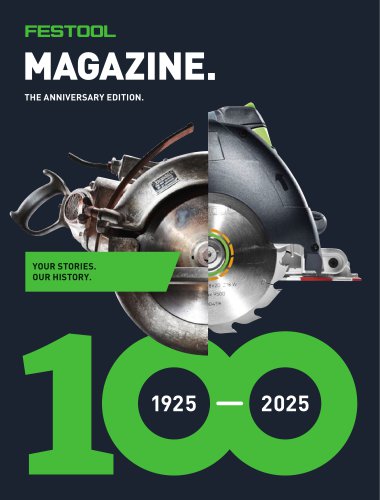 THE ANNIVERSARY EDITION
84 Pages
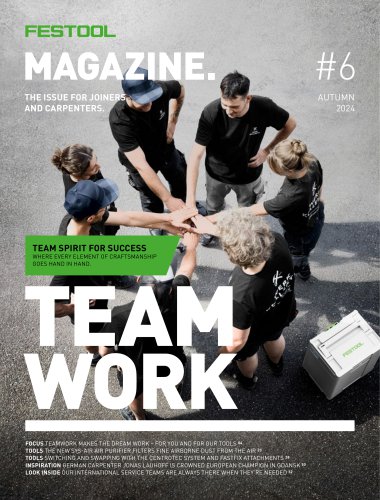
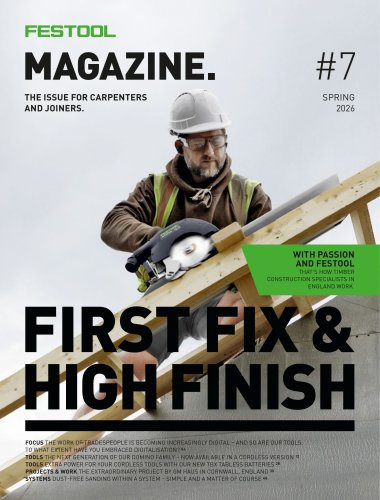
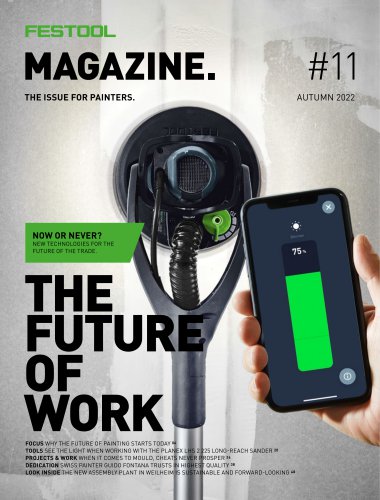
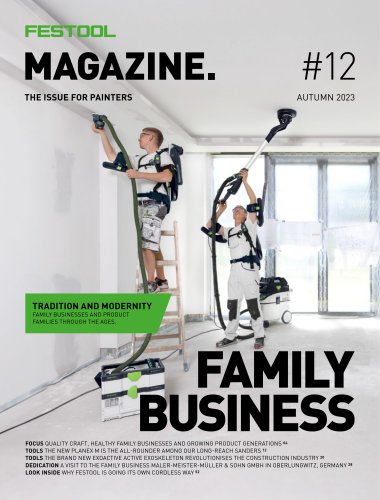
Archived catalogs
 Catalogue 2019
438 Pages
 Festool Catalogue 2017
434 Pages
 Catalogue 2020
352 Pages
 routing system brochure
36 Pages
 Edge trimming
3 Pages
 Circular saw TS 55 R
8 Pages
 Groove cutting
4 Pages
 EXTRACTION Product range
26 Pages
 SAWING Product range
28 Pages
 Festool Catalogue 2016
422 Pages
 CMS brochure
14 Pages
 sawing system brochure
28 Pages
 MFT 3 brochure
12 Pages
 p2010_broschfambs
14 Pages