
- Catalogs
- Feinmetall GmbH
- contact probes


- Products
- Catalogs
- News & Trends
- Exhibitions
contact probes

contact probes
This document provides an overview of contact probes used for wire harness and connector testing, including types such as switch probes, step probes, threaded probes, and push back probes. It emphasizes the importance of using original products for traceability and highlights the company's commitment to quality and customer service.
FEINMETALL prioritizes customer collaboration, offering international service with subsidiaries and partners worldwide, ensuring high delivery performance through local stocks and customs certifications.
Quality control is integral to FEINMETALL's processes, known for its expertise in electronic component contact solutions, offering a wide range of applications from board tests to wire harness tests.
FEINMETALL is recognized for its innovative solutions in test engineering, with many patented technologies. Contact probes are laser-marked for traceability, and the company is certified according to DIN ISO 9001.
The company adheres to current environmental and health regulations, with detailed statements available on their website.
The catalogue includes various types of probes, each suited for specific applications, such as switch probes for switching applications, step probes for position tests, threaded probes for secure connections, and push back probes for push-back functionality.
Spring contact probes consist of a plunger, barrel, and spring, made from materials like beryllium-copper and steel, chosen for their mechanical properties and electrical conductivity.
The spring force is crucial for ensuring contact quality without damaging the surface, emphasizing the importance of not exceeding recommended travel to maintain probe longevity.
FEINMETALL offers a comprehensive range of contact probes designed for precision and reliability in electronic testing, focusing on quality, innovation, and customer service.
The document discusses various plating materials used for contact probes, highlighting their properties and applications, such as chemical nickel for wear resistance, rhodium for abrasion resistance, silver for conductivity, and gold for chemical durability.
Various types of spring contact probes are described, including ICT/FCT probes, fine pitch probes, battery contacts, interface probes, threaded probes, high current probes, switch probes, and Kelvin probes.
The life cycle of spring contact probes depends on design and operating conditions, with life cycle tests conducted under controlled conditions to evaluate performance.
Receptacles are used for mounting spring contact probes, available in plug-in or threaded types, offering different electrical connections like solder, crimp, and wire wrap.
The document outlines factors affecting contact resistance, such as material conductivity and contact forces, with specified operating temperature ranges.
The document discusses the dielectric strength of insulators, crucial for products with insulating functions like switching probes and receptacles.
FEINMETALL conducts high current tests to define the maximum current a contact probe can handle, with self-heating measured and nominal current determined based on temperature rise.
Derating involves reducing operating current as temperatures increase, with diagrams illustrating the relationship between temperature and current.
Power loss in high current probes should be minimized through design and material choices, emphasizing low internal and contact resistance.
Factors affecting the pointing accuracy of spring contact probes include manufacturing tolerances and plunger guiding.
The document provides guidelines for drilling and mounting receptacles, emphasizing the need for careful assembly and testing.
FEINMETALL offers a range of contact probes for wire harness and connector tests, highlighting innovative solutions for various testing needs.
The document describes the use of push-back probes for variable switch travel and the design of vacuum-tight modules.
Different solutions for presence and position tests are discussed, including standard switch probes and position sensor systems.
This document provides detailed information on various types of probes and sensor systems used for precise measurement and testing in wire harness production and other applications.
The document discusses the use of off-on-off switch probes for precise results and position sensor systems for exact measurement and documentation of Device Under Test (DUT) positions.
The LED probe serves dual functions by indicating the correct cavity during connector assembly and performing electrical tests.
Includes LED contact probes for guiding wire assembly in connectors and modular design systems.
Designed for precise measurement of plunger travel, featuring a modular design with a contact probe, receptacle, and sensor element.
The document provides detailed specifications for different probe systems, including measuring ranges, operating voltages, and material compositions.
FEINMETALL offers advanced solutions for wire harness testing and connector assembly, enhancing precision and efficiency in various industrial applications.
The PS733 system is designed for use in vacuum fixtures or modules with a maximum leakage rate of less than 0.5 cm³/min at 0.7 bar.
Switch probes are used for presence and position tests of connectors or components, featuring an integrated switch circuit.
Includes standard switch probes, backward assembly probes, potential-free probes, off-on-off function probes, and ball head probes.
Includes presence tests, solderless replacement, and insulated tips for different mechanical exposures.
Includes specifications for switch probe 157mil, pneumatic switch probe, and ball head probes.
This document provides detailed specifications and descriptions of various switch probes, including their materials, plating, dimensions, and applications.
Includes materials and plating, switch travel, spring force, temperature range, and current ratings.
Probes are designed for lateral presence tests of connector housings and are insensitive to lateral forces.
Includes insertion and screw-in tools for probe installation and adjustment.
Various receptacles are available, including those with knurls for secure seating and options for solderless exchange.
Includes F888 Series, F863 Series, F879 Series, and F875 Series.
This document provides detailed specifications and descriptions of various switch probes used in electronic testing.
The probes are primarily made from Beryllium Copper (BeCu) and brass, with gold plating for enhanced conductivity and durability.
Each probe series has specific attributes including tip diameter, spring force, travel distance, and switch travel.
The spring force varies across models, with nominal values ranging from 70 cN to 1250 cN.
Various tools are available for insertion and screw-in operations.
The document details receptacle options, including those with and without knurls, and insulating sleeves for mounting in conductive materials.
The probes operate within a temperature range of -45°C to +100°C, with a continuous current capacity of up to 10.0 A.
These probes are suitable for various testing environments, including modules that are difficult to access.
This document provides detailed specifications and descriptions of various switch probes and step probes used in testing applications.
Includes F887 (NO) Switch Probe and F419 (NO) Switch Probe.
Includes position testing, F720SP Step Probe, F730SP Step Probe, and F175SP Step Probe.
Probes are made from materials such as BeCu, brass, and bronze, with gold or silver plating.
Various insertion and screw-in tools are available for mounting and adjusting the probes.
These probes are used in various testing scenarios, including detecting the presence of DUTs and ensuring correct positioning of connectors.
This document provides detailed specifications and descriptions of various threaded probes and twist-proof probes used in testing applications.
Includes spring force, travel, materials and plating, thread and wrench size.
Various insertion and screw-in tools are specified for probe installation.
These probes are designed for testing aligned connectors and contact blades.
Includes continuous current, resistance, and temperature range.
Various tip styles and materials are available, including gold-plated BeCu and steel options.
The document serves as a comprehensive guide for selecting and using threaded and twist-proof probes in various testing applications.
Includes HDMI 1.4 with a maximum data rate of 8.16 Gbit/s and 19 poles.
Radio Frequency (RF) probes are coaxial, designed to minimize signal loss across a wide frequency band.
Two-port networks describe transmission paths, characterized by S-parameters.
Proper impedance matching is crucial for minimizing signal loss.
High-frequency probes are essential for testing components in automotive applications.
Various connectors are supported, including HSD, Fakra, and HFM.
Coaxial probes are used for Kelvin measurements and RF applications.
Kelvin probes feature two insulated circuits for precise resistance measurement.
Various mounting options are available for coaxial probes.
Includes order codes for coaxial cables and connectors.
Includes pluggable synthetic receptacles and compatible probes.
Compatible with F822 / F832 probes.
Various order codes with different specifications for sense pin tip style.
A variety of tools for installation and maintenance.
Tools for mounting twist-proof receptacles and removing them without damage.
Continuous current ratings, frequency, and temperature range for probes.
The document outlines the effective protection of probes through proper alignment of receptacles during assembly.
Various tools and accessories available for mounting and alignment.
FEINMETALL provides application-specific catalogs to help users find the right contact probe quickly.
FEINMETALL emphasizes its global presence with subsidiaries and representations worldwide.
The document provides contact details for FEINMETALL's subsidiaries in various countries.
Catalog excerpts

switch probes step probes threaded probes push back probes contact probes for wire harness test
Open the catalog to page 1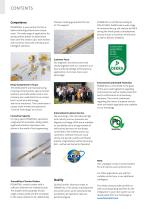
CONTENTS Competence FEINMETALL is your partner for the reliable contacting of electronic components. The wide range of applications for spring contact probes includes board tests with fine centers up to wire harness and connector tests with individual and intelligent solutions. the laser marking guarantees the use of “the original”. FEINMETALL is certified according to DIN ISO 9001. Additionally a wide range of measures like e.g. risk analysis by FMEA during the whole product development process ensure a maximum of technical as well as delivery reliability. Customer Focus Our engineers and technicians...
Open the catalog to page 2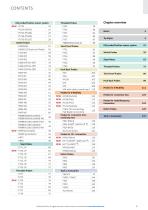
Threaded Probes F731 F732 F733 F734 F737 F88890M2104G150 Twist Proof Probes F751 F752 F754 F755 F756 F760 Push Back Probes V03 V04 VF100 VF3 VF4 VF4 with elastic round head Probes for E-Mobility NEW HC08 (Sockets) NEW HC09 (Pins) NEW HC10 (Pins) NEW HC11 (Sockets) F762C (for Contacting Flat Blade Connectors) Probes for Connector test continuity test F822 (Fakra) F835 (HFM® / MATE-AX ®) F819 (HSD) Test connectors Probes for RF - Connectors NEW HF66 (Fakra) NEW HF77 (HFM® / MATE-AX ®) NEW HF77 (H-MTD ®) HF819 (HSD) HF860 (Fakra) Kelvin Probes F810 F822 F832 F835 Tools / Accessories Spacers FEWZ...
Open the catalog to page 3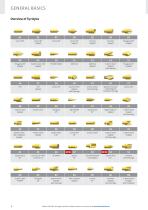
GENERAL BASICS Overview of Tip Styles Concave stepped Serrated stepped Flexible Needle Spherical stepped 4-point crown stepped (self cleaning Flat stepped 4-point crown stepped (self cleaning) 4-point crown (self cleaning) Special version for contacting into connector housings Rigid needle 15° stepped 3-point crown stepped (self cleaning) 36 6-point crown with middle pin stepped 6-point crown stepped (self cleaning) Conical 120° with eccentric cut 50 Concave with drill hole stepped 55 Concave (self cleaning) 8-point crown stepped (self cleaning) Mini-serrated stepped Serrated stepped (self cleaning)...
Open the catalog to page 4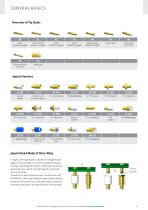
GENERAL BASICS Overview of Tip Styles Spade spadeØ < plungerØ Reduced spade spadeØ < plungerØ Spade spadeØ = plungerØ Spade spadeØ > plungerØ Reduced spade spadeØ > plungerØ Square spade Square spade not centric Special version for spade tips Rolling ball Special Versions Concave stepped C = High current (marked by groove) Spherical stepped Flat stepped H = Synthetic head with ring T = Insulated BeCu head Special Head Made of Silver Alloy In high current applications ideally no voltage should apply and accordingly no current should flow during closing or releasing the contact. Otherwise, an electric...
Open the catalog to page 5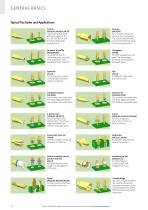
GENERAL BASICS Typical Tip Styles and Applications Conical (01,02,03,10,18,32,34,35) Universal tip style with different angles of 10°, 15°, 30°, 60°, 90° or 120° for contacting solder pads and vias. Serrated, W-profile (06,46,64,66) Universal tip style for contacting wires, pins and wire wrap posts, even suitable for bent contacts. Hexagonal (07,08) For testing plated vias and pads. The sharp edges penetrate contamination and oxide layers. Spherical (11,12) For testing clean contact surfaces, does not leave marks or scratches. Flat (16,17) Suitable for solder pads and contact pins. Triangular...
Open the catalog to page 6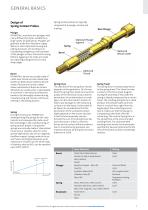
GENERAL BASICS Design of Spring Contact Probes Spring contact probes are typically composed of a plunger, a barrel and a spring. Plunger FEINMETALL manufactures plungers with many different tip styles, suitable for a large variety of applications. Plungers are generally made from beryllium copper (BeCu) or steel. Optimized turning and plating processes are resulting in an outstanding straightness and exactness of the plunger surface, the base for a long lifetime. Aggressive tip styles are made by a special grinding process for ultra sharp edges. Barrel FEINMETALL barrels are usually made of nickel...
Open the catalog to page 7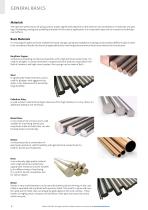
GENERAL BASICS Materials The optimum performance of spring contact probes significantly depends on the selection and combination of materials and platings. Developing, testing and qualifying materials for the various applications is an important aspect of our research and development efforts. Basic Materials For choosing the optimum basic material for barrel, plunger, spring and receptacle of spring contact probes different aspects need to be considered. Besides the technical applicability also machining and economical factors are relevant for this decision. Beryllium-Copper combines outstanding...
Open the catalog to page 8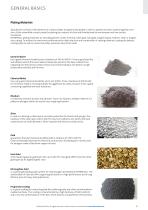
GENERAL BASICS Plating Materials Typically the surfaces of all elements of contact probes are galvanically plated in order to protect the basic material against corrosion. At the assembled contact probe the plating also reduces friction and thereby leads to low abrasion and low contact resistances. FEINMETALL plating materials are basically galvanic nickel, chemical nickel, gold, hard gold, longtime gold, rhodium, silver or progressive coating. To achieve the maximum performance the ideal selection and combination of coating materials, coating thicknesses, coating alloys as well as various boundary...
Open the catalog to page 9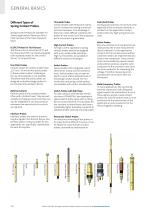
GENERAL BASICS Push Back Probes During push back tests of connectors the tight seat of the connector elements is verified. For this application contact probes with very high spring forces are used. Kelvin Probes Very low resistances of components are measured by the 4-wire measurement (Kelvin-method). For this application contacts for the current source and the voltmeter need to be implemented very close to the component. These connections can be realized by special coaxial probes (Kelvin probes), using the outer conductor for the constant current and the inner conductor for measuring the voltage....
Open the catalog to page 10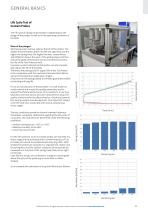
GENERAL BASICS Life Cycle Test of Contact Probes For us as manufacturer of these probes, it is vital to permanently control and review the quality parameters and to analyze the lifetime performance of our products. In our own laboratory we have various test and measurement setups for quality control and for the determination of technical parameters during research and development. One important subject is the life cycle test, conducted with several autonomous stress stages. For the life cycle test up to 10 sample probes are mounted in a stress stage and then pressed with a stroke frequency of...
Open the catalog to page 11All Feinmetall GmbH catalogs and technical brochures
 WIRE HARNESS TESTING
9 Pages
 FeinProbe ll®
2 Pages
 INTERFACE SOLUTIONS
7 Pages
 FINE PITCH TESTING
7 Pages
 ELECTRONIC TESTING
9 Pages
 Product Portfolio
11 Pages
 FOR THE ENVIRONMENT
2 Pages
 TEST CONNECTORS
4 Pages
 POGO CONNECTORS
8 Pages
 PRODUCT PORTFOLIO CONTACT PROBES
20 Pages
 HIGH CURRENT PROBES
20 Pages
 WAFER PROBE CARD SOLUTIONS
8 Pages


