
- Catalogs
- Federal-Mogul Deva GmbH
- deva_glide_EN


deva_glide_EN

deva_glide_EN
The technical manual for deva.glide® focuses on maintenance-free, self-lubricating sliding bearings made from bronze with solid lubricant plugs. These materials are designed for high-performance applications, offering long-term reliability without the need for additional lubrication.
deva.glide® materials are composed of wear-resistant cast copper alloys with solid lubricant deposits. They exhibit high wear resistance, impact stress insensitivity, and resistance to harsh mechanical and chemical environments, suitable for high static and dynamic loads.
The manual details the structure and microstructure of deva.glide® materials, highlighting the use of solid lubricants like graphite and PTFE for optimal film formation and corrosion resistance. Two standard formulations, dg12 and dg16, are available, with additional variants for special applications.
deva.glide® products comply with international standards such as RoHS, REACH, and ISO certifications, ensuring quality, environmental protection, and safety in production.
Four load cases are defined to account for fatigue influences under dynamic loads: constant normal force without sliding, frequent load changes without sliding, constant force with sliding, and frequent load changes with sliding.
The manual specifies the required hardness and surface roughness for mating materials to ensure optimal performance and longevity of the sliding bearings. Recommendations include using stainless steel in corrosive environments and considering protective coatings.
deva.glide® sliding bearings are used in various industries, including bridges, steel construction, mechanical engineering, and wind turbines. They are suitable for applications requiring high dimensional stability and resistance to environmental factors.
Guidelines for the design and installation of cylindrical and spherical sliding bearings, as well as sliding plates and segments, are provided. Installation methods include press-fitting and supercooling.
The manual includes information on chemical resistance and provides design examples and applications to assist in the selection and implementation of deva.glide® sliding bearings.
The document outlines various materials suitable for use in seawater environments, including 1.4462 X2CrNiMoN22-5-3, 1.4501 X2CrNiMoCuWN25-7-4, and Inconel 625. These materials are compared against standards and suggested for specific applications.
deva.glide® alloys are produced through different casting processes, affecting material properties and dimensions. The document specifies standard dimensions for cylindrical bushings and flanged sliding bushings, highlighting the importance of manufacturing processes on material characteristics.
Tables provide detailed dimensions for various deva.glide® bearings, including cylindrical, flanged, and spherical bearings. These dimensions are crucial for ensuring proper fit and function in applications.
The document describes installation methods such as press-fitting and supercooling. Press-fitting requires precise application of force, while supercooling involves using dry ice or liquid nitrogen to aid assembly. Safety precautions for handling hazardous substances are emphasized.
Recommended fits and tolerances are provided to ensure satisfactory bearing operation. The document advises on machining allowances and the adaptation of bearing tolerances to shaft deviations.
A table outlines the chemical resistance of deva.glide® alloys to various substances, including acids, bases, solvents, and gases. This information is critical for selecting materials based on environmental conditions.
The document includes a section for recording project-specific data, such as bearing type, dimensions, load conditions, and lubrication requirements. This aids in the design and selection of appropriate sliding bearings for specific applications.
Catalog excerpts

Technical manual deva.de | Maintenance-free, self-lubricating sliding bear
Open the catalog to page 1
Your challenges are our fascination. Bronze with solid lubricant plugs With maintenance-free, self-lubricating high-performance sliding materials from the DEVA® product range, it is now possible to realize sliding bearing concepts that operate reliably over long periods of time. deva.glide® materials consist of highly wear-resistant cast copper alloys, whose sliding surfaces are uniformly provided with solid lubricant deposits in macro distribution. They are suitable for applications with high static and dynamic loads. In addition, the deva.glide® range of materials is characterized by the following...
Open the catalog to page 2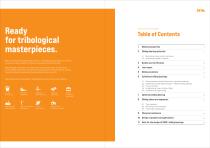
Ready for tribological masterpieces. Technical manual deva.glide® Material properties 2 Sliding bearing materials Load cases Mating materials Cylindrical sliding bearings 6.1 Recommended standard dimensions – cylindrical bushings 6.2 Empfohlene Standardabmessungen – flanged sliding bushings 6.3 Fits and surfaces 6.4 Installation by means of press-fitting 6.5 Installation by supercooling Spherical sliding bearing With deva.glide®, lubrication is provided by the sliding material itself. Already during the first sliding movements, solid lubricant is released by micro-abrasion from the sliding material...
Open the catalog to page 3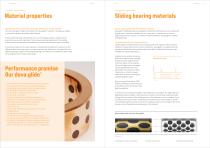
deva.glide® sliding bearings deva.glide® sliding bearings Material properties Sliding bearing materials Maintenance-free and self-lubricating high-performance sliding material The dry-running principle is the same for all deva.glide® materials. The plugs arranged in a particular pattern provide a solid lubricant. Copper casting alloys with solid lubricant deposits deva.glide® sliding bearings are available in preferred dimensions and as customized special parts. Customers benefit from our many years of experience in various applications and our service in the field of material selection and...
Open the catalog to page 4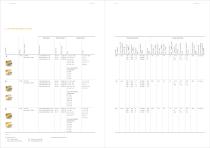
2.2 Overview deva.glide® materials Max. permissible stat. load p stat/max | [MPa] Max. permissible dyn. load p dyn / max | [MPa] Max. glide speed U max | [m/s] Friction coefficient (water) Minimum hardness mating material [HB] Recommended surface roughness of mating material Ra | [µm] Storage properties Linear coefficient of thermal expansion α | [10−6 / K] Alloy number Weight shares Material number ASTM Standard
Open the catalog to page 5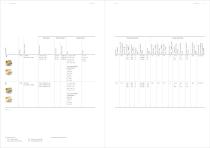
Max. permissible stat. load p stat/max | [MPa] Max. permissible dyn. load p dyn / max | [MPa] Max. glide speed U max | [m/s] Friction coefficient (water) Minimum hardness mating material [HB] Recommended surface roughness of mating material Ra | [µm] Storage properties (1) Delivery form: GS = Sand casting GM = Gravity die casting (2) elated to base bronze R GC = Continuous casting GZ = Centrifugal casting Linear coefficient of thermal expansion α | [10−6 / K] Weight shares
Open the catalog to page 6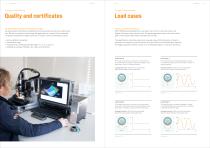
deva.glide® sliding bearings deva.glide® sliding bearings Load cases Environmental protection and production safety We attach great importance to qualitative, environmentally conscious and safe production. We are committed to this through the application of a variety of internationally recognized standards for quality assurance, emission control and workplace safety. The four cases of bearing load DEVA® differentiates between four load cases. We do this to take into account the fatigue influences under dynamic load. The percentage values refer to the limit values given in the material data sheets...
Open the catalog to page 7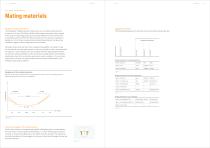
deva.glide® sliding bearings Roughness and surface finish The deva.glide® sliding materials require the use of a mating material with a hardness of at least 180 HB (for detailed information see material data sheets). In the case of long sliding distances or abrasive effects from the environment, a hardened surface 35 HRC / 45 HRC should be used. The surface roughness is ideally Ra = 0.2 to 0.8 μm, produced by grinding. Depending on the operating conditions, higher surface roughness can be accepted. Suggested materials The following table gives an overview of some possible mating materials. Normally,...
Open the catalog to page 8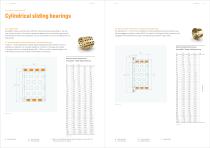
deva.glide® sliding bearings Cylindrical sliding bearings 6.2 Recommended dimensions - flanged sliding bushing For diameters D1 > 150 mm, a combination of sliding bearing and thrust washer may be advantageous. (please contact DEVA® for advice). The flanged of the bushing is only equipped with solid lubricant plugs if the operating conditions require this. Cast copper alloy deva.glide® alloys are produced by different casting processes depending on the size and number of pieces. The material properties depend on the manufacturing process. The dimensions that can be produced, such as the maximum...
Open the catalog to page 9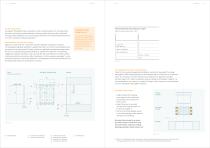
6.3 Fits and surfaces deva.glide® sliding bearings are pressed in with overlap between the housing inside diameter and bearing outside diameter. Bearing outside, bearing inside, shaft and housing inside diameters must be manufactured within the recommended tolerances to ensure satisfactory bearing operation. deva.glide® flange sliding bearing deva.glide® sliding bearing E7 H9 Free size – medium c8 / d8 Installation description 6.4 Installation by means of press-fitting Press-fit is a universally applicable installation method for deva.glide® bushings. deva.glide® radial sliding bearings can be...
Open the catalog to page 10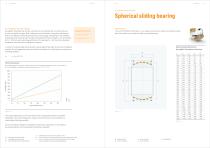
deva.glide® sliding bearings Spherical sliding bearing 6.5 Installation by supercooling deva.glide® bearings may also be subcooled as an assembly aid. Cooling media are dry ice and liquid nitrogen. Both substances are classified as hazardous substances. Due to the different material pairings (bronze and plugs), depending on the selected overlap between bearing and housing, subcooling with liquid nitrogen is recommended for D1 < 200 mm and subcooling with dry ice for bearings D1 > 200 mm. More detailed installation instructions are available on request. Fixed bearing You can find further information...
Open the catalog to page 11All Federal-Mogul Deva GmbH catalogs and technical brochures
 deva_metal_EN
21 Pages
 deva_tex_EN
32 Pages
 deva_bm_EN
32 Pages


Archived catalogs
 DEVA Spherical Bearings
32 Pages
 deva.metal technical handbook
24 Pages
 deva.bm technical handbook
24 Pages
 deva.glide technical handbook
20 Pages
 deva.tex technical Handbbok
20 Pages
 Product Range
12 Pages


- DEVA plain bearing
- DEVA metal plain bearing
- DEVA cylindrical plain bearing
- DEVA self-lubricating plain bearing
- DEVA plastic plain bearing
- Steel plain bearing
- PTFE plain bearing
- DEVA bronze plain bearing
- DEVA composite plain bearing
- DEVA maintenance-free plain bearing
- DEVA high-performance plain bearing
- Radial plain bearing
- Wear-resistant plain bearing
- DEVA lube-free plain bearing
- Linear plain bearing
- Corrosion-resistant plain bearing
- Heavy load plain bearing
- Sintered bronze plain bearing
- DEVA dry plain bearing
- DEVA stainless steel plain bearing