
- Catalogs
- Federal-Mogul Deva GmbH
- deva_bm_EN


deva_bm_EN

deva_bm_EN
DEVA® specializes in self-lubricating, maintenance-free sliding bearings, suitable for harsh environments like underwater, extreme temperatures, and corrosive conditions. They provide both standard and customized solutions, assisting clients with material selection, design, and installation.
deva.bm® bearings are bi-metallic, with a steel backing and a sintered bronze sliding layer containing solid lubricants such as graphite or PTFE. These materials are maintenance-free, support high loads, have low friction, and are suitable for diverse environments, including marine and radioactive settings.
The bearings feature a steel backing and a bronze matrix with solid lubricants, available in over 44 variants with different microstructures and compositions. They are designed for both dry running and lubricated applications, accommodating high loads and speeds.
DEVA® prioritizes quality, environmental consciousness, and safety, complying with standards like RoHS, REACH, and ISO certifications.
Four load cases are defined to address dynamic load fatigue influences, including static and dynamic loads with or without sliding movements, each with specific permissible limits.
Mating materials should have a minimum hardness of 180 HB, with surface roughness ideally between Ra = 0.2 to 0.8 μm. Protective coatings may be applied based on environmental conditions.
DEVA® bearings are utilized in various industries, such as bridges, steel construction, railways, and turbines, providing solutions for both standard and demanding applications.
Mating materials are categorized by application environments: normal, corrosive, and seawater. Recommended materials include 1.0543 and 1.0503 for normal, 1.4021 and 1.4057 for corrosive, and 1.4462 and Inconel 625 for seawater applications.
Standard dimensions for cylindrical sliding bearings are specified, with tolerances for inner and outer diameters, wall thickness, and sliding layer thickness. Special dimensions can be manufactured upon request.
Installation methods include press-fitting using hydraulic or spindle presses, and supercooling with liquid nitrogen for larger bearings. Proper tools and techniques are emphasized to prevent damage.
Design rules for fastening with countersunk screws are detailed, including dimensions and tolerances. Recommendations for mechanically securing bearings are provided to prevent slipping.
The chemical resistance of deva.bm® alloys is detailed, with specific resistance levels for various acids, bases, solvents, gases, and lubricants.
Examples of radial and axial segments, spherical bearings, and other configurations are provided, illustrating potential applications in industries such as steel, wind energy, and marine.
The document includes a disclaimer noting that the technical information is verified but not guaranteed, and specific guarantees require written agreements.
Catalog excerpts

Technical manual deva.de | Maintenance-free, self-lubricating sliding bear
Open the catalog to page 1
Your challenges are our fascination. Self-lubricating bi-metal sliding bearings For more than 85 years, the name DEVA® has stood for self-lubricating, maintenance-free high-performance materials and sliding bearing solutions. Since the development of the world’s first powder-metallurgical material with embedded solid lubricants in 1936, DEVA® sliding bearings perform where other bearings reach their limits. Our sliding bearing materials are used in a wide range of industrial applications. Wherever it matters: under water, at freezing temperature or hot heat, DEVA® is the world’s first address...
Open the catalog to page 2
Maintenance-free, self-lubricating sliding bearings
Open the catalog to page 3
The continuous development of our products and manufacturing processes is our objective. Continuous development is the basis for a wide range of customer-specific and standardized bearing elements. Constantly improving requirements such as longer service life and maintenance intervals, optimized friction coefficients and environmental compatibility are taken into account. Typical applications for deva.bm® sliding bearings can be found in these industries: Iron and steel industry Hydro-Civil Engineering Bridges and steel construction Mechanical engineering Injection molding and tire molding Shipbuilding...
Open the catalog to page 4
Technical manual deva.bm® Material properties 2 Sliding bearing materials 2.1 Microstructure and material composition 2.2 deva.bm® standard materials 2.3 ariants – macrostructure and V different material compositions Load cases Mating materials Cylindrical sliding bearings 6.1 ecommended standard dimensions R 6.2 its F 6.3 nstallation by means of press-fitting I 6.4 nstallation by supercooling with liquid nitrogen I Sliding plates and segments 7.1 imensions of sliding plates D 7.2 eva.bm® contour parts d 7.3 esign principles for fastening with countersunk screws D 7.4 nstallation description...
Open the catalog to page 5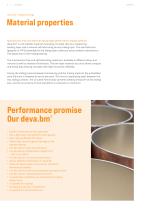
deva.bm® sliding bearings Material properties Maintenance free and self-lubricating high-performance sliding material deva.bm® is a bi-metallic material consisting of a steel strip as a supporting backing layer and a sintered self-lubricating bronze sliding layer. The solid lubricant (graphite or PTFE) embedded in the sliding layer under pre-stress enables maintenancefree application of the sliding bearing. The maintenance free and self-lubricating material is available in different alloys and variants as well as material thicknesses. The two-layer material structure allows compact and heavy-duty...
Open the catalog to page 6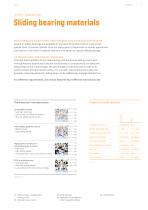
deva.bm® sliding bearings Sliding bearing materials Steel backing and bronze matrix with homogeneously distributed solid lubricant deva.bm® sliding bearings are available in standard dimensions and as customized special parts. Customers benefit from our many years of experience in various applications and service in the field of material selection and design of special sliding bearings. 2.1 Microstructure and material composition The high load capability of the steel backing and the bronze sliding matrix with homogeneously distributed lubricant incorporation is characteristic for deva.bm®....
Open the catalog to page 7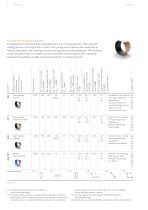
Recommended surface roughness of mating material Ra | [µm] • tandard for dry running S and water lubricated applications • tandard material for S mechanical engineering; high static load, low number of cycles Intermediate Graphite content • eneral for dry running G and water lubricated applications • edium load at high M sliding speed High Graphite content • eneral for dry running G and water lubricated applications • Abrasive environment PTFE as Solid lubricant • eneral for dry running G • High dynamic load • vailable for bearings A D1 ≥ 28 mm Available designs Available shapes Operating conditions...
Open the catalog to page 8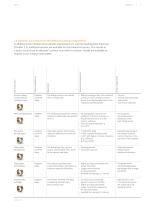
Technical characteristics Smooth sliding surface without running-in layer Graphite and PTFE alloys The sliding surface is not coated with running-in film • ithout running-in film, the coefficient W of friction in the running-in phase is similar to or slightly higher than in the stationary operating phase • Dry run • il and water lubricated O applications • Low friction distances Graphite alloys The residual porosity of the sintered material is additionally impregnated with oil • il impregnation improves the O coefficient of friction and wear as long as the amount of oil in the pores is sufficient...
Open the catalog to page 9
deva.bm® sliding bearings Quality and certificates Environmental protection and production safety We attach great importance to a qualitative, environmentally conscious and safe production. We are committed to this through the application of a variety of internationally recognized standards for quality assurance, emission control and workplace safety. • RoHS und REACH compliant • Certificate of origin • Acceptance test certificates DIN EN 10204 – 2.1; 2.2; 3.1 and 3.2 • Certified according to ISO 9001; ISO 14001 an
Open the catalog to page 10
deva.bm® sliding bearings Load cases The four cases of bearing load DEVA® differentiates between four load cases. We do this to take into account the fatigue influences under dynamic load. The percentage values refer to the limit values given in the material data sheets and technical manuals. The specifications should be understood as guide values. With alternation of loads in particular, the frequency and the number of cycles need to be considered with regard to the fatigue properties. Please contact us for a detailed analysis in a personal discussion. The acting normal force is constant or...
Open the catalog to page 11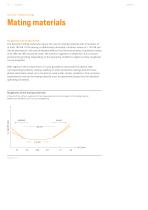
deva.bm® sliding bearings Mating materials Roughness and surface finish The deva.bm® sliding materials require the use of a mating material with a hardness of at least 180 HB. If the bearing is additionally lubricated, hardness values of > 130 HB can also be permitted. In the case of abrasive effects from the environment, a hardened surface of 35 HRC / 45 HRC should be used. The surface roughness is ideally Ra = 0.2 to 0.8 μm, produced by grinding. Depending on the operating conditions, higher surface roughness can be accepted. With regard to the surface finish, it is also possible to use protective...
Open the catalog to page 12All Federal-Mogul Deva GmbH catalogs and technical brochures
 deva_metal_EN
21 Pages
 deva_glide_EN
17 Pages
 deva_tex_EN
32 Pages


Archived catalogs
 DEVA Spherical Bearings
32 Pages
 deva.metal technical handbook
24 Pages
 deva.bm technical handbook
24 Pages
 deva.glide technical handbook
20 Pages
 deva.tex technical Handbbok
20 Pages
 Product Range
12 Pages


- DEVA plain bearing
- DEVA metal plain bearing
- DEVA cylindrical plain bearing
- DEVA self-lubricating plain bearing
- DEVA plastic plain bearing
- Steel plain bearing
- PTFE plain bearing
- DEVA bronze plain bearing
- DEVA composite plain bearing
- DEVA maintenance-free plain bearing
- DEVA high-performance plain bearing
- Radial plain bearing
- Wear-resistant plain bearing
- DEVA lube-free plain bearing
- Linear plain bearing
- Corrosion-resistant plain bearing
- Heavy load plain bearing
- Sintered bronze plain bearing
- DEVA dry plain bearing
- DEVA stainless steel plain bearing