

- Company
- Products
- Catalogs
- News & Trends
- Exhibitions
GSLC2
GSLC2
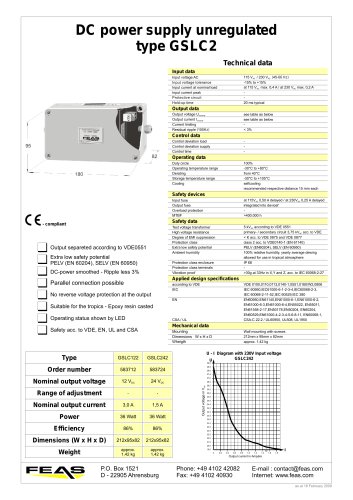
The document outlines the specifications for an unregulated DC power supply, type GSLC2. It operates with input voltages of AC 115 V / 230 V (45-66 Hz) and has an input voltage tolerance of -15% to +15%. The nominal output voltage and current are specified in a table, with a power rating of 36 Watts. The efficiency is noted at 86%, and the device dimensions are 212mm x 95mm x 82mm, weighing approximately 1.42 kg.
The power supply features a control deviation load and supply, with a typical hold-up time of 20 ms. It operates within a temperature range of -30°C to +80°C, with derating starting from 40°C. The storage temperature range is -30°C to +105°C, and it is self-cooled with a recommended distance of 15 mm for optimal performance.
Safety features include input and output fuses, overload protection, and a high MTBF of over 400,000 hours. The device is compliant with various safety standards, including VDE, EN, UL, and CSA. It has a high voltage resistance of 5 kV according to VDE 0551 and is vibration-proof according to IEC standards.
The power supply is designed for wall mounting and is suitable for use in tropical atmospheres. It is epoxy resin casted for durability and has an IP68 protection class. The device supports parallel connection and has an LED indicator for operating status. It complies with multiple international standards, ensuring safety and reliability.
The document includes a U-I diagram for the GSLC242 model, showing the relationship between output voltage and current with a 230V input voltage.
Catalog excerpts
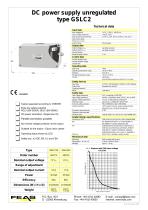
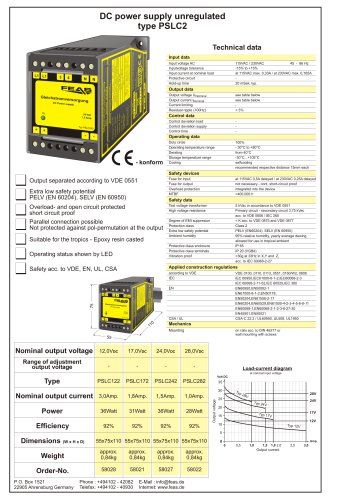
Technical data Input data Input voltage tolerance Input current at nominal load Input current peak Protective circuit Hold-up time Output data Current limiting Control data Control deviation load Control deviation supply Control time Operating data Duty circle Operating temperature range Storage temperature range see table as below see table as below recommended respective distance 15 mm each □ Output separeted according to VDE0551 □ Extra low safety potential □ DC-power smoothed - Ripple less 3% □ Parallel connection possible □ No reverse voltage protection at the output □ Suitable for the tropics - Epoxy resin casted □ Operating status shown by LED | | Safety acc. to VDE, EN, UL and CSA Safety devices Input fuse Output fuse Overload protection Safety data Test voltage transformer High voltage resistance Protection class Extra low safety potential Ambient humidity at 115Vac 0,50 A delayed / at 230VAC 0,25 A delayed integrated into devicef Protection class enclosure Protection class terminals Vibration proof Applied design specifications primary- / secondary circuit 3,75 kV acc. to VDE 100% relative humidity, yearly average dewing allowed for use in tropical atmosphere IP 68 Mechanical data Wfell mounting with screws 212mm x 95mm x 82mm approx. 1,42 kg U - I Diagram with 230V Input voltage P.O. Box 1521 D - 22905 Ahrensburg E-mail : [email protected] Internet: www.feas.com
Open the catalog to page 1All FEAS GmbH catalogs and technical brochures
 SNT9424-3
1 Page
 GSNT90
1 Page
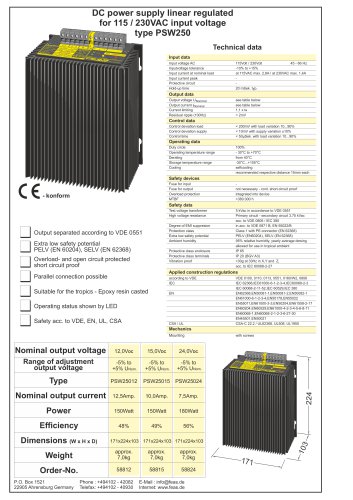 PSW250
1 Page
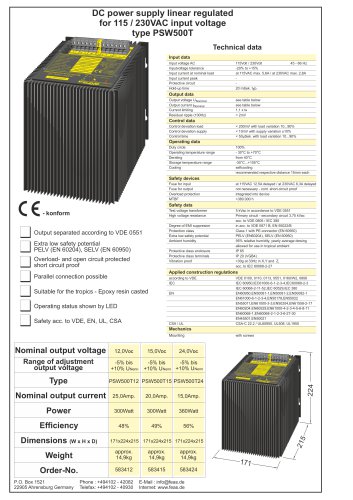 PSW500T
1 Page
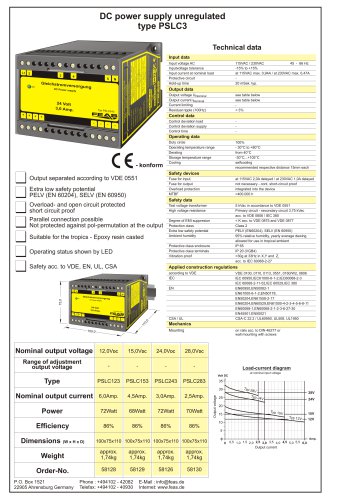 PSLC3
PSLC31 Page
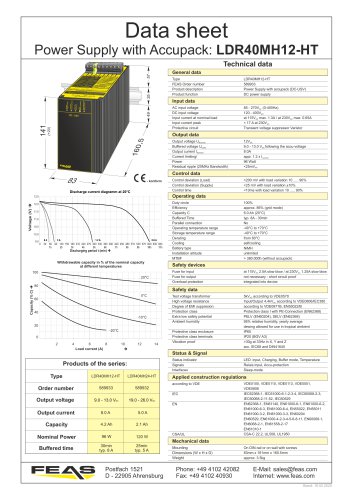 LDR40MH12-HT
1 Page
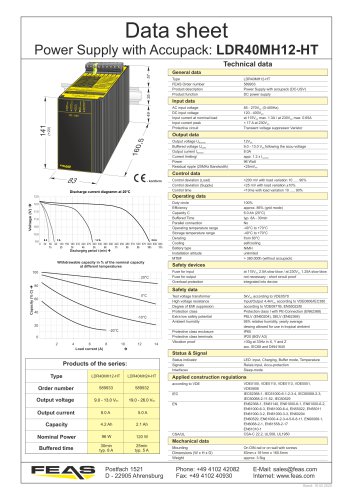 LDR40MH12-HT
1 Page
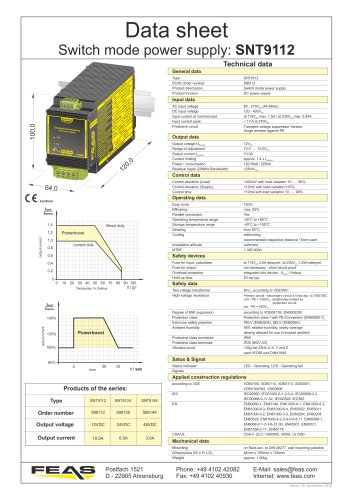 SNT9112
1 Page
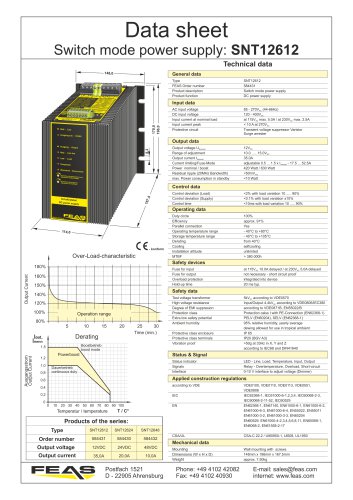 SNT12612
1 Page
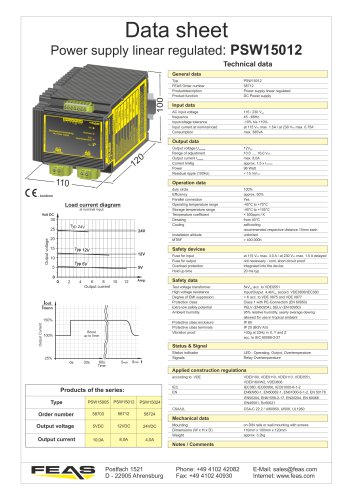 PSW15012
1 Page
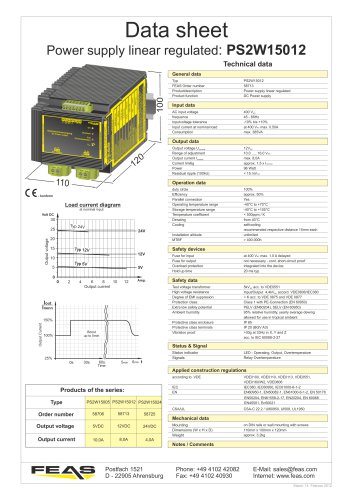 PS2W15012
1 Page
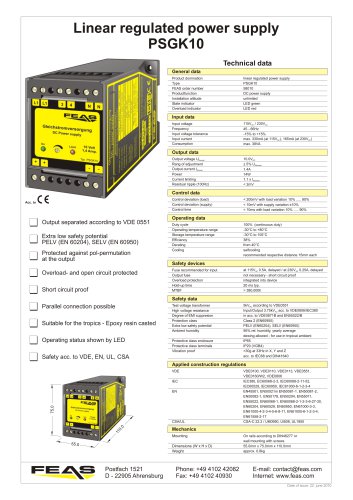 PSGK10
1 Page
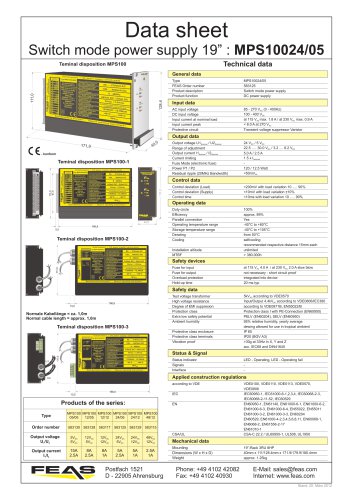 MPS10024/05
1 Page
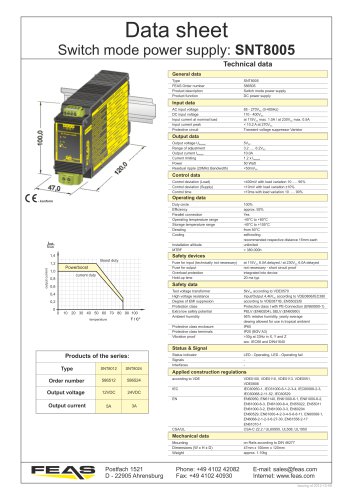 SNT8005
1 Page
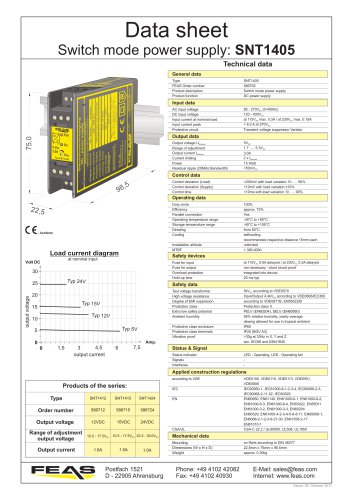 SNT1405
1 Page
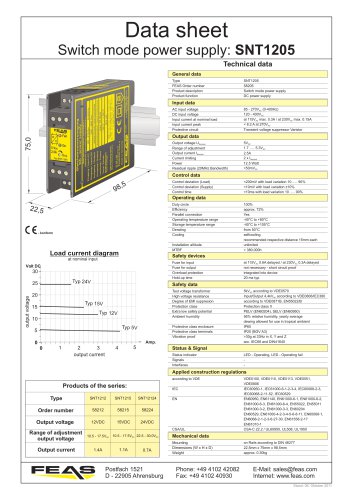 SNT1205
1 Page
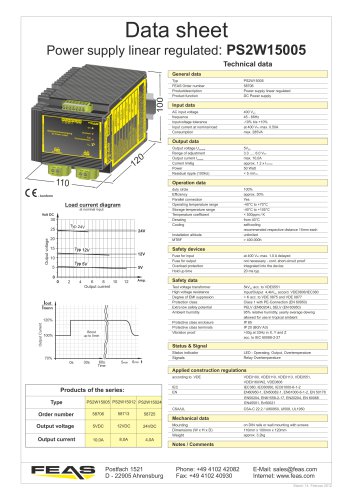 PS2W15005
1 Page
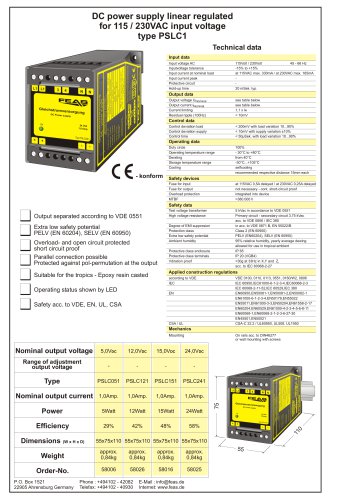 PSLC1
PSLC11 Page
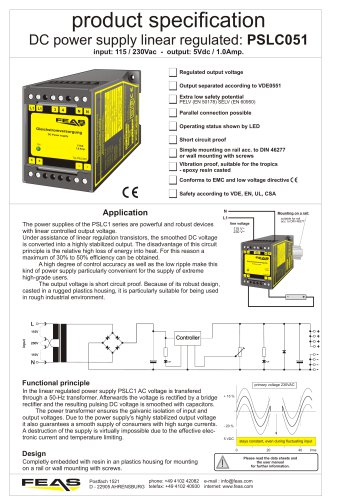 PSLC051
1 Page
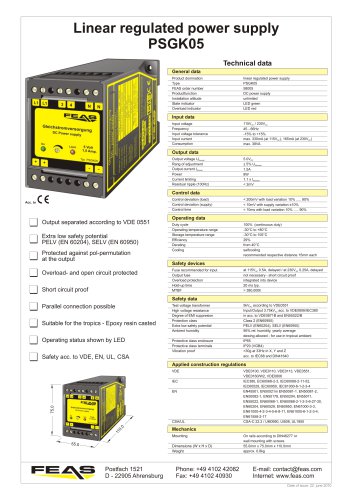 PSGK05
1 Page
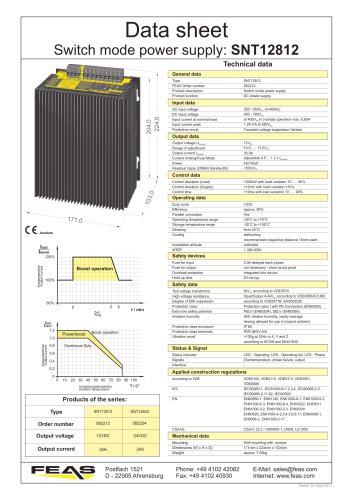 SNT12812
1 Page
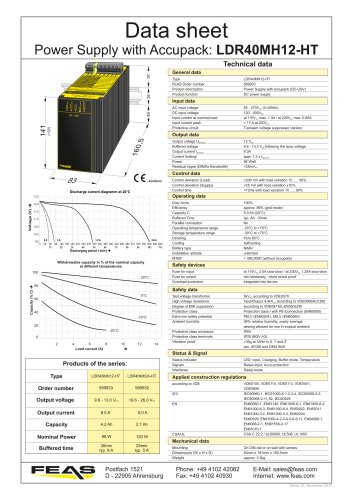 LDR40MH12-HT
1 Page
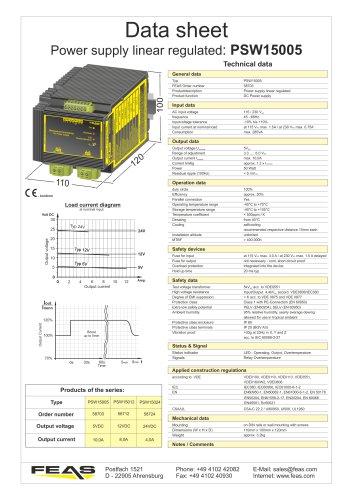 PSW15005
1 Page
Archived catalogs
 FEAS GmbH - product range
2 Pages
 FEAS Catalogue
24 Pages
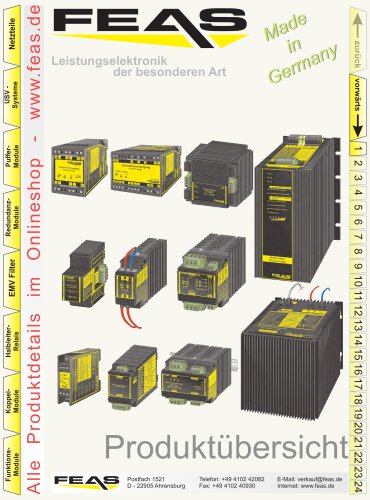
- DC power supply
- AC/DC power supply
- Dry transformer
- CE power supply
- Switching relay
- Single-output power supply
- Power supply for industrial applications
- Switched-mode power supply
- Battery charger
- DC-DC converter
- Compact power supply
- Electronic filter
- Electromechanical relay
- DIN rail power supply
- Isolation transformer
- Variable-output power supply
- DC electromechanical relay
- Power supply with overload protection