
- Catalogs
- FCI Fluid Components International
- FCI Green Energy Applications Guide


- Company
- Products
- Catalogs
- News & Trends
- Exhibitions
FCI Green Energy Applications Guide

FCI Green Energy Applications Guide
- Landfill Gas Recovery: Involves extracting methane and carbon dioxide from landfills for use as a fuel source. Accurate flow measurement is crucial for optimizing gas extraction and reporting for environmental compliance.
- Biogas/Organic Biomass Fermentation Systems: Utilizes organic waste to produce biogas, which is used for heating or electricity generation. Challenges include handling wet, dirty gas and ensuring accurate flow measurement in varying conditions.
- Wastewater Treatment Plant Digester Gas: Focuses on measuring digester gas, a mix of methane and carbon dioxide, for process control and compliance with environmental regulations.
- On-Farm Methane, Biogas Recovery Systems: Agricultural operations recover methane-rich biogas from livestock waste, using it as fuel and earning carbon credits.
- Accurate calibration for mixed gas compositions.
- Temperature compensation for varying conditions.
- No moving parts to prevent clogging in dirty gas environments.
- Wide turndown for measuring a broad range of flow rates.
- Agency approvals for use in hazardous environments.
- ST51: A compact and accurate solution for measuring biogases, digester gases, methane, and natural gas flow. It is easy to install.
- MT86 and MT91: Multi-point flow measuring systems configurable with two to sixteen flow sensing elements, ideal for large pipes and ducts.
- ST98 and ST98L: High-performance measurement devices offering a wide selection of options and gas calibrations.
- ST75: An economical in-line meter with extensive standard features, providing an easy-to-specify alternative to maintenance-intensive technologies.
- FLT93 Series: A robust line of flow/level/temperature switches suitable for liquid, gas, and slurry applications.
- GF90 and GF92: Feature-rich meters with FCI's patented VeriCal™ In-Situ Calibration Verification System.
- Largest installed base in environmental and greenhouse gas applications.
- Superior flow meter calibrations with an on-premises NIST certified flow laboratory.
- Capability for actual gas and process condition calibrations, including mixed gas composition calibration.
- Extensive global approvals for hazardous gas installations, including FM, ATEX, IEC, CSA, NEPSI, CPA, GOST/RTN, and more.
- Complete instrument approvals covering enclosure, electronics, sensor, and seals.
- Field service and local repair and recalibration depot service.
- Installation and start-up assistance.
- Local sales and application engineering available in more than 60 countries.
Catalog excerpts

Methane-to-Market Greenhouse Gas Reduction Biogas-to-Energy Specifying Gas Flow Meters in Green Energy and Pollution Reduction Applications g Landfill Gas Recovery g Biogas/Organic Biomass Fermentation Systems g Wastewater Treatment Plant Digester Gas g Livestock and Dairy On-Farm Biogas Recovery g Ethanol Production and Refining g Coal Mine Methane Recovery g Biomass Gasification g Flare Gas Measurement g Flue Gas Monitoring FCI Green Energy Applications Guide Emissions Measurement, Control & Reduction
Open the catalog to page 1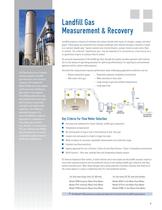
3 Landfills produce a mixture of methane and carbon dioxide with traces of nitrogen, oxygen and other gases. These gases are extracted from multiple wellheads and collected through a network of pipes to a common header pipe. Typical systems also involve blowers, pumps, knock-out pots and a flare or oxidizer. The collected “greenhouse gas” may be disposed of or recovered as a fuel source for a co-generation engine to produce electric power. An accurate measurement of the landfill gas flow through the system provides operators with information on the amount of gas being extracted for optimizing...
Open the catalog to page 3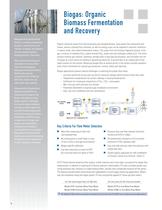
4 Klärgastechnik Deutschland GmbH is a leading engineering designer, manufacturer and installer of biogas and digester gas processing systems headquartered in Germany. After extensive testing and evaluation of various flow metering technologies, Klärgastechnik Deutschland GmbH selected and standardized FCI ST98 and ST51 flow meters for use within their gas systems. Klärgastechnik Deutschland GmbH found that FCI’s no moving parts to plug or foul design, low pressure drop, biogas-specific calibration, hot tap ball valve installation and agency safety approvals provided the best engineered and most...
Open the catalog to page 4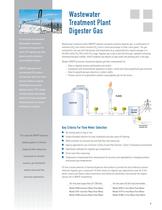
5 Wastewater treatment plant (WWTP) digester processes produce digester gas, a combination of methane (CH4) and carbon dioxide (CO2) with a small percentage of other trace gases. The gas composition can vary with the process and temperature (e.g. seasonally) but a typical average is in the 65% (±5%) CH4 35% (±5%) CO2 range. Digester gas is also a wet and dirty gas, typically containing entrained hydrogen sulfides, which condense and deposit on pipe walls and anything else in the pipe. Modern WWTP processes incorporate digester gas flow measurement for: – Data on digester process performance and...
Open the catalog to page 5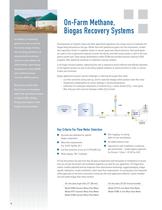
6 Decomposition of livestock waste and other agricultural operations are a major source of methane rich biogas being harvested as fuel gas. Rather than emit greenhouse gases into the environment, modern farm operations invest in a digester system to recover gases and reduce emissions. Recovered gases are used to fuel co-generation engines to power the facility, and often excess power is sold to the local electric power grid. Clean energy development credits (CDM) and certified emission reduction (CER) programs offer additional incentives to implement recovery systems. In all biogas recovery systems,...
Open the catalog to page 6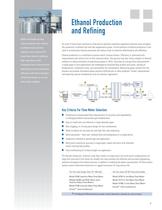
7 As costs of fossil fuels continue to climb and air pollution reduction regulations become more stringent, the production of ethanol fuel and fuel supplements grows. At the forefront of ethanol production is the need to continuously improve processes and reduce costs to maximize effectiveness and efficiency. Ethanol production is a distillation process which involves boilers. Efficiency is optimized with measurement and control of air-to-fuel mixtures/ratios. The process may also utilize catalytic or thermal oxidizers to reduce emissions of greenhouse gases or VOCs. Accurate air and gas flow...
Open the catalog to page 7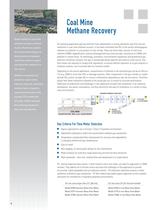
8 An emerging application gaining attention from stakeholders in mining operations and from environmentalists is coal mine methane recovery. It has been estimated that 8% of the world’s anthropogenic methane air pollution is a by-product of coal mining. There are three major sources of coal mine methane (CMM): degasification systems (drainage) both pre-mine and gob; ventilation air (VAM); and abandon or closed mines. As technology, economics, environmental regulations and greenhouse gas reduction incentives increase, this gas is increasingly being captured and used as a fuel source. Gas flow...
Open the catalog to page 8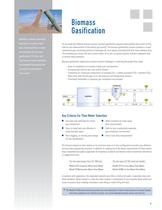
9 For accurate and efficient process control, biomass gasification requires measurement and control of fuel, inlet air and measurement of the extract gas (outlet). The biomass gasification process produces a mixed composition gas consisting primarily of hydrogen (H2) and carbon monoxide (CO) with trace methane (CH4). The extracted gas stream will also contain water, tar or ash, so typical systems include a separator tank to remove these elements. Biomass gasification applications present several challenges in selecting the proper flow meter: – Ease of installation in a variety of pipe sizes and...
Open the catalog to page 9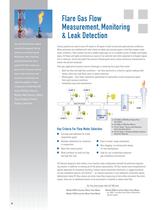
10 Flaring systems are used to burn-off waste or off-gases in both normal and upset process conditions. Many processes are outfitted with relief valves to safely vent process gases to the flare system under upset conditions. Flare systems can be a simple single pipe run or a complex series of feeder and header pipes. All flares are highly scrutinized as a source of air pollution and often subjected to stringent regulation to measure, record and report the amount of flared gases and to show continuous improvement to reduce the amount produced. Flare gas applications present several challenges...
Open the catalog to page 10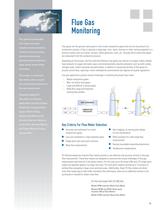
11 Flue gases are the general name given to the mixed composition gases that are the by-product of a combustion process. A flue is typically a large pipe, duct, stack, chimney or other venting attached to a process system such as a boiler, furnace, steam generator, oven, etc. through which waste flue gases are exhausted from the combustion process. Depending on the process, the fuel used and efficiency, flue gases can consist of nitrogen, carbon dioxide, trace amounts of oxygen and water vapor, and environmentally sensitive pollutants such as sulfur oxides, nitrogen oxide, carbon monoxide and...
Open the catalog to page 11Archived catalogs
 FLT
FLT8 Pages
 FCI
FCI12 Pages
 ST51
ST512 Pages
 FCI Nuclear Products
16 Pages
 FCI Aerospace Products
8 Pages
 ST100
ST10020 Pages
 ST50
ST504 Pages
 ST75
ST758 Pages
 FCI Vortab Flow Conditioners
6 Pages
 MT series
12 Pages
 FCI Product Line Brochure
12 Pages


- Liquid flow monitor
- FCI level switch
- FCI liquid level switch
- FCI waterproof flow meter
- FCI stainless steel flow meter
- FCI industrial flow meter
- Precision flow meter
- In-line flow meter
- Compact flow monitor
- DC flow monitor
- RS485 flow monitor
- FCI mass flow meter
- FCI flow meter with display
- Stainless steel level detector
- FCI digital flow meter
- FCI Modbus flow meter
- DN25 - 1" flow monitor
- DN50 - 2" flow meter