
- Catalogs
- FCI Fluid Components International
- Advances In Thermal Dispersion Technology White Paper


- Company
- Products
- Catalogs
- News & Trends
- Exhibitions
Advances In Thermal Dispersion Technology White Paper

Advances In Thermal Dispersion Technology White Paper
This document discusses the advancements in thermal dispersion mass flow meter accuracy, focusing on the evolution of thermal sensing designs and the integration of microprocessors to enhance performance. It highlights the role of calibration methodologies and the challenges of transferring laboratory results to field applications.
Advances in Thermal Sensing Designs
Thermal flow measuring technology has evolved significantly from early thermocouple and hot wire anemometer designs. Modern thermal sensors utilize Resistance Temperature Detectors (RTDs) for improved manufacturing tolerances and temperature tracking. The development of the Equal Mass sensor configuration by FCI was a critical breakthrough, ensuring consistent process tracking and broadening the applicability of thermal sensing technology.
Microprocessors Drive Performance Improvements
Advancements in signal processing and firmware have led to significant performance improvements. FCI's D2P curve fit capabilities have reduced error and uncertainty, enabling calibrations at 0.5% of reading across 100:1 turndowns.
Calibration Methodologies and NIST Traceable Facilities
To achieve high performance, manufacturers must combine product improvements with high accuracy calibration capabilities. FCI operates its own fluid calibration center, capable of handling a variety of gases and liquids, ensuring calibrations better than 0.5% of reading.
Transferring Laboratory Results To The Field
Field installations pose challenges such as fluid stratification and turbulence. Proper product selection and installation are critical for achieving high accuracy. Flow conditioning, such as FCI's Vortab® flow conditioners, helps reduce installation effects and maintain performance specifications.
Process Condition Effects and Multi-Variable Sensing
Thermal flow meters inherently utilize temperature sensing and are designed for automatic correction of process temperature changes. They are largely insensitive to pressure effects, except at extremely low flow rates. FCI has developed a patented sensor with embedded pressure sensing for demanding applications.
Conclusion
Advancements in sensor design, signal processing, and calibration have positioned thermal-type flow instruments as high-performance, cost-effective solutions for demanding applications. These instruments offer high accuracy and repeatability, meeting the needs of modern process applications.
Catalog excerpts
Technical Publication Advances in Thermal Dispersion Mass Flow Meter Accuracy By Dan McQueen, President Fluid Components International (FCI) Visit FCI on the Worldwide Web g www.fluidcomponents.com Headquarters g 1755 La Costa Meadows Drive San Marcos, California 92078 USA Phone 760-744-6950* g Toll Free 800-854-1993 g Fax 760-736-6250* European Office g Persephonestraat 3-01 5047 TT Tilburg, The Netherlands Phone 31-13-5159989 g Fax 31-13-5799036 FCI is ISO 9001:2000 and AS9100 certified * Please note FCI area code changes from “760” to “442” effective January 1, 2009
Open the catalog to page 1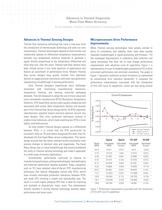
Advances in Thermal Sensing Designs Thermal flow measuring technology has come a long way since the introduction of thermocouple technology and early hot wire anemometers. Thermal technologies depend on heat transfer and traditionally operate on differential temperature measurements between two temperature sensitive materials to generate a signal directly proportional to the temperature differential and mass flow rate. Over the years, Thermal type flow sensors have been utilized across a very wide spectrum of applications and feature an assortment of performance limits. Modern Thermal flow sensor...
Open the catalog to page 2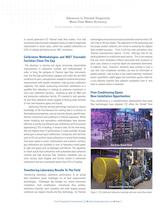
in current generation FCI Thermal mass flow meters. Error and uncertainty reduction have undergone nearly an order of magnitude improvement in recent years, which has enabled calibrations at 0.5% of reading and below across 100:1 turndowns. Calibration Methodologies and NIST Traceable Facilities Close The Gap The advances in sensing and signal processing necessitated improvements in calibration routines and methodologies. In order to bring the pedigree of Thermal type flow instruments truly into the high performance category and match the real field conditions of users, manufacturers needed to...
Open the catalog to page 3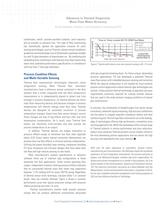
conditioners, which provide excellent isolation, swirl reduction and at virtually no pressure loss. This type of flow conditioning has dramatically opened the application universe for point sensing technologies, such as Thermal, whose normal installation guidelines recommend pipe runs of 20 diameters upstream straight run and 10 pipe diameters of downstream run. By combining and embedding flow conditioners with thermal mass flow meters they attain their published performance specifications in installations with less than 7 total pipe diameters. Process Condition Effects and Multi-Variable Sensing...
Open the catalog to page 4Archived catalogs
 FLT
FLT8 Pages
 FCI
FCI12 Pages
 ST51
ST512 Pages
 FCI Nuclear Products
16 Pages
 FCI Aerospace Products
8 Pages
 ST100
ST10020 Pages
 ST50
ST504 Pages
 ST75
ST758 Pages
 FCI Vortab Flow Conditioners
6 Pages
 MT series
12 Pages
 FCI Product Line Brochure
12 Pages


- Liquid flow monitor
- FCI level switch
- FCI liquid level switch
- FCI waterproof flow meter
- FCI gas flow meter
- FCI stainless steel flow meter
- FCI industrial flow meter
- Precision flow meter
- In-line flow meter
- Compact flow monitor
- DC flow monitor
- RS485 flow monitor
- FCI flow meter with display
- Stainless steel level detector
- FCI digital flow meter
- FCI Modbus flow meter
- DN25 - 1" flow monitor
- DN50 - 2" flow meter