
- Catalogs
- FBF Italia SRL
- Microlab 400

Microlab 400

Microlab 400
- Flow Rate: 400 l/h
- Working Pressure: 120 Bar
- Pumping Pistons: 2
- Net Weight: 120 kg
- Dimensions: 45x49x75 cm
- Single Pasteurizer (Recirculation Duty): The product is recirculated approximately five times at 50°C to ensure full homogenization.
- Two Pasteurizers (In-Line Installation): The product is transferred from the first pasteurizer at 85-90°C to the second for cooling.
Catalog excerpts
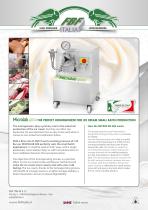
HIGH PRESSURE Microlab 400: THE PERFECT HOMOGENIZER FOR ICE CREAM SMALL BATCH PRODUCTION The homogenizers play a primary rule in the industrial production of the ice cream, but they are often too expensive, far oversized and not so easy to be used when it comes to non-industrial small batch duties. With a flow rate of 400 l/h and a working pressure of 120 Bar our MICROLAB 400 perfectly suits the small batch applications. It could be used in both ways: with a single pasteurizer (recirculation duty) or with two pasteurizers (in line installation between the two pasteurizers). The objective of the homogenizing process is a positive effect on the ice cream’s taste and flavour, furthermore it make the ice cream more creamy and with a less cold feeling. The ice cream, thanks to the homogenizing process, will benefit of a longer overrun, a higher storage stability, a better dissolution and an increased digestibility. How the MICROLAB 400 works The pumping pistons push the product trough the homogenizing valve at a pressure of 120 Bar. Into the homogenizing valve, due to a quick increase of the speed (up to a 9.300 cm/sec), a strong cavitation and due to the friction among the cells, the product is subject to a micronization process which reduces the average diameter of the solid fat particles to a few micrometers in diameter (< 0.0035 mm). The micronization process removes the fat cell’s external coating, increases the area in contact with the emulsifiers, favours the water-oil phase, makes the ice cream texture more soft and gives a dry taste which makes the ice cream a quality product. FBF ITALIA S.r.l. Via Are, 2 - 43038 Sala Baganza (Parma) - Italy [email protected] English versio
Open the catalog to page 1
Technical Features Included equipment: Suction filter, lubricant oil, set of seal kit, O&MM. Optional equipment: Food grade hose c/w fittings. When the product in the first pasteurizer reaches 51 the pasteurization temperature of 85-90°C, then the ^ homogenizer transfers the product into the second pasteurizer to accomplish the cooling duty. Once the product in the pasteurizer reaches the temperature of 50°C and the sugar has been fully solubilized, the homogenizer starts recirculating the batch in a loop (5 times approx), to make sure the ice cream is fully homogenized. The recommended...
Open the catalog to page 2All FBF Italia SRL catalogs and technical brochures
 FBF7 Series
2 Pages
 FBF8 Series
2 Pages
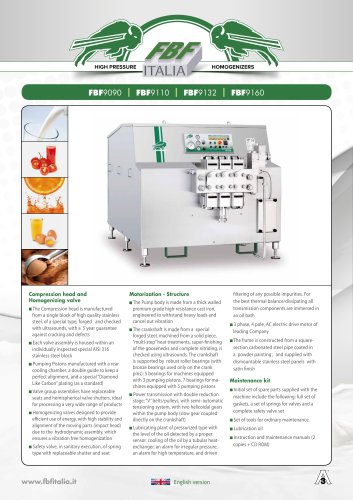 FBF9 Series
2 Pages
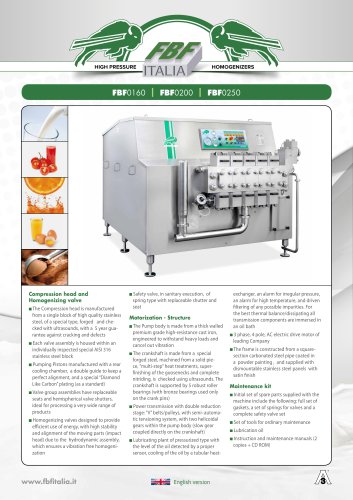 FBF0 SERIES
2 Pages
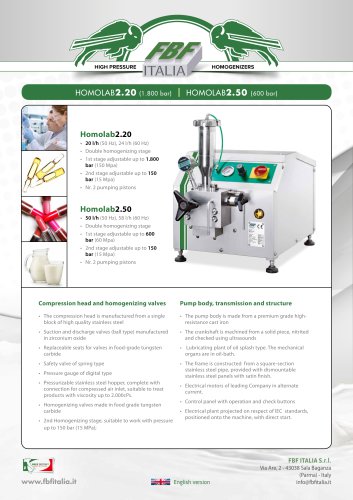 HOMOLAB
2 Pages
 HIGH PRESSURE HOMOGENIZERS
2 Pages