
- Catalogs
- FAULHABER Drive Systems
- FAULHABER motion 2/2022


FAULHABER motion 2/2022

FAULHABER motion 2/2022
FAULHABER celebrated its 75th anniversary in Schönaich, Germany, highlighting its pioneering role in miniaturization and drive technology. The event underscored the company's dedication to sustainability and innovation.
Managing Director Hubert Renner discussed FAULHABER's evolution from manual to automated production, stressing adaptability and innovation as key to meeting market demands and staying competitive.
The BAMMsat project, utilizing FAULHABER motors, developed a minilab for space scientific studies, showcasing the application of FAULHABER technology in space exploration.
The colorDoS dosing system, featuring FAULHABER drives, enables rapid color changes in injection molding, demonstrating the precision and efficiency of FAULHABER technology.
Pipetronics uses FAULHABER technology for trenchless sewer renovation, highlighting its role in advanced robotic solutions.
The FAULHABER Drive Calculator helps developers efficiently select suitable drive systems, while the new FAULHABER L series offers comprehensive solutions for linear drive tasks.
The document details the colorant dosing process in injection-molding machines, emphasizing the precision of FAULHABER BX4 CS brushless DC-servomotors, which use Hall sensors for precise dosing.
Pipetronics focuses on trenchless sewer renovation with robotic systems, preferring electric drives for their efficiency and reduced noise, and moving towards automation to address personnel shortages.
This tool aids developers in quickly selecting suitable drive systems, offering a user-friendly interface and detailed performance data.
These actuators provide a comprehensive package for various linear drive tasks, emphasizing flexibility and compatibility with other FAULHABER products, suitable for demanding applications in optics, robotics, and medical technology.
Catalog excerpts

THE MAGAZINE WITH DRIVE AMAZING color variety
Open the catalog to page 1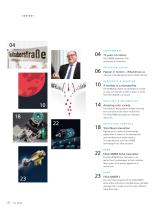
75 years of motion FAULHABER celebrates 75th anniversary in Schönaich. INTERVIEW SERIES Passion in motion – What drives us Interview with Managing Director Hubert Renner. A E R O S PA C E & AV I AT I O N A minilab in a minisatellite The BAMMsat project has developed a minilab to carry out scientific studies in space. A motor from FAULHABER is on board. I N D U S T RY & A U T O M AT I O N Amazing color variety The colorDoS dosing system enables switching from one color to the next in record time. The FAULHABER drive plays an important role in this. INSPECTION ROBOTICS Trenchless renovation Pipetronics...
Open the catalog to page 2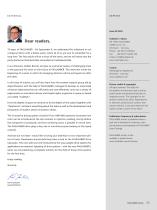
Dear readers, 75 years of FAULHABER – On September 9, we celebrated this milestone in our company history with a festive party, which all of us are sure to remember for a long time. The first article will be a revue of the event, and we will reveal why the party started on Daimlerstraße and ended on Faulhaberstraße. In an interview, Hubert Renner will give us a personal review of challenging times in the past and his views on the future of FAULHABER. This interview marks the beginning of a series in which all managing directors will be portrayed one after the other. In this issue of motion, you...
Open the catalog to page 3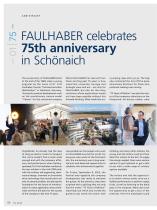
FAULHABER celebrates 75th anniversary in Schönaich The success story of FAULHABER starts at the end of the 1940s when a young engineer by the name of Dr. Fritz Faulhaber founds “Feinmechanischen Werkstätten” in Schönaich, Germany. During his previous development work on the revolutionary camera model “Vitessa” for the renowned company a jumping rope and a yo-yo. The bag also contained the hot-off-the-press anniversary brochure for those who preferred reading over moving. Voigtländer, he already had the idea of using an electric motor to transport film. As he couldn’t find a motor small enough...
Open the catalog to page 4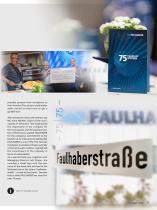
Also among the many well-wishers was Ms. Anna Walther, mayor of the municipality of Schönaich. She emphasized the importance of the company for the municipality and the business location of Schönaich, praised FAULHABER for the company's commitment to the location at its roots and, by stating that FAULHABER is one of the first German companies to produce climate-neutrally at the Schönaich location, highlighted the commitment of the company in terms of sustainability. As a special thank you, together with Managing Director Lutz Braun, she unveiled a street sign with the new name of the street that...
Open the catalog to page 5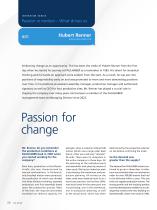
INTERVIEW SERIES Passion in motion – What drives us Hubert Renner MANAGING DIRECTOR Embracing change as an opportunity. This has been the credo of Hubert Renner from the first day when he started his journey at FAULHABER as a toolmaker in 1983. His talent for analytical thinking and his hands-on approach were evident from the start. As a result, he was put into positions of responsibility early on and was promoted to more and more demanding positions over time. In his positions as assistant assembly manager, production manager and authorized signatory as well as CEO for four production sites,...
Open the catalog to page 6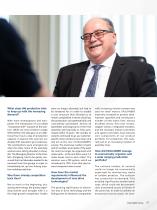
What steps did production take to keep up with the increasing demand? With more womanpower and manpower. The introduction of a so-called “housewives shift” was part of the solution. While we only worked in single shifts before, this step gave us an additional four hours a day of production capacity. In essence, this was how our double shift operation got underway. The workstations were arranged one after the other. Some of the assembly workers were sitting shoulder to shoulder. The Managing Director at the time, Mrs. Klingberg, had to be gently convinced that her Mercedes needed to be removed...
Open the catalog to page 7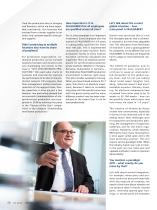
ched the production sites in Hungary and Romania, which we have expanded consistently. Our business had evolved from a motor supplier to an order- and customer-specific drive system supplier. Didn’t producing at multiple locations also have its share of problems? For production organization, ondemand production across multiple locations has been and remains to be very challenging. Our answer to this issue is “SITE-SYNCHRONIZED PRODUCTION.” We used radar charts to evaluate and consistently improve the performance of all sites in the production network. CIP programs, shop floor management, kanban...
Open the catalog to page 8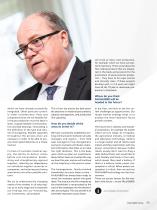
Let’s look at clean room production, for example, which we have just started in Germany. There we produce the first medical products that are implanted in the body and products for the automation of semiconductor production – they have to be super precise and clinically clean. If these projects develop well, in 3–4 years we might have 50, 60, 70 jobs in cleanroom production in Schönaich. Where do you think FAULHABER will be headed in the future? which we have already successfully integrated. Other parts are currently under consideration. Parts and components that are not feasible for in-house...
Open the catalog to page 9
What are the health concerns when traveling to Mars? A mini laboratory in a mini satellite is looking for answers Space is a hostile environment. This – in addition to the vast distances – makes manned space travel pretty difficult. Central problems include weightlessness and exposure to cosmic radiation. Anyone planning long-duration journeys through the universe needs to be aware of and fully understand the effect that these problems have on biological processes. Space exploration with human subjects is, however, very expensive and extremely complex. The British BAMMsat project has therefore...
Open the catalog to page 10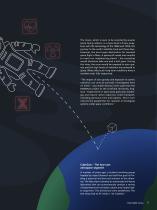
The moon, which is soon to be revisited by several space-faring nations, is a mere stone's throw away. Even with the technology of the 1960s and 1970s, the journey to the earth's satellite took just three days. However, the next major destination for manned space flight is Mars. A spacecraft needs nine months to reach our neighboring planet – the roundtrip would therefore take one and a half years. During this time, the crew would be exposed to zero gravity and the high levels of radiation encountered in space. What effect such long-term conditions have is nowhere near fully researched. "The...
Open the catalog to page 11All FAULHABER Drive Systems catalogs and technical brochures
 FAULHABER nmotion 1/2026
48 Pages
 FAULHABER motion 2025
36 Pages
 Encoders - Series IEX3- L
2 Pages
 Series 1218 ... SXR
2 Pages
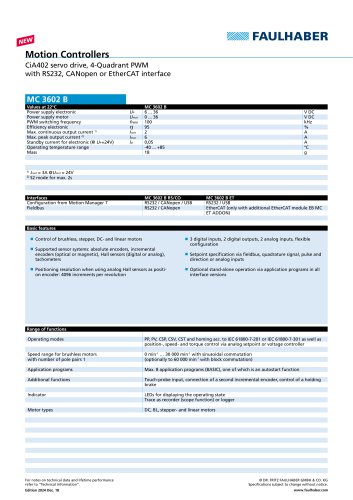 MC 3602 B
2 Pages
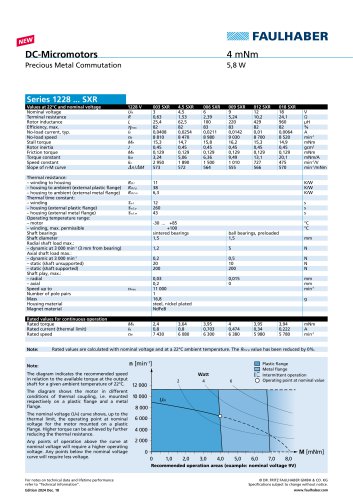 Series 1228 ... SXR
2 Pages
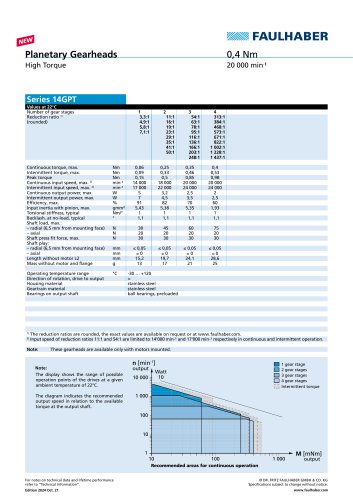 14GPT
14GPT2 Pages
 FAULHABER motio
36 Pages
 FAULHABER motion 1/2023
32 Pages
 Motion Controllers MC 3603 S
2 Pages
 FAULHABER motion 1/2021
24 Pages
 Linear Actuators L series
12 Pages
 FAULHABER motion 1/2022
33 Pages
 Faulhaber motion 02/2021
28 Pages
 The magazine with drive
28 Pages
 motion 1/2020
32 Pages
 Technical Information
162 Pages
 motion 2/2019
28 Pages
 FAULHABER motion 2/2017
28 Pages
 FAULHABER motion 1/2017
28 Pages
 motion the magazine with drive
28 Pages
 Drives Systems
40 Pages
 motion the magazine with drive
28 Pages
 The magazine with drive
28 Pages
 EVOLUTION humanoids ROBOTICS
28 Pages
 TECHNOLOGY UNDER THE SKIN
24 Pages


Archived catalogs
 The magazin with drive 1/2019
28 Pages
 Drive Systems
521 Pages
 FAULHABER Info Issue 1/2013
16 Pages
 news brochure
48 Pages
 FAULHABER info issue 1 / 2012
20 Pages
 FAuLHABER info issue 2 / 2011
16 Pages
 FAULHABER info edition 1/2011
16 Pages


- FAULHABER DC motor
- FAULHABER synchronous motor
- Alternating current motor
- Multipole motor
- Electric gearmotor
- FAULHABER rotary encoder
- Linear actuator
- FAULHABER planetary gear reducer
- Electric actuator
- FAULHABER coaxial gear reducer
- Incremental encoder
- EC motor
- Electromotor for industrial applications
- Precision gearhead
- 24 V motor
- Incremental rotary encoder
- Direct current gear-motor