
- Catalogs
- Farris Engineering
- 2600 series : Pressure Relief Valves

2600 series : Pressure Relief Valves

2600 series : Pressure Relief Valves
The document provides detailed information on the Series 2600, 2600S, and 2600L pressure relief valves by Farris Engineering, designed for automatic overpressure protection in industrial settings. It highlights the design, construction, and operational features, emphasizing reliability and safety.
Farris valves are known for ease of sizing and selection, supported by catalogs and software. They offer a flexible design for use and repair, ensuring safety and seat tightness, with extensive customer support and parts availability.
The Series 2600 valves are suitable for air, gases, steam, and liquid services, complying with ASME Section VIII standards. They feature a full nozzle for stable flow and a balanced bellows for consistent performance under variable backpressure. The construction resists discharge piping strains and isolates the bonnet spring chamber, minimizing high temperature and corrosive impacts.
The document includes technical definitions, scope, and a type numbering system for ordering and replacements. It provides standard bills of materials and details on specific designs like the 2600L certified design and the 2600S exposed spring.
Orifice selection tables and charts are provided in U.S. and metric units, covering various overpressure scenarios. Capacity tables for air, steam, and water detail performance under different conditions.
Information on accessories such as cap and lever materials, test gag installations, and steam jacketing methods is provided, along with dimensions and weights for valves and flange connections.
Sizing equations and nomenclature are detailed for conventional and BalanSeal valves, with fluid data and sizing factors for vapors, gases, steam, and liquids, along with conversion factors.
Farris Engineering offers a warranty against defects in material and workmanship for a specified period, with conditions outlined for returns and replacements.
The Farris pressure relief valve features an integral sleeve guide for positive alignment and high corrosion resistance. The design minimizes foreign particle interference by extending the sleeve guide above the guide flange and providing drainage openings.
The valve ensures exceptional tightness through positive alignment, a high-strength disc design, elimination of thermal distortion, and optimal seating surface finish.
The valve features an all stainless steel stem construction to prevent galvanic corrosion and ensure proper alignment. A two-piece design allows easy conversion to bellows construction, reducing maintenance costs.
The valve can be converted between conventional and BalanSeal configurations with minimal changes, maximizing parts interchangeability to reduce spare parts inventory.
Standard flanged connections conform to ANSI B16.5, and the valve trim includes the nozzle and disc. Set pressure should be at least 10% above operating pressure, with temperature compensation necessary for set pressure adjustments.
Definitions for terms like overpressure, accumulation, blow down, lift, and back pressure are provided, emphasizing the importance of maintaining a suitable margin above operating pressure.
Various materials are specified for different temperature ranges, with a type numbering system for ordering, specifying quantity, size, materials, and other parameters.
Orifice letters correspond to specific areas in square inches and millimeters, with API and actual areas provided for each orifice letter.
Specify quantity, size, type number, materials, set pressure, temperature, fluid state, back pressure, capacity, and accessories. Code requirements and physical properties of fluid must be included for verification.
Specify valve type, size, and serial number for replacements, ordering spare parts using part names from the bills of materials.
Classes range from 150 to 2500, with special materials available upon request.
Special materials like 316L stainless steel and Hastelloy C are available for corrosive environments.
The 2600L Series is designed for ASME Section VIII Code applications, offering greater capacity at 10% overpressure. The 2600S Series is enhanced for steam service with exposed springs, built to ASME Code Section VIII. Both series maintain interchangeability of parts and are certified by the National Board.
Applies to specific orifice sizes and materials, with additional pages providing details for corrosive and low temperature materials. Capacities and dimensions are specified in separate sections.
The document outlines specifications for the 2600 Series pressure relief valves, including the use of a standard 2600 vapor service valve with an open lever. The valves are designed with a balanced piston and bellows to handle back pressure conditions and prevent set pressure increases due to bellows rupture.
In case of bellows failure, the piston design compensates for back pressure, allowing the valve to continue functioning. Guidance is provided on converting conventional valve type numbers to catalog numbers for balanced bellows valves.
The valves are constructed in compliance with ASME Code Section VIII and certified by the National Board, suitable for heat transfer fluid service, requiring tightness and precise guiding. Materials for corrosive and low-temperature services are specified, including options for Monel and Hastelloy C constructions.
The valves comply with NACE MR0103 and MR0175/ISO 15156 standards for sour gas service, with material requirements for compliance and suffixes for specifying NACE-compliant valves.
For corrosive environments, more resistant materials like Monel and Hastelloy C are recommended. Damaged bellows should be replaced to prevent product loss, and consulting the Farris Factory is advised for special applications requiring non-standard materials.
The document discusses the use of O-ring seat seals in pressure relief valves to address issues such as operation close to set pressure, handling of light fluids, and conditions involving foreign particles, vibrations, corrosive fluids, and nozzle icing.
Farris Engineering introduced the O-ring seat in the 1950s to achieve tightness at pressures closer to the valve set pressure, allowing set pressures up to 1500 psig.
The O-ring seat seal is available for the 2600/2600L/2600S Series of flanged pressure relief valves, including conventional, BalanSeal, and BalanSeal/piston constructions.
The O-ring seat pressure seal is beneficial in applications with fluctuating pressures, light fluids, vibrations, foreign particles, and corrosive environments, ensuring tightness and reducing leakage.
The document provides a detailed O-ring material selection table, listing materials like Viton, Ethylene Propylene, Buna N, Silicone, Kalrez, and Neoprene, along with their temperature ranges and pressure ratings.
Selection charts detail valve sizes, ANSI flange classes, maximum set pressures, back pressure limits, and material specifications for different orifice sizes.
Standard seat tightness for O-ring valves is specified, with additional notes on material compatibility and application conditions.
Detailed specifications for various valve types, including conventional and BalanSeal valves, categorized by orifice size, ANSI flange class, maximum set pressure, back pressure limit, material, and inlet temperature range.
Procedures for selecting the appropriate valve type based on application requirements, including temperature and pressure conditions.
References ANSI B16.5 for outlet pressure ratings above 38°C and the ASME Pressure Vessel Code (UV) for air capacities.
Consult additional pages for BalanSeal, O-ring construction, balanced piston design, and other valve options.
Tables provide detailed data on valve sizes, flange classes, maximum set pressures, back pressure limits, materials, and temperature ranges.
Key parameters include maximum set pressure, back pressure limits, and material specifications for different temperature ranges.
- Dimensions & Weights: Lists dimensions in inches and millimeters for different valve models, including inlet and outlet sizes, and provides approximate weights.
- ANSI Flange Connection Types: Explains different types of flange connections and their impact on valve dimensions.
- Detail of Flanges on Farris Nozzle Valves: Provides information on full nozzle inlet facings, referencing ANSI B16.5 standards.
- ANSI Flange Dimensions: Lists dimensions for ANSI raised face and ring joint flange facings.
- Valve models are identified by codes with specific dimensions and weights provided for each.
- Flange dimensions are critical for ensuring compatibility with existing systems.
- Understanding flange connection types is essential for proper installation and maintenance.
- ASME “V”, “UV” and “NV”
- National Board “NB” approval
- ISO 9001-2008
- US Coast Guard
- PED 97/23/EC (European Pressure Equipment Directive)
- ATEX 94/9/EC (European Potentially Explosive Atmospheres)
- B51 CRN (Canadian Registration)
- China Safety Quality License
- Russian GOSH-R and GGNT (Russian Certification and Permits)
- First Point Assessment Limited
- Nuclear – 10 CFR 50 Appendix B, NCA-4000, NQA-1, N285.0
10195 Brecksville Road, Brecksville, OH 44141 USA
Telephone: 440-838-7690
Fax: 440-838-7699
Website: http://farris.cwfc.com
- Brecksville, Ohio, USA
- Brantford, Ontario
- Edmonton, Alberta, Canada
- Bridport, Dorset, UK
- Delhi, India
- Tianjin, China
Catalog excerpts

Pressure Relief Valves 'Flow Control Company Farris Engineering
Open the catalog to page 1
Introduction This catalog covers Series 2600, 2600S and 2600L pressure relief valves including the latest infor ation available to assist m you in the sizing and selection of the proper valves for your application. Farris pressure relief valves have over a half century of proven performance providing auto atic and positive m protection against overpressure in thousands of industrial plants and facilities worldwide. Our earned reputation as “the First Line of Safety” is the result of countless Farris innovations combined with progressive engineering, sound design and high quality production....
Open the catalog to page 3
The Farris Advantage Farris pressure relief valves are designed to automatically protect your equipment against excessive overpressure. Every care is taken in the development, design and production of these valves to ensure complete dependability in performance. Our constant objective is to provide a superior valve that will assure ultimate protection at the lowest cost, both initially and throughout its service life. What is the Farris Advantage? Easy sizing and selection of valves using Farris catalogs and/or SizeMaster™ Sizing and Selection software. A method of specification and ordering...
Open the catalog to page 4
2600 Series Design Valve Selection This catalog simplifies the sizing and selection of Series 2600 process pressure relief valves. The pressure relief valves are presented here in an easy-to-understand format. Unless otherwise stated, references made to the Code refer specifically to ASME Section VIII, Division 1. Certified Capacity Code Compliance The Series 2600 pressure relief valves have been carefully constructed and tested in accordance with the requirements of the ASME Pressure Vessel Code, Section VIII. Their capacity rating for the applicable fluids is certified by the National Board...
Open the catalog to page 5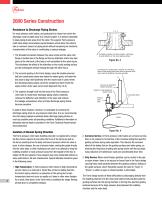
2600 Series Construction Resistance to Discharge Piping Strains For most pressure relief valves, and particularly for those from which the discharge must be piped away to a remote location, it is almost impossible to keep piping strains away from the valve. The superior Farris pressure relief valve design incorporates several features which allow this valve to take a maximum amount of piping strain without hampering the functional characteristics of the valve or contributing to serious leakage. 1. The threaded connection between the valve nozzle and the valve inlet flange is located low in the...
Open the catalog to page 6
2600 Series Metallurgy Integral Sleeve Guide The Farris pressure relief valve design incorporates an integral sleeve guide (Fig 5), assuring continual positive alignment after the part has been manufactured, and including the same high corrosion resistant properties in the guide flange that are present in the sleeve portion of the guide. The sleeve guide is extended above the top of the guide flange, minimizing the possibility of corrosive or other foreign particles washing onto the guiding surfaces when the valve is relieving or when it is “breathing” as a result of atmospheric temperature changes....
Open the catalog to page 7
2600 Series Operation All Stainless Steel Stem Construction The Farris pressure relief valve design features an all stainless steel stem. This construction cost-effectively eliminates dangerous sticking due to galvanic corrosion at the upper guiding point in the spring adjusting screw. The careful design of this upper bearing also ensures proper alignment and optimum freedom from galling and erratic popping. Positive Connection of Parts The Farris design incorporates a positive connection between the valve stem and the stem retainer as well as between the disc and disc holder (Fig 7). These connections...
Open the catalog to page 8
2600 Series Operation Steam Jacketing for Better Heat Transfer In modern process plants, it is necessary to keep some valves and lines warm at all times to avoid solidification of the lading fluid and to guarantee the safety of equipment. Farris offers a steam jacket (Fig 8) to substantially increase the rate of heat transfer into the valve and, at the same time, simplify the problem of removing or dismantling the valve for maintenance. This design offers a separate two-piece jacket that installs on a standard valve body. See details on page 71. Simple, Accurate Adjustments The single Blow Down...
Open the catalog to page 9
General Technical Information Standard Flanged Connections 1. All steel raised face flanges are supplied with a serrated spiral finish with 45 to 55 grooves per inch and a finish between 125 and 160 AARH. 2. All ring joint flanged facings are supplied for octagonal or oval gaskets. 3. Facings other than raised face or large male can be supplied at additional cost. 4. Flange ratings that conform to ANSI B16.5 are indicated on each Orifice Selection Table. Heavier outlet flanges can be supplied at additional cost. For flange dimensions, see ANSI Dimension Table, page 77. 5. Drilling of all flanges...
Open the catalog to page 10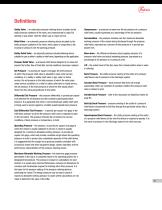
Definitions Safety Valve – an automatic pressure relieving device actuated by the static pressure upstream of the valve, and characterized by rapid full opening or pop action. Used for steam, gas or vapor service. Relief Valve – an automatic pressure relieving device actuated by the static pressure upstream of the valve, which opens in proportion to the increase in pressure over the opening pressure. Safety Relief Valve – an automatic pressure actuated relieving device suitable for use as either a safety or relief valve, depending on the application. Pressure Relief Valve – a pressure relief...
Open the catalog to page 11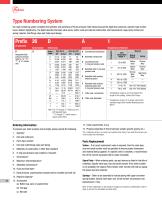
Type Numbering System Our type numbering system simplifies the selection and specifying of Farris pressure relief valves because the digits that comprise a specific type number have a distinct significance. The digits describe the basic valve series, orifice, seat and internal construction, inlet temperature range, body, bonnet and spring material, inlet flange class and Code liquid design. H Designates high pressure versions. Used for “Q”, “R”, “T”, & “U” orifices only. Series Number Orifice Areas Orifice Letter E BalanSeal with auxiliary balancing piston F BalanSeal with auxiliary balancing...
Open the catalog to page 12All Farris Engineering catalogs and technical brochures
 Serie 2700
20 Pages
 Farris engineering
8 Pages
 nuclear product
4 Pages
Archived catalogs
 Universal test stand
1 Page
 Authorized Service team
4 Pages
 Size master
2 Pages
 Serie 2856
2 Pages
 Serie 6400-6600
8 Pages
 Serie 2850
2 Pages
 Serie 4200
16 Pages
 Serie 1896M
2 Pages
 Serie 1890
2 Pages
 Serie 3800
24 Pages
