


- Company
- Products
- Catalogs
- News & Trends
- Exhibitions
High Performance Sound Insulation

High Performance Sound Insulation
Farrat is an engineering company specializing in vibration control, thermal isolation, and precision levelling, serving sectors such as construction, industrial, and power generation. The company focuses on innovation, technical expertise, and customer support.
Modern buildings require careful design to manage noise and vibration. Floating floors are a cost-effective solution, enhancing acoustic performance by adding mass and stiffness.
Farrat's floating floors are used in various settings like cinemas, studios, and residential buildings for noise and vibration isolation.
Farrat's products comply with BS 6177:1982 and BS EN 1337-3:2005 standards, with acoustic testing in UKAS accredited labs and ISO 9001:2008 quality assurance.
Farrat offers concrete, screed, and dry floating floor systems, each with specific benefits. Concrete systems are known for strength, while dry systems allow quick installation.
These systems provide guaranteed isolation by lifting the slab, ideal for high-load applications and adjustable air-gaps.
Farrat uses natural rubber and synthetic elastomers for isolators, focusing on low stiffness and high resilience, with specific damping properties and load capacities.
Farrat floating floors are typically rated for a 5kN/m2 load, with adjustments for higher loads. Proper planning for isolator placement is crucial for heavy equipment and point loads.
Supporting walls on floating floors requires increased isolator area or decreased spacing. Two methods for interfacing steel columns with floating floors are discussed.
Mineral wool in the cavity enhances low-frequency performance, with 50% filling increasing sound insulation by 1dB and 100% filling achieving up to 6dB improvement at 100Hz.
Detailed steps for installing Isomat and Jack-Up floating floors include grid marking, isolator placement, and concrete pouring, emphasizing the importance of maintaining adequate air volume.
Examples like Westfield, Stratford City, and Milton Court demonstrate successful applications of Farrat systems in complex projects.
Farrat and AcouStruct focus on sustainability, using recyclable materials and certified timber, aiming to reduce their carbon footprint.
The document outlines design and installation procedures for acoustic and vibration control solutions, featuring box-in-box designs with Jack-Up floors and specialist acoustic components.
- 608-seat concert hall and 227-seat theatre, with additional theatres and studios.
- Over 1,310 elastomeric bearings and pads used.
- Jack-Up and precast floating floors designed to a natural frequency of 9Hz.
- Precast Floor Installation: Use concrete upstands or grout pedestals for height matching, ensuring level surfaces with grout beds or steel packers.
- Steel Sections: Adjust steel sections with temporary bracing for stability, ensuring full contact support.
- Precast Planks: Install planks onto steel sections, minimizing joint gaps and using Isofoam for acoustic sealing.
- Concrete Pouring: Construct formwork and pour concrete carefully to avoid overspill.
Farrat Isolevel Ltd, Balmoral Road, Altrincham, Cheshire, WA15 8HJ, England, UK. Phone: +44 (0) 161 924 1600, Email: [email protected]
Farrat specializes in solutions for vibration control, thermal isolation, and precision levelling across various industries.
Catalog excerpts

Farrat is a specialist engineering company that manufactures solutions for vibration control, thermal isolation and precision levelling applications in the global construction, industrial and power generation sectors. We produce structural and acoustic vibration isolation systems, thermal break connections and machine levelling mounts as well as other ancillary products serving a variety of end user applications. Our multi-disciplinary team encompasses mechanical, structural, acoustic and construction engineering specialists and is backed up with 50 years of technical expertise. We work closely...
Open the catalog to page 2
Acoustic Floating Floor Systems
Open the catalog to page 3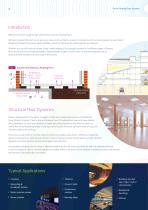
Farrat Floating Floor Systems Introduction Welcome to Farrat’s guide to high-performance, acoustic floating floors. We have prepared this brochure to serve as a resource for architects, acoustic consultants and structural engineers to assist when designing and specifying spaces where vibration control or high levels of sound insulation are required. Whether you use this brochure to gain a basic understanding of the concepts involved in the different types of floating floors or use the technical data provided to design bespoke systems, Farrat’s team of specialist engineers are on hand to provide...
Open the catalog to page 4
Why choose Farrat Acoustic Floating Floors? Farrat’s Isomat and Jack-Up floating floors... ❫ Are used in a wide range of buildings to protect sensitive areas from noise sources or to contain noise sources within their areas ❫ Offer flexibility in delivery as well as being easy, fast and economical to install ❫ Provide a high degree of impact, shock and vibration control through a combination of mass addition and structural decoupling by constructing the floating slab on elastometric or coil spring isolators tuned to specific frequencies ❫ Provide a high degree of airborne noise isolation through...
Open the catalog to page 5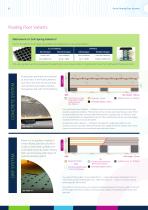
Floating Floor VariantsElastomeric or Coil-Spring Isolators? Each of the options on this page are available with elastomeric or coil-spring isolators. Coil-spring isolators are more expensive than elastomeric ones, however allow for higher performance from lightweight floating elements. Floating floor performance is achieved by extra mass in the floating element. Such floors are more economical than Jack-Up floors and create a full area, homogenous slab with minimal flanking. H Concrete or screed | Plywood: 15mm H Isolation zone: 37-200mm with mesh or fibre reinforcement: Perimeter isolation:...
Open the catalog to page 6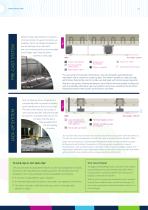
KEY: Screed: 100-400mm Pre-cast concrete planks: 50mm Isolation zone: 80-300mm Packer: as required Mesh reinforcement loops Pre-cast system is formed by combining pre-cast concrete planks spanned between steel beams with a concrete or screed top layer. This makes it possible to create very high performance floating floors which can take very high loads with minimal supporting points. SEE PAGE 18 Jack-Up floating floors comprise of a concrete slab which is poured on a damp proof membrane on the structural slab. The slab is then 'jacked’ up by way of units cast into the slab. They are favoured...
Open the catalog to page 7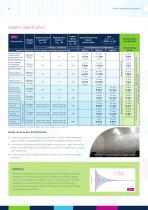
Isolator Specification Fig 8.1 Construction For loads considered in the above table, ADL = DL + 33% LL, LL = 5kN/m2 Notes on Acoustic Performance ) Configurations based on a 12m x 6m room with 75mm x 75mm x 50mm elastomeric isolators at 600mm centres and 90 x 55 x 63mm spring isolators at 400mm centres. ) Some available test values are only “predicted from test results” rather than directly tested as the performance of our products was too high for the laboratory to test at some frequencies. ) Further acoustic data is available on request. Site test data is available to validate predictions....
Open the catalog to page 8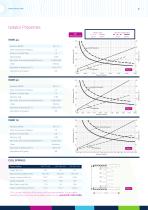
Isolator Properties KEY (all graphs p9) Static Compression Modulus 1.3 Dynamic to Static Ratio 1.2 Max Static Pressure [Overload] (N/mm2) 0.26 [0.39] Creep Minimal Operational Life (years) 60 Static Compression Modulus 2.0 Dynamic to Static Ratio 1.5 Max Static Pressure [Overload] (N/mm2) 0.40 [0.60] Creep Minimal Operational Life (years) 60 Static Compression Modulus 3.5 Max Static Pressure [Overload] (N/mm2) 0.70 [1.05] Creep Moderate Operational Life (years) 60 COIL SPRINGS Farrat Isolator OSI 75-63 OSI 100-63 OSI 125-83 Spring Constant (kN/mm)...
Open the catalog to page 9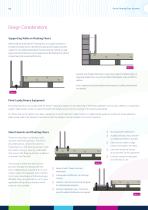
Design Considerations Supporting Walls on Floating Floors Where walls are to be built off a floating floor, it is usually necessary to increase the isolator area or decrease the spacing of the pads to provide support for the additional line load of the wall. Using this method, any wall types, even dense blockwork can be supported by the floating floor without compromising the acoustic performance. A quicker and cheaper alternative to supporting walls on a floating slab is to separately isolate them using Farrat FAVIM stud isolation strips and AWTH washes. A very high level of sound insulation...
Open the catalog to page 10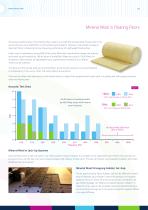
Mineral Wool in Floating Floors The acoustic performance of our floating floor systems is so high that incorporating mineral wool in the cavity only has a very small effect on the overall sound insulation. However mineral wool can play an important factor in boosting the low frequency performance of a lightweight floating floor. Under most circumstances, having 50% of the cavity filled with mineral wool increases the airborne and impact sound insulation by 1dB (in terms of overall Rw). When the cavity is 100% filled, this increases to 2dB, however for lightweight floors a performance increase...
Open the catalog to page 11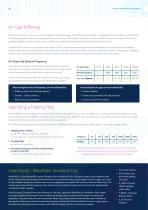
Air-Gap Stiffening When the volume of air in the cavity is low in relation to the surface area of the floating element above it, a phenomenon occurs called 'air-gap stiffening'. As the floating element vibrates, it compresses the air in the cavity, which causes it to behave more like a solid than a gas. In small rooms, the effect is generally negligible, however in large rooms, the effect can significantly undermine the acoustic performance of the floor. The results of our acoustic testing show that air-gaps less than 35mm should be avoided to reduce the likelihood of encountering air-gap stiffening unless...
Open the catalog to page 12All Farrat catalogs and technical brochures
 Isoblocs
3 Pages
 FSL Isolators
4 Pages
 PRECISION LEVELLING ELEMENTS
2 Pages
 Building Vibration Isolation
28 Pages
 Farrat Favim (FV)
2 Pages
 Farrat Isomat Nitrile (IMNR)
8 Pages
 Farrat Verlimber (VR)
6 Pages
 Farrat Vidam (VM)
7 Pages
 Farrat Squaregrip (SG)
8 Pages
 Farrat Nitrile (BR)
9 Pages
 AVA - PLAS - 17a
2 Pages
 Farrat Jackmounts
2 Pages
 Farrat Isolated Foundations
36 Pages
 Farrat Wedgemounts
16 Pages
 Farrat Isomounts
4 Pages
 Farrat Isoblocs
3 Pages
 Farrat Levalators
2 Pages
 Full Building Isolation
28 Pages
 Farrat AWTH Acoustic Washers
2 Pages
 Farrat AWR Acoustic Washers
2 Pages


