


- Company
- Products
- Catalogs
- News & Trends
- Exhibitions
Farrat Vidam (VM)

Farrat Vidam (VM)
Farrat offers design and consultancy services to select appropriate materials for applications requiring resilient supports or connections, emphasizing the importance of material choice to prevent negative impacts on machinery performance.
VM material is a granulated cork composite with a low Poisson's ratio, minimal bulging, and stability under various conditions. It can handle high dynamic and static loads, is manufactured in the UK, and is free from harmful substances. It operates effectively between -25ºC and +120ºC.
Farrat VM materials are used worldwide as anti-vibration and damping pads in industrial applications, suitable for foundations, HVAC equipment, lifts, escalators, conveyors, generators, pumps, compressors, buildings, and modular accommodations.
The document details specifications for VM materials, including hardness, thickness, tread types, and performance metrics like working pressure, natural frequency, peak operating pressure, and damping ratio.
Performance is categorized by pressure and natural frequency, with tables providing material codes, thickness, working pressures, frequencies, and damping ratios. This data serves as guidance and may change.
1. Tests comply with ISO standards, adapted for customer applications.
2. Optimum working pressure is where natural frequency increases.
3. Peak operating pressure indicates minimal strain change.
4. Natural frequency is averaged from various tests.
5. Damping ratio describes vibration decay and can be adjusted.
6. Transmissibility data is available upon request.
Graphs illustrate relationships between deflection, pressure, natural frequency, damping ratio, and transmissibility under different conditions.
Characteristics of elastomeric materials include thickness, hardness, compression chord modulus, static stiffness, optimum working pressure, peak operating pressure, minimum natural frequency, and average damping ratio, with a tolerance of ±10%.
Static and dynamic tests follow ISO 7743:2011 (E) and ISO 4664-1:2011 (E) standards, with adaptations for customer needs. Contact the company for specific data or tests.
- Optimum Working Pressure (Po): Pressure where natural frequency increases.
- Peak Operating Pressure (PUS): Pressure with minimal strain change.
- Natural Frequency (fn): Based on average test outputs.
- Damping Ratio (ζ): Describes vibration decay.
- Transmissibility (Tr): Ratio of transmitted to exciting force amplitude.
Graphs show relationships between deflection, natural frequency, damping ratio, and transmissibility against pressure and frequency, aiding in understanding material behavior under different conditions.
For specific performance characteristics or material suitability, contact Farrat Isolevel Ltd. for support in selecting appropriate materials for specific applications.
Catalog excerpts
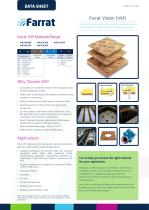
DATA SHEET Farrat Vidam (VM) A high performance general purpose anti vibration material used globally in a wide range of industrial applications. Farrat VM Materials Range VM7006PP VM7020PP V HARDNESS (IRHD) BR = Nitrile (NBR) CR = Neoprene HM = Hamamat IS = Isofoam NR = Natural Rubber VR = Verlimber VM = Vidam SG = Squargrip T = Square Tread I = Isomat P = Plain Why Choose VM? Granulated cork composite material with low poisons ratio, limited bulging and no tread AWTH WASHER AWTH WASHER Stable under a wide range of atmospheric conditions and is suitable for use outdoors Ability to withstand very high dynamic and static loads Manufactured in the UK by Farrat using high quality compounds Can be supplied as full sheets (1000x1000 mm), cut to size pads and strips (including holes and slots if required) according to the customer’s requirements. Free of Polycyclic Aromatic Hydrocarbons (PAH), Heavy Metals (Pb, Cd, Hg and Cr (VI)) and Asbestos Working temperature range: -25ºC to +120ºC High chemical resistance including oils & grease Applications Farrat VM materials can be used as anti-vibration & damping pads for a wide range of industrial applications. Isolated Foundations for machine tools and industrial equipment (saws, lathes, drills, guillotines, textile manufacturing equipment, reciprocating machines e.g. bodymakers, metal extruding presses, drawing presses etc.) Heating, ventilating and refrigeration equipment (AHUs, CHRVs, Chillers etc.) Lifts and escalators Conveyors Gen sets Pumps & compressors Buildings and structures Modular accommodation, pods Note: These applications are a guide. The most suitable material will depend on the specific characteristics and constraints of your application Let us help you choose the right material for your application. Designing a resilient support or connection, and selecting a suitable material, can be complex. Without the correct consideration it is possible to adversely affect the performance of plant or machinery when incorporating a flexible support. Farrat offer a wide range of design and consultancy services, so please contact us with your requirements and we will work with you to find the right solution
Open the catalog to page 1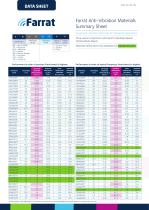
DATA SHEET Farrat Anti-Vibration Materials Summary SheetFarrat Anti-Vibration Materials for Industrial ApplicationsTo be used in conjunction with Farrat's individual material Technical Data Sheets. Materials referenced in this datasheet are highlighted green. BR = Nitrile (NBR) CR = Neoprene HM = Hamamat IS = Isofoam NR = Natural Rubber VR = Verlimber VM = Vidam SG = Squargrip Performance in order of pressure from lowest to highest: Performance in order of natural frequency from lowest to highest: MATERIAL CODE MATERIAL CODE All information in this datasheet is for guidance only based on current...
Open the catalog to page 2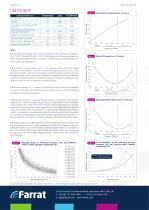
1.1 The static and dynamic tests were in accordance with international standards: ISO 7743:2011 (E) and ISO 4664-1:2011 (E) although some factors were adapted to better suit typical applications of our customers. Please contact us if would like specific data or tests to be undertaken. 1.2 Optimum working pressure, (Po), is the pressure point where the natural frequency of the system, fn, starts to increase. Peak operating pressure, (PUS), is the pressure point from where the strain change would be much lower than the pressure change (de<<da). Farrat's elastomeric materials are adaptable to different...
Open the catalog to page 3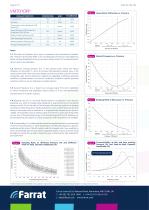
Notes Quasi-Static Deflection vs. Pressure 1.8 1.6 1.4 1.2 E LO o 0.8 _0J | 0.6 0.4 0.2 0.0 1.1 The static and dynamic tests were in accordance with international standards: ISO 7743:2011 (E) and ISO 4664-1:2011 (E) although some factors were adapted to better suit typical applications of our customers. Please contact us if would like specific data or tests to be undertaken. 1.2 Optimum working pressure, (Po), is the pressure point where the natural frequency of the system, fn, starts to increase. Peak operating pressure, (PUS), is the pressure point from where the strain change would be much...
Open the catalog to page 4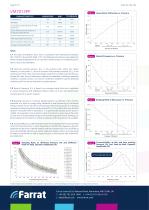
Notes 1.1 The static and dynamic tests were in accordance with international standards: ISO 7743:2011 (E) and ISO 4664-1:2011 (E) although some factors were adapted to better suit typical applications of our customers. Please contact us if would like specific data or tests to be undertaken. 1.2 Optimum working pressure, (Po), is the pressure point where the natural frequency of the system, fn, starts to increase. Peak operating pressure, (PUS), is the pressure point from where the strain change would be much lower than the pressure change (de<<da). Farrat's elastomeric materials are adaptable...
Open the catalog to page 5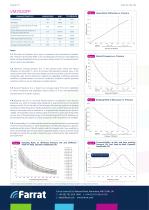
Quasi-Static Deflection vs. Pressure 1.1 The static and dynamic tests were in accordance with international standards: ISO 7743:2011 (E) and ISO 4664-1:2011 (E) although some factors were adapted to better suit typical applications of our customers. Please contact us if would like specific data or tests to be undertaken. 1.2 Optimum working pressure, (Po), is the pressure point where the natural frequency of the system, fn, starts to increase. Peak operating pressure, (PUS), is the pressure point from where the strain change would be much lower than the pressure change (de<<da). Farrat's elastomeric...
Open the catalog to page 6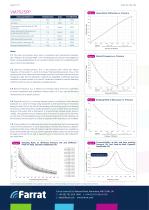
1.1 The static and dynamic tests were in accordance with international standards: ISO 7743:2011 (E) and ISO 4664-1:2011 (E) although some factors were adapted to better suit typical applications of our customers. Please contact us if would like specific data or tests to be undertaken. 1.2 Optimum working pressure, (Po), is the pressure point where the natural frequency of the system, fn, starts to increase. Peak operating pressure, (PUS), is the pressure point from where the strain change would be much lower than the pressure change (de<<da). Farrat's elastomeric materials are adaptable to different...
Open the catalog to page 7All Farrat catalogs and technical brochures
 Isoblocs
3 Pages
 FSL Isolators
4 Pages
 PRECISION LEVELLING ELEMENTS
2 Pages
 Building Vibration Isolation
28 Pages
 Farrat Favim (FV)
2 Pages
 Farrat Isomat Nitrile (IMNR)
8 Pages
 Farrat Verlimber (VR)
6 Pages
 Farrat Squaregrip (SG)
8 Pages
 Farrat Nitrile (BR)
9 Pages
 AVA - PLAS - 17a
2 Pages
 Farrat Jackmounts
2 Pages
 Farrat Isolated Foundations
36 Pages
 Farrat Wedgemounts
16 Pages
 Farrat Isomounts
4 Pages
 Farrat Isoblocs
3 Pages
 Farrat Levalators
2 Pages
 Full Building Isolation
28 Pages
 Farrat AWTH Acoustic Washers
2 Pages
 Farrat AWR Acoustic Washers
2 Pages


