
- Catalogs
- Farley Laserlab
- Farley Laserlab Plasma Cutting Machine


- Company
- Products
- Catalogs
- News & Trends
- Exhibitions
Farley Laserlab Plasma Cutting Machine

Farley Laserlab Plasma Cutting Machine
Plasma cutting is a high-speed, efficient cutting method widely used in industries such as machinery, shipbuilding, steelwork, and automotive. It is increasingly replacing flame cutting in certain applications due to its superior performance.
What is Plasma Cutting?
Plasma cutting involves using heat generated by an arc discharge between the cutting material and an electrode within a torch. This heat transforms working gas into a high-temperature plasma state, which is then expelled at high speed to cut the material.
Comparison of Plasma Cutting and Flame Cutting
Plasma cutting is effective on metal conductors like low-carbon steel, aluminum, and stainless steel, offering faster and deeper cuts, especially for steel up to 1 inch thick. In contrast, flame cutting, or oxy-fuel cutting, is limited to ferrous metals and is ideal for steel over ½ inch thick. Plasma cutting does not require oxidation and is faster and more efficient for sheet metal.
Plasma Cutting Processing Range
Developed in the 1950s, plasma cutting is suitable for metals such as stainless steel, aluminum, and copper. It uses electrically conductive gases like argon, hydrogen, nitrogen, and their mixtures, along with air and oxygen, to transfer energy from a power supply through a torch to the material being cut.
Catalog excerpts
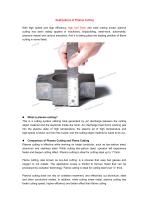
Applications of Plasma Cutting With high speed and high efficiency, high kerf finish and wide cutting scope, plasma cutting has been widely applied in machinery, shipbuilding, steel-work, automobile, pressure vessel and various industries. And it is taking place the leading position of flame cutting in some fields. What is plasma cutting? This is a cutting system utilizing heat generated by arc discharge between the cutting object material and the electrode inside the torch. Arc discharge heat forms working gas into the plasma state of high temperature; the plasma jet of high temperature and high-speed is blown out from the nozzle; and the cutting object material is fused to be cut. Comparison of Plasma Cutting and Flame Cutting Plasma cutting is effective while working on metal conductor, such as low-carbon steel, aluminum and stainless steel. While cutting low-carbon steel, operator will experience faster and deeper cutting effect. Plasma cutting is ideal for cutting steel up to 1″ thick. Flame cutting, also known as oxy-fuel cutting, is a process that uses fuel gasses and oxygen to cut metals. The application scope is limited to ferrous metal that can be processed by oxidation technology. Flame cutting is ideal for cutting steel over ½” thick. Plasma cutting does not rely on oxidation treatment, and effectively cut aluminum, steel and other conductive metals. In addition, while cutting sheet metal, plasma cutting has faster cutting speed, higher efficiency and better effect than flame cutting.
Open the catalog to page 1
Trident Bevel of Farley Laserlab http://www.farleylaserlab.com/PRODUCTS/PLASMA/Trident.aspx Plasma Cutting Processing Range Plasma cutting was developed in the 1950s for metal cutting, such as stainless steel, aluminum and copper. The plasma cutting process uses electrically conductive gas to delivery energy from an electrical power supply through a plasma cutting torch to the cut material. The plasma gases include argon, hydrogen, nitrogen and mixtures, plus air and oxygen. Plasma Cutting Sample
Open the catalog to page 2All Farley Laserlab catalogs and technical brochures
 Alkaline Electrolyzer
1 Page
 Deburring machine
10 Pages
 3D Laser cutting machine
14 Pages
 Hand Laser Engraving Machine
6 Pages
 Tire Mold Laser Cleaning Machine
26 Pages
 Desktop Laser Marking
1 Page
 Press Brake
1 Page
 CNC Bending Machine
6 Pages
 PCB Laser Marking Sample
2 Pages
 Welding Serials Products
3 Pages
 LWF1000-HLW
2 Pages
 CO2 Laser Marking sampe
2 Pages
 MARVEL Series
2 Pages
 Flying CO2 Laser Marking
1 Page
 Laser Marking Sample
2 Pages
 Green Laser Marking Machine
2 Pages
 UV Laser Marking Sample
2 Pages
 UV Laser Marking Machine
2 Pages
 3D Marking Sample
3 Pages
 3D Laser Marking Machine
3 Pages
 PCB LASER MARKING MACHINE
3 Pages
 LASER BLANKING LINE
5 Pages
 Marvel12000-3015
1 Page
 Laser Cutting Sample
2 Pages
 Fiber Laser Cutter
13 Pages
 3015 Fiber Laser Cutting Machine
19 Pages
 Tube Laser Cutting
2 Pages
 Laser Cutting and Engraving
21 Pages
 Handheld Laser Welder
2 Pages
 Fiber Laser Cutting Machine
2 Pages
 Fiber Welding Machine
7 Pages
 3D Laser Cutting
4 Pages
 Handheld Laser Welder
2 Pages
 SMT PCB Laser Solution
10 Pages
 20000W Laser Cutting Machine
2 Pages
 PCB Laser Marking
9 Pages
 FPC Laser Cutting
1 Page
 Fiber Laser Welding System
2 Pages
 Flying laser marking machine
8 Pages
 laser cleaning machine
2 Pages
 PCB Laser Marking Solution
7 Pages
 PCB Laser Marking Machine
6 Pages
 Farley Laserlab PROFILE PLUS
4 Pages











- Farley Laserlab cutting machine
- Farley Laserlab metal cutting machine
- Farley Laserlab CNC cutting machine
- Farley Laserlab welding machine
- Farley Laserlab laser cutting machine
- Farley Laserlab automatic cutting machine
- Farley Laserlab cutting machine for industrial applications
- Knife cutting system
- Farley Laserlab sheet metal cutting machine
- Farley Laserlab automatic welding machine
- Farley Laserlab high-precision cutting machine
- Farley Laserlab marking machine
- Measuring machine
- Bender
- Farley Laserlab automatic cleaning machine
- Farley Laserlab high-speed cutting machine
- Farley Laserlab fiber laser cutting machine
- Making machine
- Farley Laserlab tube cutting machine
- Farley Laserlab precision cutting machine