

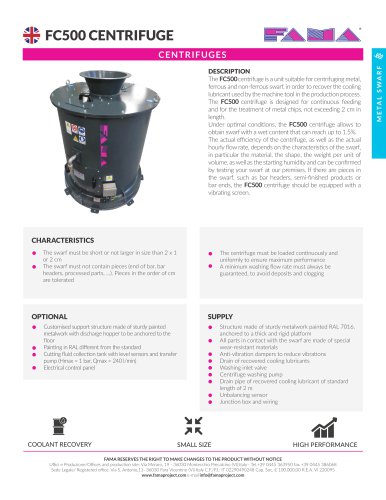
FC300 automatic centrifuge product sheet
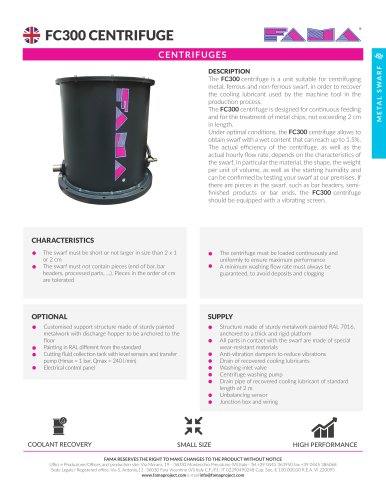
FC300 automatic centrifuge product sheet
- Structure: Made of sturdy metalwork painted RAL 7016, anchored to a thick and rigid platform.
- Material: Parts in contact with swarf are made of special wear-resistant materials.
- Features: Includes anti-vibration dampers, a drain for recovered cooling lubricants, a washing inlet valve, a centrifuge washing pump, a 2 m drain pipe, an unbalancing sensor, and a junction box with wiring.
The FC300 centrifuge is designed for centrifuging metal, ferrous, and non-ferrous swarf to recover cooling lubricants used in machine tool production. It supports continuous feeding and treats metal chips up to 2 cm in length. Under optimal conditions, it can achieve swarf with a wet content of up to 1.5%. Efficiency depends on swarf characteristics and can be confirmed by testing at the manufacturer's premises. For swarf containing larger pieces, a vibrating screen is recommended.
- Custom support structure with discharge hopper.
- Non-standard RAL painting.
- Cutting fluid collection tank with level sensors and transfer pump (Hmax = 1 bar, Qmax = 240 l/min).
- Electrical control panel.
- Swarf size: Must be short or not larger than 2 x 1 or 2 cm.
- Content: Should not contain large pieces; small pieces are tolerated.
- Loading: Must be continuous and uniform for optimal performance.
- Washing: A minimum flow rate must be maintained to prevent deposits and clogging.
- Dimensions: 850 x 960 mm
- Weight: 300 kg
- Power: 1.1 kW
- Voltage: 230/400 V
- Power Supply: Continuous
- RPM: 1,480 rpm
The centrifuge can process various metals with different densities, affecting the hourly production rate. For example, brass has a density of 1.2 kg/l and can be processed at 480 kg/h. The actual production rate depends on swarf density, shape, oil content, and coolant type.
A sample of 400 kg brass with 15% wet content resulted in a 2% wet residue after centrifugation, recovering 52 kg of oil in one hour. Over a year (8 hours/day, 220 days), this equates to 91,520 kg of oil recovered.
Residual swarf moisture after centrifugation can be confirmed by testing your swarf sample.
Catalog excerpts
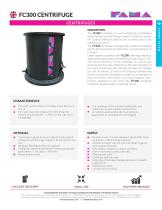
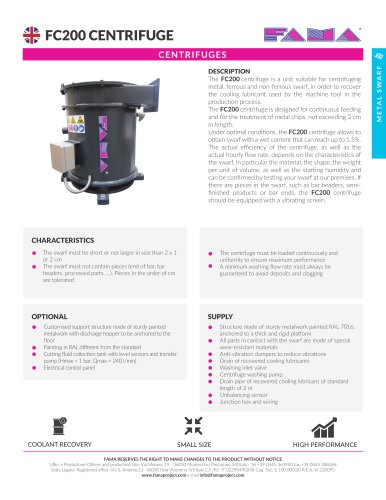
FC300 CENTRIFUGE DESCRIPTION The FC300 centrifuge is a unit suitable for centrifuging metal, ferrous and non-ferrous swarf, in order to recover the cooling lubricant used by the machine tool in the production process. The FC300 centrifuge is designed for continuous feeding and for the treatment of metal chips, not exceeding 2 cm in length. Under optimal conditions, the FC300 centrifuge allows to obtain swarf with a wet content that can reach up to 1.5%. The actual efficiency of the centrifuge, as well as the actual hourly flow rate, depends on the characteristics of the swarf, in particular the material, the shape, the weight per unit of volume, as well as the starting humidity and can be confirmed by testing your swarf at our premises. If there are pieces in the swarf, such as bar headers, semifinished products or bar ends, the FC300 centrifuge should be equipped with a vibrating screen. The swarf must be short or not larger in size than 2 x 1 or 2 cm The swarf must not contain pieces (end of bar, bar headers, processed parts, ...). Pieces in the order of cm are tolerated The centrifuge must be loaded continuously and uniformly to ensure maximum performance A minimum washing flow rate must always be guaranteed, to avoid deposits and clogging Customised support structure made of sturdy painted metalwork with discharge hopper to be anchored to the floor Painting in RAL different from the standard Cutting fluid collection tank with level sensors and transfer pump (Hmax = 1 bar, Qmax = 240 l/min) Electrical control panel COOLANT RECOVERY SMALL SIZE Structure made of sturdy metalwork painted RAL 7016, anchored to a thick and rigid platform All parts in contact with the swarf are made of special wear-resistant materials Anti-vibration dampers to reduce vibrations Drain of recovered cooling lubricants Washing inlet valve Centrifuge washing pump Drain pipe of recovered cooling lubricant of standard length of 2 m Unbalancing sensor Junction box and wiring HIGH PERFORMANCE FAMA RESERVES THE RIGHT TO MAKE CHANGES TO THE PRODUCT WITHOUT NOTICE Uffici e Produzione/Offices and production site: Via Moraro, 19 - 36030 Montecchio Precalcino (VI) Italy– Tel.+39 0445 363950 fax +39 0445 386068 Sede Legale/ Registered office: Via S. Antonio,11- 36030 Fara Vicentino (Vi) Italy C.F./P.I.: IT 02290490248 Cap. Soc. € 100.000,00 R.E.A. VI 220095 www.famaproject.com e-mail [email protected]
Open the catalog to page 1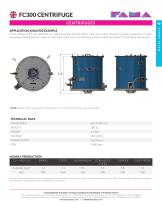
APPLICATION ANALYSIS EXAMPLE A wet residue of 2% was obtained on a 400 kg sample of brass with a 15% wet content. 52 kg of oil were recovered in 1 hour. Assuming working 8 hours a day, for 220 days of the year, the following amount will be recovered: 91,520 kg of oil per year. NOTE: Resid ual swarf moisture after centrifugation can be confirmed by testing your swarf sample POWER SUPPLY Q = 400 l/h BRASS STEEL ALUMINIUM STAINLESS COPPER CAST IRON The data in kg/h are approximate and in any case depend on the density of the swarf, the shape, the oil content and the type of coolant. The density...
Open the catalog to page 2All FAMA SRL catalogs and technical brochures
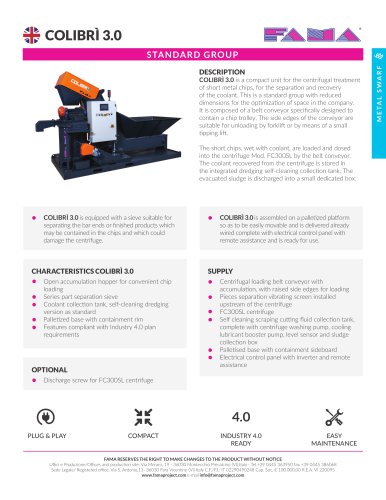 Colibrì 3.0 product sheet
2 Pages
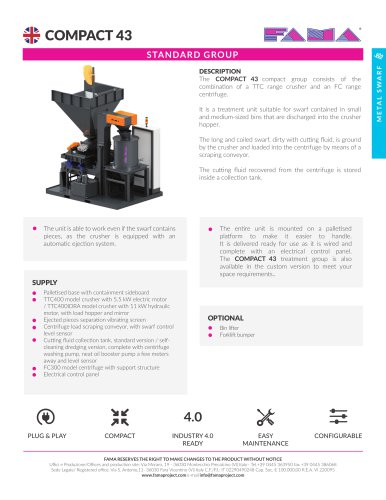 COMPACT 43
2 Pages
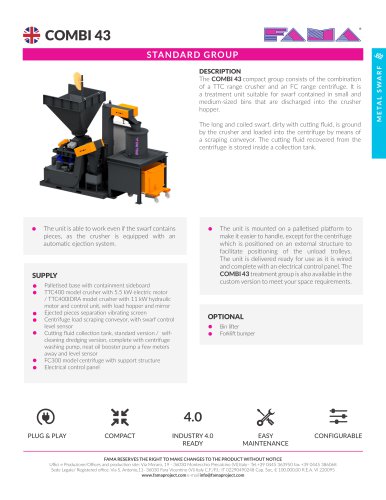 COMBI 43
2 Pages
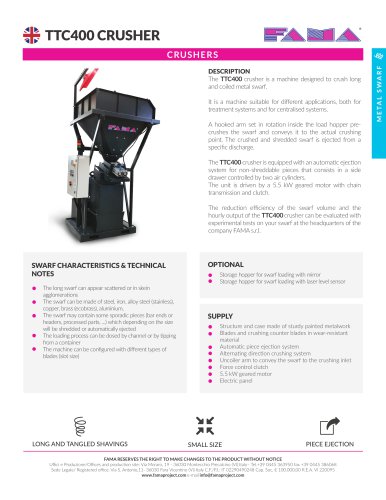 TTC400 crusher product sheet
2 Pages
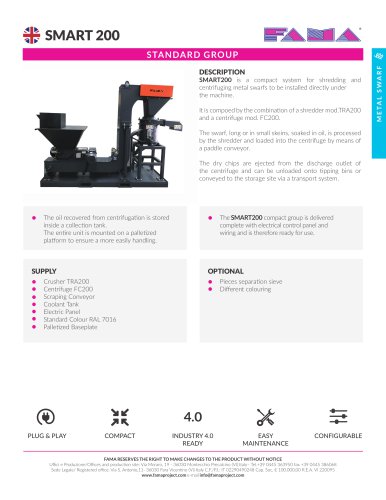
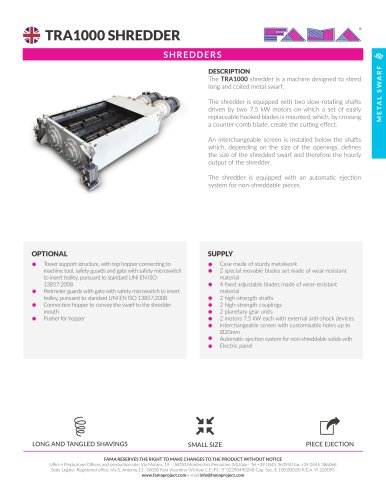
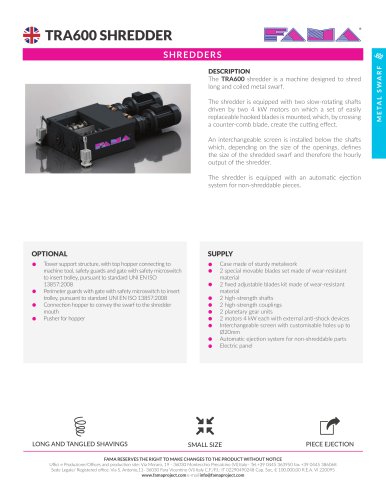
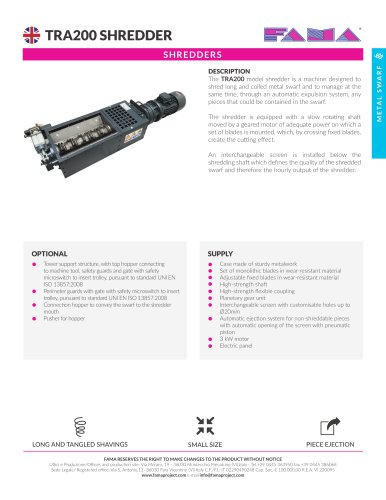
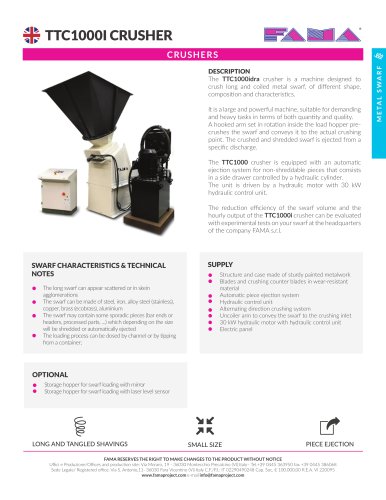
- Cutting system
- Rail conveyor
- Electric vacuum cleaner
- Industrial vacuum cleaner
- Transport rail conveyor
- Belt conveyor
- Mobile vacuum cleaner
- Crushing plant
- Solids separator
- Filter cartridge
- Plastic cutting machine
- Stationary crushing plant
- Waste shredder
- Filtration unit
- Inclined conveyor
- Wet vacuum cleaner
- Wheel-mounted vacuum cleaner
- Three-phase cut-off machine
- Single shaft shredder machine
- Double shaft shredding machine