
- Catalogs
- FAFNIR GmbH
- FAFNIR Universal Device Protocol (UDP)


FAFNIR Universal Device Protocol (UDP)

FAFNIR Universal Device Protocol (UDP)
This document provides a comprehensive guide to the FAFNIR Universal Device Protocol, detailing its specifications, message dialogues, and data fields. The protocol is designed for communication with various device types, supporting both static and dynamic data exchanges.
The protocol uses RS-485 modulation with asynchronous, half-duplex mode. It supports baud rates of 1200 bps and 4800 bps, with specific timing conditions for character transmission and response timeouts. The host system must manage the RS-485 driver state effectively.
Key abbreviations include F, G, X, Y for message headers, AC for multiplexer board address and channel, D for device type, and SN for serial number. The document specifies the format for decimal and hex values, as well as checksum calculations using CRC16.
The protocol supports static and dynamic data requests. Static data can be read or written, with optional inclusion of serial numbers for devices on the same VPI channel. Dynamic data requests follow a similar structure, with specific examples provided for both standard and optional requests.
The document lists various device types supported by the protocol, including VISY-Stick, VISY-Input, VISY-Output, and others, each with specific data field requirements.
Static and dynamic data fields are detailed, with identifiers and values for each device type. The document explains how to read and write these fields, including handling execution errors.
Attachment A provides examples of CRC calculation routines in Pascal and Visual Basic, essential for ensuring message integrity.
Attachment B lists all supported data fields for different device types, ensuring comprehensive protocol implementation.
The document outlines the procedures for reading and writing dynamic data in devices using the FAFNIR Universal Device Protocol V1.09. Dynamic data read responses can be standard or optional, with the latter including a serial number. Writing dynamic data involves sending new values to writable fields, with responses indicating current values. Most devices do not respond to write requests, and many data IDs are read-only. If execution is not possible, a response with a value of "minus zero" is returned.
Devices are identified by unique type IDs, with specific IDs assigned to different device types such as VISY-Stick, VISY-Output, and Pressure Sensor. Some IDs are reserved for future expansions.
Data fields consist of an ID and a value, with static and dynamic data fields using the same IDs but differing in meaning. Static data fields are generally read-only, while dynamic data fields can be writable. The document provides detailed descriptions of various data fields, including their IDs, descriptions, valid ranges, and examples of data transfer formats.
These fields include serial numbers, density module positions, hold times after communication loss, probe lengths, option flags, protocol versions, maximum distances, temperature sensor positions, device sub-types, and firmware versions. Each field has specific characteristics and valid ranges.
Dynamic fields report device status, alarms, battery status, channel data, density, and events. Each field is described with its resolution, valid range, and applicable device types. Some fields are only included if certain conditions are met, such as active alarms or wireless connections.
The document outlines the FAFNIR Universal Device Protocol V1.09, detailing the dynamic data fields and their specifications for various device types such as VISY-Stick, VISY-Sludge, and Pressure Sensors. It includes information on data field IDs, descriptions, resolutions, valid ranges, and examples of data transfer formats.
- Field Strength ('f'): Measures wireless receiver field strength, with a resolution of 1 and a valid range of 0-5. Available since protocol version 1.00.
- Pressure ('i'): Represents measured pressure/vacuum with resolution depending on the sensor type. Available since protocol version 1.04.
- Age Of Data ('o'): Indicates data age with a resolution of 1 second and a valid range of 1-604800 seconds. Available since protocol version 1.00.
- Product Level ('p'): Represents product level with a resolution of 1 µm and a valid range of 0-65535 mm. Available since protocol version 1.00.
- Distance ('s'): Measures distance from the sensor to the reflection surface with a resolution of 0.1 mm. Available since protocol version 1.08.
- Temperature ('t'): Represents temperature with a resolution of 0.001 °C and a valid range of -99.999 to 999.999 °C. Available since protocol version 1.00.
- Water Level ('w'): Represents water level with a resolution of 0.1 mm and a valid range of 0-65535 mm. Available since protocol version 1.00.
The document provides routines for CRC calculation in C, Pascal, and Visual Basic, demonstrating how to compute CRC16 for data integrity verification.
Tables are provided showing which static and dynamic data fields are supported by each device type. Static data fields include serial number, firmware version, and protocol version, while dynamic data fields cover aspects like product level, water level, and temperature.
Catalog excerpts

Technical Documentation FAFNIR Universal Device Protocol
Open the catalog to page 1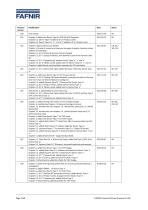
FAFNIR Universal Device Protocol V1.09
Open the catalog to page 2
FAFNIR Universal Device Protocol V1.09
Open the catalog to page 3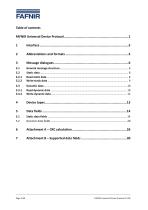
Page 4/30 FAFNIR Universal Device Protocol V1.09
Open the catalog to page 4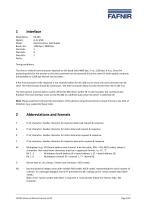
1 Interface Modulation: Signals: Mode: Baud rate: Start-bits: Data-bits: Stop-bits: Parity: Timing conditions: The time to transmit one character depends on the baud rate (4800 bps: 2 ms, 1200 bps: 8 ms). Since the processing time for the answer or the next command can be assumed to be the same for both speeds, timeouts are doubled for 1200 bps and set into brackets. If the first character of the response is not received within 50 ms (100 ms) or more, the next command can be send. The transmission should be continuous. The inter-character delay must be shorter than 20 ms (40 ms). The host system...
Open the catalog to page 5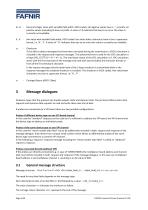
N...N - Decimal integer value with variable field width, ASCII coded, all negative values have a as prefix, all positive values (including 0) have no prefix. A value of -0 indicates that due to an error this value is currently not available. X...X - Hex value with variable field width, ASCII coded. Hex value letter characters have to be in uppercase format, i.e. 'A'...'F'. A value of "-0" indicates that due to an error this value is currently not available. cs - Checksum To be able to detect messages that have been corrupted during the transmission a CRC16 checksum is included in the request...
Open the catalog to page 6
FAFNIR Universal Device Protocol V1.09
Open the catalog to page 7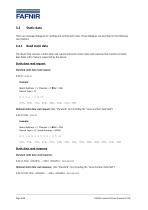
FAFNIR 3.2 Static data There are message dialogues for reading and writing static data. These dialogues are described in the following sub-chapters. 3.2.1 Read static data The device that receives a static data read request will send a static data read response that contains all static data fields (<ID><Value>) supported by the device. Static data read request Standard static data read request: G AC D : cs cs cr Example: Board Address = 1, Channel = 2 ^AC = 01H Device Type = 'a' G 0 1 a : 2 A cr 47H, 30H, 31H, 61H, 3AH, 32H, 41H, 0DH Optional static data read request: (like "Standard",...
Open the catalog to page 8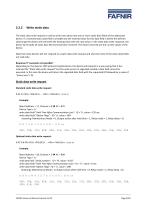
3.2.2 Write static data The static data write request is used to write new values into one or more static data fields of the addressed device. If a received static data field is writable and the received value for this data field is within the defined valid range the device will overwrite the existing value with the new value. In the static data write response, the device will include all static data IDs that have been received. The values returned are the current values of the device. Note that most devices will not respond to a static data write request and also that most of the static data...
Open the catalog to page 9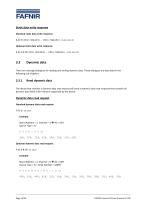
Static data write response Standard static data write response: X AC D <ID1> <VALUE1> ... <IDn> <VALUEn> : cs cs cs cs cr Optional static data write response: X AC D # SN <ID1> <VALUE1> ... <IDn> <VALUEn> : cs cs cs cs cr 3.3 Dynamic data There are message dialogues for reading and writing dynamic data. These dialogues are described in the following sub-chapters. 3.3.1 Read dynamic data The device that receives a dynamic data read request will send a dynamic data read response that contains all dynamic data fields (<ID><Value>) supported by the device. Dynamic data read request Standard dynamic...
Open the catalog to page 10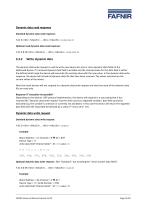
Dynamic data read response Standard dynamic data read response: F AC D <ID1> <VALUE1> ... <IDn> <VALUEn> : cs cs cs cs cr Optional read dynamic data read response: F AC D # SN <ID1> <VALUE1> ... <IDn> <VALUEn> : cs cs cs cs cr 3.3.2 Write dynamic data The dynamic data write request is used to write new values into one or more dynamic data fields of the addressed device. If a received dynamic data field is writable and the received value for this data field is within the defined valid range the device will overwrite the existing value with the new value. In the dynamic data write response, the...
Open the catalog to page 11
Y 8 A o # 3 7 3 1 c 0 : 4 9 cr 59H, 38H, 41H, 6FH, 23H, 33H, 37H, 33H, 31H, 63H, 30H, 3AH, 34H, 39H, Dynamic data write response Standard dynamic data write response: Y AC D <ID1> <VALUE1> ... <IDn> <VALUEn> : cs cs cs cs cr Optional dynamic data write response: (like "Standard", but including the "serial number data field") Y AC D # SN <ID1> <VALUE1> ... <IDn> <VALUEn> : cs cs cs cs cr FAFNIR Universal Device Protocol V1.09
Open the catalog to page 12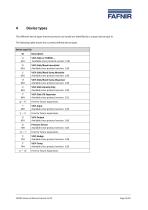
Device types The different device types that the protocol can handle are identified by a unique device type ID. The following table shows the currently defined device types. Device type IDs ID VISY-Stick or TORRIX … Available since protocol version: 1.00 VISY-Stick/Reed Interstitial Available since protocol version: 1.00 VISY-Stick/Reed Sump Manhole Available since protocol version: 1.00 VISY-Stick/Reed Sump Dispenser Available since protocol version: 1.00 VISY-Stick Density Only Available since protocol version: 1.00 VISY-Stick Oil Separator Available since protocol version: 1.01 Free for future...
Open the catalog to page 13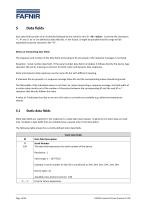
Notes on interpreting data fields: The sequence and number of the data fields (consisting of ID and value) in the response messages is not fixed. Exception: Serial number data field. If the serial number data field is included, it follows directly the device type character (D) and its meaning is common for both, static and dynamic data responses. Static and dynamic data responses use the same IDs but with different meaning. If unknown IDs are present in a response message these IDs and the corresponding values should be ignored. The field width of the individual values is not fixed. So, when...
Open the catalog to page 14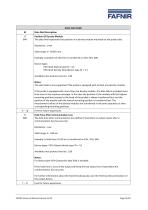
FAFNIR Universal Device Protocol V1.09
Open the catalog to page 15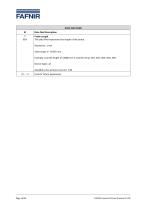
FAFNIR Universal Device Protocol V1.09
Open the catalog to page 16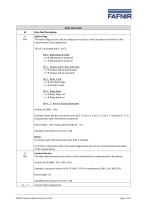
FAFNIR Universal Device Protocol V1.09
Open the catalog to page 17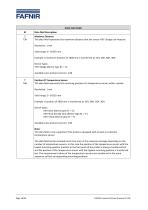
FAFNIR Universal Device Protocol V1.09
Open the catalog to page 18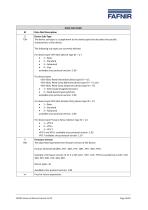
FAFNIR Universal Device Protocol V1.09
Open the catalog to page 19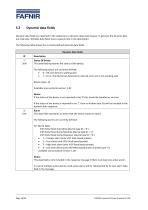
Dynamic data fields are reported in the response to a dynamic data read request. In general, the dynamic data are read-only. Writable data fields have a special note in the description. The following table shows the currently defined dynamic data fields. FAFNIR Universal Device Protocol V1.09
Open the catalog to page 20All FAFNIR GmbH catalogs and technical brochures
 TORRIX M12 MOBILE
2 Pages
 TORRIX XTS
2 Pages
 TORRIX 6
1 Page
 LPG Sensors
8 Pages
 SEPARIX
8 Pages
 Process Automation
28 Pages
 O²-PID
4 Pages
 VAPORIX Flow and Control
40 Pages
 Wallmounting Typ 907
4 Pages
 QE 200
4 Pages
 UM 2.1/2.2/2.3
20 Pages
 TORRIX HART
28 Pages
 TORRIX RS485 Modbus
16 Pages
 TORRIX M12
40 Pages
 LS 300 / 500
7 Pages
 76 A / NB 220
5 Pages
 SECON-X
4 Pages
 PRESSURIX
12 Pages
 Insite360
4 Pages
 Plugs
Plugs12 Pages
 UM 2.1/UM 2.2/UM 2.3
20 Pages
 TORRIX-HART
28 Pages
 DIVELIX
8 Pages
 CONDURIX-HART
28 Pages
 CONDURIX
24 Pages
 VAPORIX
12 Pages
 VISY-X
24 Pages
 Accessories
3 Pages
 VISY-Command Web
4 Pages
 VISY-Reed
4 Pages
 VISY-RF
2 Pages
 VISY-Stick
15 Pages
 VISY-TD Display
2 Pages
 VISY-View Touch
2 Pages
 TORRIX
10 Pages
 TORRIX CI
1 Page
 TORRIX RS485
3 Pages
 UM-X Transducer
3 Pages
 TEMPERIX
8 Pages
 VISY-Input VISY-Output
4 Pages
 VISY-Command
5 Pages
 LPG-Sensoren
8 Pages


Archived catalogs
 76 / NB 220
2 Pages
 FAFNIR Hart Setup
9 Pages
 COMS Leaflet
4 Pages
 HPH Ex d
3 Pages
 VISY-Monitor
2 Pages
 2019 VISY-Stick Flex
2 Pages
 2016 VISY-Stick Flex
2 Pages
 VISY-X LON
10 Pages
 SEPARIX
23 Pages
 VAPORIX Flow/Control
32 Pages
 VISY-Setup V 3.1.0
40 Pages
 VISY-Setup V2.10
42 Pages
 VISY-View
24 Pages
 VISY-Stick and VISY-Command
24 Pages
 Overfill Prevention (GWG)
12 Pages


- Display module
- LCD display panel
- Industrial display panel
- FAFNIR level switch
- FAFNIR liquid level switch
- FAFNIR level sensor
- FAFNIR liquid level sensor
- Analog I/O
- Round plug
- Interface software
- Thermocouple temperature transducer
- Float level switch
- FAFNIR analog level sensor
- Control display system
- Automatic test kit
- Stainless steel level detector
- Leak monitor
- Network software
- Information display