
- Catalogs
- F. H. SCHULE Muehlenbau
- Protein Shifting


Protein Shifting

Protein Shifting
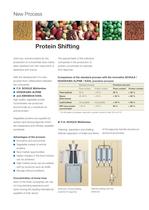
The document compares the standard process with the innovative precision process developed by SCHULE, HOSOKAWA ALPINE, and KAHL for producing protein concentrates from legumes.
Standard vs. Precision Process
- Fines and Protein Content: The precision process generally results in higher protein content and fines content across various legumes compared to the standard process.
- Peas (yellow): Standard process yields 30% fines and >50% protein, while the precision process yields 35% fines and >55% protein.
- Beans (field beans): Standard process yields 25-30% fines and >60% protein, while the precision process yields >35% fines and >60% protein.
- Lupins (blue): Not possible with the standard process, but the precision process yields >40% fines and >60% protein.
- Soy Protein Concentrate (SPC): Both processes yield >60% fines and >65% protein.
Protein Shifting and New Process
- The new process involves defined shelling using the Verticone machine, which is a conical shelling machine for legumes.
- This process is a collaboration between F.H. SCHULE Mühlenbau, HOSOKAWA ALPINE, and AMANDUS KAHL, aiming to produce high-quality vegetable protein concentrates economically.
- Vegetable proteins are sourced from legumes, which are inexpensive and widely available.
Advantages of the Precision Process
- Innovative and economical, using vegetable instead of animal proteins.
- Opens new market opportunities and achieves higher margins in the food industry.
- By-products such as shells can be sold at high market prices.
- Allows for problem-free storage.
Company Expertise
- F.H. SCHULE Mühlenbau: Specializes in cleaning, separation, and shelling of legumes.
- HOSOKAWA ALPINE: Focuses on fine grinding and air classification to separate protein and starch concentrates.
- AMANDUS KAHL: Provides gentle pelleting and cooling for storage and transport of fine-grained fractions.
Conclusion
The precision process is presented as an economical and environmentally friendly alternative for sourcing new protein resources, with a medium-term return on investment.
Catalog excerpts
Comparison of the standard process with the innovative SCHULE / HOSOKAWA ALPINE / KAHL precision process Standard process Precision process Fines content Protein content Fines content Protein content Peas (yellow) 30 % > 50 % 35 % > 55 % Beans 25–30 % > 60 % > 35 % > 60 % (field beans) Lupins (blue) not possible not possible > 40 % > 60 % SPC (soy protein > 60 % > 65 % 65 % > 65 % concentrate)* * On the basis of soybean meal with a protein content of abt. 50 to 55 % Protein Shifting New Process Defined shelling with the Verticone Verticone, conical shelling machine for legumes Until now, animal proteins for the production of concentrate have mainly been obtained from fish meal which is expensive and scarce. With the development of a new process from collaboration between the companies ¡ F.H. SCHULE Mühlenbau ¡ HOSOKAWA ALPINE ¡ and AMANDUS KAHL high-quality vegetable protein concentrates are produced economically as a substitute for animal protein. Vegetable proteins are supplied by quickly reproducing legumes which are inexpensive and infinitely available worldwide. Advantages of the process ¡ Innovative and economical ¡ Vegetable instead of animal proteins ¡ New market opportunities ¡ Higher margins in the food industry can be achieved. ¡ High market prices can be realised with by-products such as shells ¡ Storage without problems Concentration of know-how Each of the three companies can rely on long-standing experience and ranks among the leading international suppliers in their sector. The special fields of the individual companies in the production of protein concentrate for example from legumes: ¡ F.H. SCHULE Mühlenbau Cleaning, separation and shelling. Defined separation of shells and fibres of the legumes kernels ensures an economical process.
Open the catalog to page 1
AK-64-E 06/09 HOSOKAWA ALPINE mill New process: > 55% protein by means of protein shifting Flow diagram of a plant for the production of protein concentrates KAHL Pelleting press Diagram of a KAHL pelleting plant ¡ HOSOKAWA ALPINE Fine grinding of legumes and separation by means of air classification into protein concentrate and starch concentrate. ¡ AMANDUS KAHL Gentle pelleting using the flat die pelleting press and cooling for storage and transport of the individual fractions, which are fine-grained to the extent that they cannot be handled without prior pelleting. ¡ Precision process In comparison...
Open the catalog to page 2All F. H. SCHULE Muehlenbau catalogs and technical brochures
 TABLE SEPARATOR TH3
3 Pages
 IMPACT HULLER
5 Pages
 DRUM GROAT CUTTER
5 Pages
 RICE PROCESSING PLANTS
11 Pages
 OAT PROCESSING PLANTS
11 Pages
 Rice Whitener VP 1 and VP 2
2 Pages
 FHS41-SH-A-13d
2 Pages
 FHS11-VertiSchael-11d
2 Pages
 FHS27-VertSheMas-13e
2 Pages
 VERTICONE VPC 320 (patented)
2 Pages
 Flaker
2 Pages
 SCHULE High-Capacity
4 Pages
 Deawner EG 200
1 Page
 Grainer Clipper
2 Pages
 Rotary Screen SI KS
2 Pages
 Destoner ST D
2 Pages
 Indented Cylinder TR
2 Pages
 HUS 1260
2 Pages
 Air Sifter AS
2 Pages
 FHS25-GTR
2 Pages
 Drumcleaner-10e
1 Page
 FHS42-Tommelsieb-9e
2 Pages
 FHS06-ST-9e
2 Pages
 FHS01-GTR
2 Pages
 Drum Groat Cutter TGS
2 Pages
 Sorting Machines: Trieur TR
2 Pages
 Rice Parboiling Plants
4 Pages


Archived catalogs
 FHS58-Aspirationskanal-9s
2 Pages

- Kiln
- Vessel
- Chamber kiln
- Heat treatment kiln
- Chiller
- Solids separator
- Screening unit
- Stainless steel vessel
- Drying kiln
- Bulk material screening machine
- Centrifugal classifier
- Cylindrical reservoir
- Air chiller
- Sorting machine
- Horizontal lump breaker
- Stainless steel kiln
- Polishing unit
- Food lump breaker
- Tank for food applications