

Laser products

Laser products
Our company specializes in producing laser triangulation rangefinders, micrometers, and scanners for industrial applications. These products are designed for contactless measurement of surface geometry, distances, and displacements, and are widely used in industrial automation, quality surveillance, and production facilities involving robots and CNC machines. Our key market advantages include reliability, compatibility, and high-speed performance at competitive prices.
- Manufacturing of metal and polymer products
- Electronics contract manufacturing
- Food industry
- Transport and logistics repair sector
- Three-dimensional scanning of surfaces and cavities
- Laser Triangulation Rangefinders: Utilize optical triangulation to measure distances and surface geometry in real-time.
- Optical Micrometers: Designed for contactless measurement of diameters, gaps, and positions of technological objects.
- Scanners with Diffractive Optical Elements: Perform surface analysis and calculate dimensions with high accuracy.
- SDK and service software for custom program integration
- Embedded custom software for enhanced functionality
- AN-0XL Module Series: Offers a wide wavelength range, high stability, and IP67 protection.
- AN-01L Module Series: Features high alignment and supports red, green, and blue laser diodes.
- AN-02L Module Series: Designed for use with diffractive optics and various laser types.
- Over 10 years of experience
- More than 100 business partners
- Custom products developed in over 15 countries worldwide
Catalog excerpts

Laser triangulation rangefinders, micrometers scanners and laser modules Laser triangulation rangefinders, micrometers and scanners produced by our company are designed for industrial application in the field of contactless measurement of surface geometry, distances and displacements. They are applied in the area of industrial automation, quality surveillance as well as for production facilities where robots and CNC machines are used. Our company core advantages in the market are reliability, compatibility and high-speed work, all at very attractive price.
Open the catalog to page 1
Application of our laser products Manufacturing of products from metal and polymers Electronics contract manufacturing Food industry Transport and logistics repair sector Manufacturing and other companies
Open the catalog to page 2
Tree-dimensional scanning of surfaces: • Products are integrated with linear, radial drives, robots, lines for the accumulation of three-dimensional data about products. Scanning of cavities, inside surfaces of tubes, holes: • Small dimensions and high reliability of our devices allows to apply our scanners in difficult conditions, for instance, for moving landing gear. The control of geometry of articles, preparations, stamps: • High accuracy of our devices allows quick and accurate measurements of the details of any complexity.
Open the catalog to page 3
Additional options SDK, service software: We support all our products during its life time by the means of its development and our unique software for its set-up and parametrization. Embedded custom software: With the help of our SDK we provide the opportunity to run custom programs in the scanner.
Open the catalog to page 4
Laser profilometers series AN-X2TL Principle of operation: • The radiation of a semiconductor laser is formed as a line and projected onto an object. • The radiation dissipated on the object by the objective is going on two-dimensional CMOS-matrix. • The resulting image of the contour of the object is analyzed by the signal processor, which calculates the distance to the object (Z coordinate) for each of plenty of points along laser line on the object (X coordinate).
Open the catalog to page 5
The scanner is intended for contactless measurement and control Of the profile of the surfaces, locations, moving, sizes as well as for definitions of defects in the objects. Mapping of their locations as well as for recognition of technological objects.
Open the catalog to page 6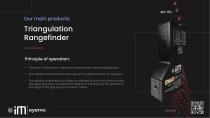
Triangulation Rangefinder Principle of operation: • The basis of the sensor is based on the principle of optical triangulation. • The radiation of a semiconductor laser is focused by the lens on the object. • The radiation scattered on an object is collected by a lens on a linear matrix. The signal processor calculates the distance to the object by the position of the image of the light spot on the linear matrix.
Open the catalog to page 7
Triangulation rangefinder will determine the distance to the object, the offset relative to the meter in real time, the surface geometry Contactless measurements of the distance to the objects. High frequency measurements. Measurements of minimum or maximum distance. Integration with robots, machines, automatic production processes
Open the catalog to page 8
Optical micrometer Principle of operation: • Optical micrometers are intended for contactless measurement and the control of diameters, backlashes and situations of technological objects. The micrometer consists of two modules: radiator and receiver. • Radiation of semiconductor laser is collimated by a lens. At placement of the object in the area of a collimated beam, the generated shadow image is scanned with a CCD photodetector part. • The geometry of the object is calculated from the position of the shadow border.
Open the catalog to page 9
Optical micrometer is designed for contactless measurement and control of diameters, gaps and positions of technological objects High precision measurements of geometric parameters and object position. Measurements of the dimensions in cross section and average diameter of an object. Product quality control without disassembling and dismantling. Ability to integrate with robots, machines, automatic lines.
Open the catalog to page 10
Scanner using diffractive optical elements Principle of operation: • Tree to 5 scanner beams in the form of parallel straight lines or crosshairs allow you to perform surface analysis, calculate the dimensions of parts, determine the direction of the joints.
Open the catalog to page 11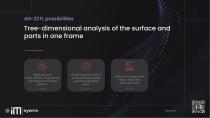
Tree-dimensional analysis of the surface and parts in one frame Highly accurate measurement of geometric parameters and object position. Product quality control without disassembling and dismantling the object. Ability to integrate with robots, machines, automatic lines.
Open the catalog to page 12
ADVANTAGES OF OUR LASER MODULES Wide range of power and supplyvoltages Wide wavelength range Long service life High stability of the laser beam parameters and the radiation axis Wide range of radiation divergences, including the lowest Stable operation in various temperature ranges Any beam shape at the output (dot,cross, etc.)
Open the catalog to page 13
AN-01L MODULE SERIES The AN-01L series laser modules provide high alignment between the emission axis and the housing axis. The size of the modules in this series allows the use of red laser diodes up to 150 mW or green/blue laser diodes up to 120 mW. This series includes commercially available laser kerf pointers (laser kerf pointers, laser cut line pointers, laser rulers) for woodworking machines.
Open the catalog to page 14
AN-02L MODULE SERIES The AN-02L series laser modules are designed for use with diffractive optics for projecting various kinds of images or as pilot lasers, includingdiode-pumpedsolid-state lasers or high-power gas lasers. These are medium-sizedmodules for a variety of applications.
Open the catalog to page 15
We Take Pride in Our Numbers >15 Custom products developed >10 Countries World Wide
Open the catalog to page 16
bringing your business to the next level
Open the catalog to page 17All EYEME catalogs and technical brochures
 Rangefinder specification
4 Pages
 Triangulation Rangefinder
4 Pages
 Micrometer
4 Pages
 Remote control devices
16 Pages
 Solutions
20 Pages

- Measurement scanner
- Laser scanner
- Inspection scanner
- Outside micrometer
- High-resolution scanner
- High-precision scanner
- XY scanner
- Compact scanner
- High-speed scanner
- Rangefinder
- Laser rangefinder
- Precision micrometer
- LIDAR scanner
- Non-contact scanner
- High-precision micrometer
- Detection scanner
- Quality control scanner
- Ethernet scanner
- Profile scanner