


- Company
- Products
- Catalogs
- News & Trends
- Exhibitions
TWINTIP
1 / 1 PageView full catalog
TWINTIP
Product catalog summary
Specifications:
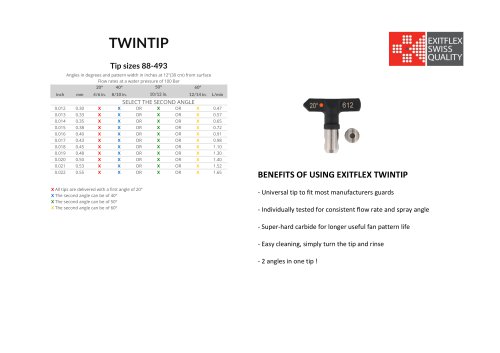
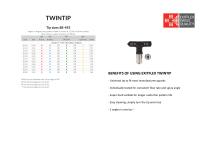
The document provides specifications for TWINTIP spray nozzles, detailing flow rates at a water pressure of 100 Bar. The table lists measurements in inches and millimeters, with corresponding flow rates in liters per minute (L/min). The tip sizes range from 88-493, and angles are provided in degrees with pattern widths in inches at a distance of 12 inches (30 cm) from the surface.
The document provides specifications for TWINTIP spray nozzles, detailing flow rates at a water pressure of 100 Bar. The table lists measurements in inches and millimeters, with corresponding flow rates in liters per minute (L/min). The tip sizes range from 88-493, and angles are provided in degrees with pattern widths in inches at a distance of 12 inches (30 cm) from the surface.
Procedures:
Users are instructed to select the second angle for the spray tip, with options for 40°, 50°, and 60°. All tips are delivered with a first angle of 20°.
Users are instructed to select the second angle for the spray tip, with options for 40°, 50°, and 60°. All tips are delivered with a first angle of 20°.
Norms:
The document specifies that all tips are individually tested to ensure consistent flow rates and spray angles.
The document specifies that all tips are individually tested to ensure consistent flow rates and spray angles.
Recommendations:
It is recommended to use EXITFLEX TWINTIP for its universal fit, durability due to super-hard carbide, and ease of cleaning. The dual-angle feature allows for versatility in application.
It is recommended to use EXITFLEX TWINTIP for its universal fit, durability due to super-hard carbide, and ease of cleaning. The dual-angle feature allows for versatility in application.
Key Data from Tables:
The table indicates that flow rates increase with the size of the tip, ranging from 0.47 L/min to 1.65 L/min. The pattern width varies with the angle and tip size, providing flexibility in spray coverage.
The table indicates that flow rates increase with the size of the tip, ranging from 0.47 L/min to 1.65 L/min. The pattern width varies with the angle and tip size, providing flexibility in spray coverage.
See more
Catalog excerpts
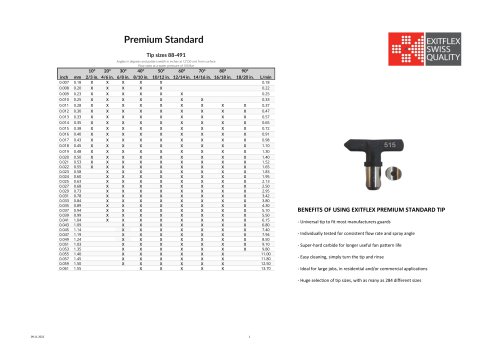
Angles in degrees and pattern width in inches at 12"(30 cm) from surface Flow rates at a water pressure of 100 Bar BENEFITS OF USING EXITFLEX TWINTIP X All tips are delivered with a first angle of 20° XThe second angle can be of 40° XThe second angle can be of 50° XThe second angle can be of 60° - Universal tip to fit most manufacturers guards - Individually tested for consistent flow rate and spray angle - Super-hard carbide for longer useful fan pattern life - Easy cleaning, simply turn the tip and rinse - 2 angles in one tip !
Open the catalog to page 1All EXITFLEX catalogs and technical brochures
 Line Marking
1 Page
 Ecoline
1 Page
 Premium Standard
1 Page
Archived catalogs
 Speedy 7
2 Pages
 2024 Paint Spray Catalogue
56 Pages
 Speedy 6
2 Pages
 Exitflex brochure
7 Pages
 TWINFIT
2 Pages
 Twisterflex
2 Pages
 Rubber catalogue
13 Pages
 Thermoplastic catalogue
43 Pages
 PTFE Hose
10 Pages


Related Searches
- Fitting
- Hydraulic fitting
- Screw-in fitting
- Metal fitting
- Stainless fitting
- Elbow fitting
- Threaded fitting
- Rotary joint
- Multi-port rotary union
- Exitflex stainless steel nozzle
- Steel rotary distributor
- Filter housing
- Metal nozzle
- Cartridge filter housing
- Liquid filter housing
- Oil rotary distributor
- Air rotary distributor
- Exitflex multi-jet nozzle
- Air nozzle
*Prices are pre-tax. They exclude delivery charges and customs duties and do not include additional charges for installation or activation options. Prices are indicative only and may vary by country, with changes to the cost of raw materials and exchange rates.
About DirectIndustry
DirectIndustry is a marketplace that offers B2B players a complete experience, from product sourcing to purchase. DirectIndustry is an entity of VirtualExpo Group.
Are you a buyer?
Are you a supplier?