
- Catalogs
- Exceltec Canada Inc.
- Duct Heaters


Duct Heaters
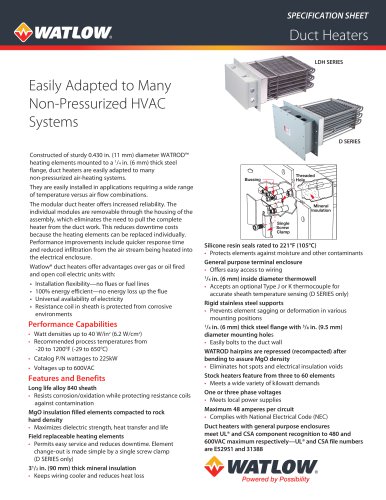
Duct Heaters
Catalog excerpts

SPECIFICATION SHEET Duct Heaters * WATLOW Easily Adapted to Many Non-Pressurized HVAC Systems Constructed of sturdy 0.430 in. (11 mm) diameter WATROD™ heating elements mounted to a 1/4 in. (6 mm) thick steel flange, duct heaters are easily adapted to many non-pressurized air-heating systems. They are easily installed in applications requiring a wide range of temperature versus air flow combinations. The modular duct heater offers increased reliability. The individual modules are removable through the housing of the assembly, which eliminates the need to pull the complete heater from the duct work. This reduces downtime costs because the heating elements can be replaced individually. Performance improvements include quicker response time and reduced infiltration from the air stream being heated into the electrical enclosure. Watlow® duct heaters offer advantages over gas or oil fired and open coil electric units with: • Installation flexibility—no flues or fuel lines • 100% energy efficient—no energy loss up the flue • Universal availability of electricity • Resistance coil in sheath is protected from corrosive environments Performance Capabilities • Watt densities up to 40 W/in2 (6.2 W/cm2) • Recommended process temperatures from -20 to 1200°F (-29 to 650°C) Features and Benefits Long life alloy 840 sheath • Resists corrosion/oxidation while protecting resistance coils against contamination MgO insulation filled elements compacted to rock hard density • Maximizes dielectric strength, heat transfer and life Field replaceable heating elements • Permits easy service and reduces downtime. Element change-out is made simple by a single screw clamp (D SERIES only) 31/2 in. (90 mm) thick mineral insulation • Keeps wiring cooler and reduces heat loss Silicone resin seals rated to 221°F (105°C) • Protects elements against moisture and other contaminants General purpose terminal enclosure • Offers easy access to wiring 1/4 in. (6 mm) inside diameter thermowell • Accepts an optional Type J or K thermocouple for accurate sheath temperature sensing (D SERIES only) Rigid stainless steel supports • Prevents element sagging or deformation in various mounting positions 1/4 in. (6 mm) thick steel flange with 3/8 in. (9.5 mm) diameter mounting holes • Easily bolts to the duct wall WATROD hairpins are repressed (recompacted) after bending to assure MgO density • Eliminates hot spots and electrical insulation voids Stock heaters feature from three to 60 elements • Meets a wide variety of kilowatt demands One or three phase voltages • Meets local power supplies Maximum 48 amperes per circuit • Complies with National Electrical Code (NEC) Duct heaters with general purpose enclosures meet UL® and CSA component recognition to 480 and 600VAC maximum respectively—UL® and CSA file numbers are E52951 and 31388
Open the catalog to page 1
• Drying ovens • Load banks Typical Applications • Heat treating • Paint drying Jard control panels are configured to work with Watlow's duct heaters. They are quickly configured for process heating applications and delivered within two weeks, q WATCONNECT panels integrate ■ Watlow's high-quality heater, 1 sensor, temperature controller and power controller products for a complete thermal solution. Normally, competitive custom panels require significantly longer lead times. The broad range of standard features allow customers to quickly configure panels. Lead times of two weeks or less • Provides...
Open the catalog to page 2
Options (con't) Thermocouple Types 1 Type J and Type K thermocouples are rated 32 to 1382°F and 32 to 2282°F (0-750°C and 0-1250°C), respectively. Watlow does not recommend exceeding temperature ranges shown on this chart for the tubular product line. See Watlow's heater catalog for additional information about choosing a duct heater, required application, watt density, pressure drop, thermocouple types, application types and ordering information. • Mount duct heaters horizontally to lower enclosure temperatures and promote unit life. • Promote heater life by keeping sheath temperature below...
Open the catalog to page 3All Exceltec Canada Inc. catalogs and technical brochures
 SERIES 5900
3 Pages
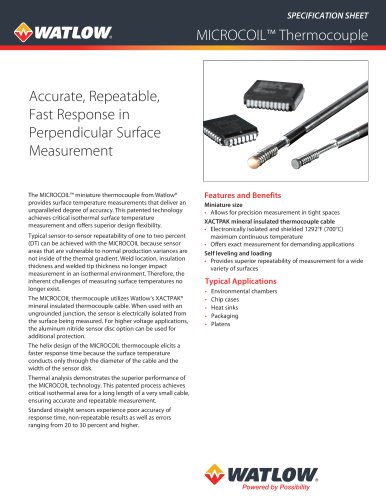 MICROCOIL
2 Pages
 SERIES 5750
3 Pages
 nanodac™ Recorder / Controller
12 Pages
 ASPYRE® DT power controller
8 Pages
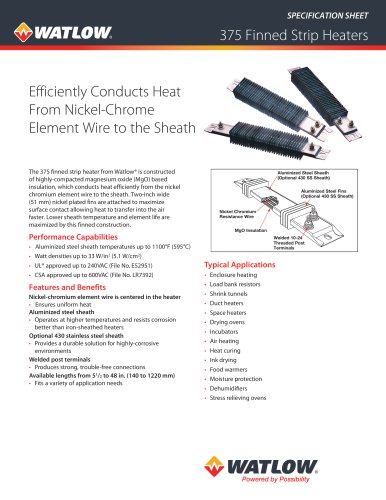 375 Finned Strip Heaters
4 Pages
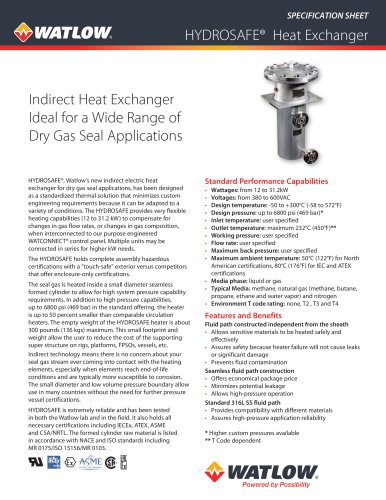 HYDROSAFE® Heat Exchanger
4 Pages
 Tubular Heaters
4 Pages
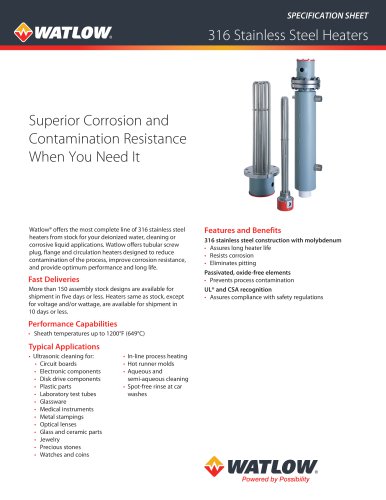 316 Stainless Steel Heaters
2 Pages
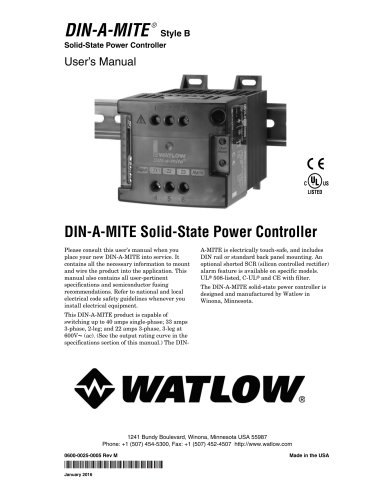 Solid-State Power Controller
13 Pages



- Temperature probe
- Data logger
- Resistance temperature sensor
- Pressure transmitter
- Analog pressure transmitter
- Temperature datalogger
- Membrane pressure transmitter
- Communication gateway
- Relative pressure transmitter
- Pt100 temperature transducer
- Digital pressure transmitter
- Fieldbus gateway
- Humidity and temperature probe
- Wireless datalogger
- Relative humidity and temperature sensor
- Wireless gateway
- RTD temperature sensor