


EUc/EUMc

EUc/EUMc
This section provides an overview of centrifugal fans, focusing on their construction, orientations, characteristics, noise levels, fittings, and special constructions. Centrifugal fans consist of a scroll with a rotating wheel powered by an external energy source, typically an electric motor. Key characteristics include delivery, pressure, efficiency, and rotation speed.
The document details various fan series (EUc, EUMc, TRc, TTRc) with specific uses, performance metrics, and overall dimensions. Performance is measured in terms of delivery (m3/min, m3/h), total pressure (kgf/m2, Pa), dynamic pressure, speed, noise level (dB/A), power absorbed (kW), and efficiency.
Fans are constructed according to UNI EN ISO 13349 (2009) standards. Different executions describe belt drive configurations, maximum air temperatures, and motor positions.
The document includes a table of symbols and measurement units used throughout, such as delivery (V), total pressure (pt), dynamic pressure (pd), speed (c2), fan rounds (n), noise level (Lp), power (P), and efficiency (η).
Formulas are provided for calculating dynamic pressure, efficiency, and variations in fan characteristics due to changes in rotation speed and air specific gravity. The document also includes tables for air specific gravity at various temperatures and barometric pressure at different altitudes.
Sections cover accessories, types of support and bearings, and spare parts nomenclature, providing comprehensive information on fan components and their configurations.
The document outlines the characteristics of centrifugal fans, focusing on their operation at a standard air temperature of 15°C, barometric pressure of 760 mm Hg, and specific gravity of 1.226 kg/m3. It adheres to the UNI EN ISO 5801:2009 (UNI 10531:1995) standards.
- Flow Rate (V): Measured in m3/sec, m3/min, or m3/h, representing the volume of fluid moved by the fan.
- Pressure (pt): Expressed in kgf/m2 or Pa, it is the sum of static and dynamic pressures.
- Efficiency (η): The ratio of energy supplied to the fluid by the fan to the energy consumed by the external source, calculated as η = V • pt / (6120 • P).
- Rotation Speed (n): The number of revolutions per minute required to achieve desired performance.
- With Constant Air Specific Gravity:
- Flow rate varies directly with the rotation ratio.
- Pressure varies with the square of the rotation ratio.
- Power varies with the cube of the rotation ratio.
- With Constant Rotation Speed:
- Flow rate remains constant.
- Pressure and power vary directly with the ratio of specific gravities.
Calculated using the formula γ = 1.293 • 273 / (273 + t) (kg/m3), where t is the air temperature in °C. Changes in atmospheric pressure affect air density, calculated as γ = Pb • 13.59 / (29.27 • (273 + t)) (kg/m3), where Pb is the atmospheric pressure in mm Hg.
Sound pressure levels are expressed in decibels (dB/A) and measured at a distance of 1.5 meters from the fan.
Fans can be constructed in 16 different orientations, with clockwise (RD) and counterclockwise (LG) rotation options. Accessories available upon request include inspection doors and drainage plugs for condensation removal.
The document outlines various specifications and features of industrial fans. Key components include anti-vibration joints to prevent vibration transmission, safety grates for accident prevention, and flow regulators to maintain efficiency. Special constructions are available for spark-proof and corrosion-proof needs, using non-ferrous materials and special coatings.
Noise levels are measured in decibels (dB/A) at a distance of 1.5 meters, following UNI EN ISO standards.
Fans can be constructed in 16 different positions, with both clockwise and counterclockwise rotations, as per DIN standards.
Optional accessories include inspection doors, discharge caps, and various regulators and safety features.
Spark-proof and corrosion-proof constructions are available for specific environments, using materials like austenitic stainless steels (AISI 304-316).
The document provides practical air speed values for different materials and environments, such as cereals dust (16-19 m/s) and metallic dust (25-38 m/s). It also lists recommended air change rates for various environments, such as hospitals (6 changes/hour) and swimming pools (25 changes/hour).
The document provides specifications for high-output centrifugal fans suitable for the suction of dust, fumes, granulates, and small wooden shavings mixed with air, excluding filament materials. These fans are characterized by high efficiency due to the use of a fan wheel with reversed blades and a flat power absorption curve to prevent motor overload.
The fans are designed for environments where harmful air needs to be transported at temperatures up to 90°C. For higher temperatures (up to 350°C), a special cooling fan is used, and the fan is coated with high-temperature aluminum paint.
These fans are used in various industries, including carpentry, mechanical, cement, ceramic, tannery, foundry, milling, and chemical industries.
The document lists practical air velocity values for different materials in duct systems, ranging from 12 to 38 m/s, depending on the material type. It also provides air exchange rates for various environments, such as 60 changes per hour for power plants and 25 for swimming pools.
Maximum permissible fan speeds are specified for different temperature ranges, with noise level tolerances and power consumption tolerances outlined. The document includes detailed dimensions and installation orientations according to UNI ISO 13349 standards.
Consult the technical office for operations within the specified 'yellow zone' parameters, indicating critical operational conditions.
The document outlines specifications for a series of fans, detailing their characteristics, dimensions, and operational parameters. It includes information on various series such as EUc 1001, EUc 1121, EUc 1251, EUc 1401, EUc 1601, and EUc 1801.
- Maximum Admissible Rounds: Varies by temperature, with specific limits set for <90°C, 90-200°C, and 200-350°C.
- Noise Level Tolerance: A tolerance of +3 dBA is specified.
- Power Consumption Tolerance: ±3% tolerance on the power consumed by the fan.
- Overall Dimensions: Provided in millimeters for each series.
- Weight: Varies by series, with specific weights provided.
- Housing Support: Specific support models are mentioned for each series.
- Fans are not revolvable, indicating fixed installation orientation.
- Rotation Directions: Both counter-clockwise and clockwise rotations are specified.
- UNI ISO 13349: The document references orientations and standards as per UNI ISO 13349, focusing on transmission side views.
- Maximum Admissible Rounds: Specific limits are set based on temperature ranges.
- Noise and Power Tolerances: Both have specified tolerances to ensure operational efficiency and compliance.
- Consult the technical office for operations within the 'Yellow Zone' as indicated in the document.
The document outlines the specifications for a series of high-efficiency centrifugal fans. These fans are designed for use in various industrial applications such as drying plants, pneumatic transport systems, fume extraction, and forced draft in chimneys. They are capable of transporting granulated materials and sawdust mixed with air, excluding filamentous materials. The fans feature a high output due to the use of a fan wheel with reversed blades and a special profile. They are characterized by a flat power absorption curve, preventing motor overload even when operating with free throats.
The fans can operate at maximum temperatures of 90°C, with special provisions for temperatures up to 350°C. For higher temperatures, a small heat-stopping fan is attached to the shaft, and the fan is painted with special aluminum paint for high temperatures.
The noise level tolerance is +3 dBA, and the power consumption tolerance is ±3%.
The document provides detailed dimensions in millimeters and weights for different fan models. The fans are not revolvable, and specific housing supports are mentioned.
The fans are suitable for installation in various industries, including carpentry, mechanical, cement, ceramic, tannery, foundry, milling, and chemical industries. They are used in applications requiring the transport of harmful air.
The document references UNI ISO 13349 standards for fan orientation and installation guidelines.
The document includes graphical data on performance metrics such as power absorption, efficiency percentages, and maximum admissible rounds per minute for different temperature ranges.
The document outlines the specifications for various fan series (EUMc 401, 451, 501, 561, 631) with details on dimensions, weight, and housing. Each fan is described as revolvable, with specific orientations and dimensions provided in millimeters.
The maximum permissible rotations per minute (RPM) vary with temperature:
- For temperatures below 90°C, RPM ranges from 3150 to 4500 depending on the series.
- For temperatures between 90°C and 200°C, RPM ranges from 2800 to 3700.
- For temperatures between 200°C and 350°C, RPM ranges from 2400 to 3300.
Noise level tolerance is set at +3 dBA, and the power consumed by the fan has a tolerance of ±3% across all series.
Fans from size 451 to 501 have a default orientation angle of 30° instead of 45° due to internal construction reasons. If a 45° orientation is required, it must be specified at the time of ordering.
For any issues or specific requirements, the document advises consulting the technical office, especially when dealing with the 'Yellow Zone' specifications.
The document includes graphical data on performance metrics such as pressure (ptPa), volume flow rate (m³/h), and power (kw/ass) across different fan speeds and conditions.
The document provides detailed specifications for a series of centrifugal fans, specifically designed for the suction of wood shavings, paper offcuts, and filament materials. These fans are equipped with radial blades and are open, making them suitable for environments like carpenter shops, tanneries, paper factories, and bookbinderies where normal wheels might get obstructed. It is recommended to select a motor with 25% additional power to account for potential errors in circuit leak evaluations.
The fans have specific maximum admissible rounds per minute, which vary depending on the temperature range (<90°C and 90-200°C). Noise level tolerance is set at +3 dBA, and the power consumption tolerance is ±3%.
The document includes detailed dimensions in millimeters for various fan models, indicating that some fans are revolvable while others are not. The orientation of the fans can be adjusted for counter-clockwise or clockwise rotation.
For specific technical queries, the document advises consulting the technical office, especially when dealing with the 'Yellow Zone' as per the UNI ISO 13349 standards.
The document contains tables and graphs illustrating performance metrics such as power consumption (kw), noise levels (dBA), and operational efficiency percentages. These are crucial for understanding the fan's performance under different conditions and ensuring optimal selection and usage.
The document outlines specifications for a series of fans, including tolerances for power consumption and noise levels. The power consumption tolerance is ±3% for the fans, and the noise level tolerance is +3 dBA. The maximum admissible rounds vary depending on the temperature, with specific limits set for temperatures below 90°C and between 90°C to 200°C.
Overall dimensions are provided in millimeters for various fan models, with specific weights and housing supports detailed. The fans are noted as non-revolvable, meaning they cannot be rotated.
The document advises consulting the technical office when dealing with the 'Yellow Zone,' indicating areas that may require special attention or expertise. It also references compliance with UNI ISO 13349 standards for fan orientations from the transmission side.
Performance data includes maximum permissible speeds (giri/min) and power absorption (kw/ass) for different fan models. The document provides detailed performance charts showing relationships between pressure (ptPa), volume flow (m3/h), and speed (n giri/min).
The document references UNI ISO 13349 standards for fan orientations, ensuring compliance with international norms for fan installations and operations.
Catalog excerpts
Catalogo edizione Gennaio 2011 January 2011 cataloque edition Catalogue edition Janvier 2011 Katalag Ausgabe Jânner 2011 Catálogo edición Enero 2011 Concetti generali sui ventilatori centrifughi. Costruzione, orientamenti, caratteristiche, rumorosità, accessori, costruzioni speciali. General concepts on centrifugal fans. Construction, orientations, characteristics, noise level, fittings, special constructions. Idées générales sur les ventilateurs centrifuges. Construction, orientations, caractéristiques, niveau sonore, accessoires, constructions spéciales. Allgemeines iiber Radialventilatoren....
Open the catalog to page 2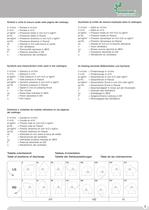
Simboli e unità di misura usate nelle pagine del catalogo. Symboles et unités de mesure employés dans le catalogue. V rrí/min = Portata in rrí/min V rrí/min = Débit en mVmin pt kgf/m2 = Pressione totale in mm H20 o kgf/m2 pt kgf/m2 = Pression totale en mm H20 ou kgf/m2 pt Pa = Pressione totale in Pascal pt Pa = Pression totale en Pascal pd kgf/m2 = Pressione dinamica in mm H20 o kgf/m2 pd kgf/m2 = Pression dynamique en mm H20 ou kgf/m2 pd Pa = Pressione dinamica in Pascal pd Pa = Pression dynamique en Pascal c2 = Velocità in m/s sulla bocca di uscita c2 = Vitesse en m/s sur la bouche refoulante...
Open the catalog to page 3
Esecuzioni costruttive dei ventilatori secondo le norme UNI EN ISO 13349 (2009). Fans constructive executions in conformity with rules UNI EN ISO 13349 (2009). Executions constructives des ventilateurs sélon UNI EN ISO 13349 (2009). Diese Ventilatoren werden nach den Normen gebaut UNI EN ISO 13349 (2009). Realizaciones constructivas de los ventiladores de conformidad con las normas UNI EN ISO 13349 (2009). Accoppiamento a cinghie. Girante calettata a sbalzo. Supporto montato su sedia al di fuori del circuito dell'aria. Temperatura max dell'aria 90°C senza ventolina dl raffreddamento; 350 °C con...
Open the catalog to page 4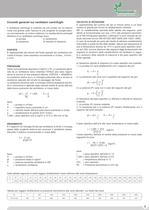
Concetti generali sui ventilatori centrifughi Il ventilatore centrifugo è costituito da una coclea nel cui interno ruota una girante sotto l'azione di una sorgente di energia ester- na (normalmente un motore elettrico). Le caratteristiche principali distintive di un ventilatore centrifugo sono: b) pressione d) velocità di rotazione È rappresentata dal volume del fluido aspirato dal ventilatore nel- l'unità di tempo; viene espressa normalmente in m3/sec, m3/min., Viene comunemente espressa in kgf/m2 o Pa. La pressione gene- rata da un ventilatore viene chiamata TOTALE (pt); essa rappre- senta...
Open the catalog to page 5
General concepts abouts centrifugal fans The centrifugal fan essentially in a scroll in which a wheel rotates. The wheel's movement is caused by an external energy source, that is usually an electric motor. The main characteristics of a cen- b) pressure d) rotation speed It is indicated by the value of the fluid intaken through the fan in the time unit; normally this is stated by the ratio m3/sec, m3/min., It is usually indicated by the ratio kgf/m2 or Pa. The pressure gen- erated through a fan is named TOTAL (pt); it is the sum of two dif- ferent pressures: STATIC + DYNAMIC. The static pressure...
Open the catalog to page 6
Généralités sur les ventilateurs centrifuges Le ventilateur centrifuge est constitué essentiellement par une bâche spirale où une couronne mobile tournante dans l'intérieur sous l'action d'une source d'énergie extérieure (normalement un moteur éléctrique). Les caractéristiques principales distinctives d'un ventilateur cen- trifuge sont: b) pression d) vitesse de rotation Il est représenté par la valeur du fluide aspiré par le ventilateur dans l'unité de temp.s.; il est exprimé normalement en m3/sec, Elle est exprimée en kgf/m2 ou Pa. La pression produite par un ventilateur s'appele TOTALE (pt);...
Open the catalog to page 7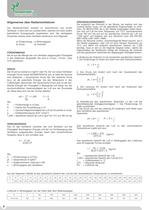
Allgemeines über Radialventilatoren Der Radialventilator besteht im wesentlichen aus einem Gehàuse, in dem sich ein Laufrad dreht, welches von einer auBen befindlichen Energiequelle angetrieben wird. Die wichtigsten Parameter welche einen Ventilator bestimmen sind folgende: Sie ist von der Menge der vom Ventilator abgesaugten Flüssigkeit in der Zeiteinheit dargestellt. Sie wird in m3/sec, m3/min., oder Der Druck ist meistens in kgf/m2 oder Pa. Der von einem Ventilator erzeugte Druck heisst GESAMTDRUCK (pt): er stelli die Summe vom statischen + dynamischen Druck dar. Der statische Druck (p.s.)...
Open the catalog to page 8
Conceptos generales sobre los ventiladores centrífugos El ventilador centrífugo está formado de una cóclea, en cuyo inte- rior gira una rueda de paletas bajo la acción de una fuente de ener- gía exterior (normalmente un motor eléctrico). Las características distintivas principales de un ventilador centrífugo son: Está representado por el volumen del fluido aspirado por el venti- lador en la unidad de tiempo; generalmente, se expresa en Generalmente, está indicada en kgf/m2 o Pa. La presión produci- da por un ventilador se llama TOTAL (pt); la misma representa la suma de dos presiones diferentes:...
Open the catalog to page 9
Le caratteristiche riportate sui diagrammi sono riferite ad aria alla temperatura di +15°C, alla pressione barometrica di 760 mm Hg, con peso specifico di 1,226 Kg/ m3 I valori di pressione sonora indicati in catalogo sono espressi in decibel scala A (db/A), si Intendono misurati In campo libero alla distanza di m.1,5 dal ventilatore funzionante alla portata di massimo rendimento e collegato a tubazione In aspirante e In premente (norme UNI EN ISO 3740-3744-3746-13347). Tutti I ventilatori possono essere costruiti In 16 posizioni diverse della bocca di mandata (8 con senso di rotazione orarlo...
Open the catalog to page 10
Die Parameter in den Tabellen bezlehen slch auf Luft mit elner Temperatur von 15°C bei elnem Luftdruck von 760 mm Hg. (Spezlfisches Gewicht der Luft 1,226 Kg/m3). Die Schallwerte sind In Dezlbel, Skala A db (A) angegeben. Sie wurden lm Freifeld im Abstand von 1,5 m entfernten, unten Vollast arbeltenden, saug-und driickseltig ange- schlossenem Ventilator entsprechend (Normen UNI EN ISO 3740-3744-3746-13347). Alle Radlalventllatoren können mit 16 verschiedenen Stellungen der Drucköffnung gebaut werden (8 mit Uhrzelgersinn RD und 8 mit Gegenuhrzeigerslnn LG) wie In der Tabelle der Elnstellungen...
Open the catalog to page 11All EUROVENTILATORI INTERNATIONAL catalogs and technical brochures
 EU/EUM/MPR/TR
62 Pages
 EVP/EVF/EVL
30 Pages
 BPRc/BPc
70 Pages
 AP APR
64 Pages
 Centrifugal Fans
62 Pages
 Protection Net
3 Pages
- Propeller fan
- Air circulation fan
- Extraction fan
- Aluminum fan
- Fan with rear-angled blades
- Exhaust fan
- Low-noise fan
- Direct-drive fan
- Drying fan
- High-pressure fan
- Suction fan
- Rooftop fan
- Low-pressure fan
- Medium-pressure fan
- Pneumatic conveying fan
- Fume exhaust fan
- Fan for chemical applications
- Fan with airfoil blades