1. Catalogs
  2. EUCHNER GmbH + Co. KG
  3. Safety Switches with Metal Housing

Safety Switches with Metal Housing

Safety Switches with Metal Housing
1 / 220 PagesView full catalog

Safety Switches with Metal Housing

Product catalog summary
Overview of EUCHNER GmbH + Co. KG: EUCHNER is a prominent company in industrial safety technology, specializing in high-quality switching systems for mechanical and systems engineering. With over 60 years of experience, the company is headquartered in Leinfelden, Germany, and employs around 750 people globally. EUCHNER is renowned for its innovative and quality products, including safety switches that protect people and processes by monitoring safety doors on machines and installations.
Product Range: The catalog details various safety switches with metal housing, categorized into several types: Transponder-coded Safety Switches, Electromechanical Safety Switches, Magnetically coded Safety Switches, and more. Each type is designed to meet specific safety requirements and applications.
Finding the Right Switch: The catalog provides guidance on selecting the appropriate safety switch based on order numbers or specific product features. It includes a detailed table of contents and selection tables to refine choices.
Standards and Approvals: EUCHNER safety switches comply with the Machinery Directive and EN 60947 Part 5-1 standards, ensuring they meet safety component requirements. Many switches have additional type examinations by notified bodies like DGUV and UL, indicating their suitability for use in various countries.
Function and Technology: Safety switches are crucial for preventing machine operation during potential hazards. They are key elements of interlocking devices, ensuring machines cannot operate when safety doors or flaps are open. The catalog explains the function of safety switches, including the importance of NC contacts and the division into type 1 and type 2 switches according to EN ISO 14119.
Technical Data and Accessories: The catalog includes technical data for each product, along with available accessories such as actuators, plug connectors, and mounting plates. This information helps in the proper installation and use of safety switches.
Specifications: The document distinguishes between Type 1 and Type 2 safety switches. Type 1 switches are approved by various international bodies such as DGUV, UL, EEU, CCC, and DNV GL. Type 2 switches feature coded actuating elements and are used with separate coded actuators. These switches are designed to ensure that machinery cannot start unless the safety conditions are met.
Actuating Elements: Type 2 switches require specific actuating elements that operate on a lock and key principle. These elements are designed to ensure that the switch can only be actuated with the correct shape, enhancing safety by preventing unauthorized operation.
Switching Elements: The document describes different switching elements available, including single, double, and quadruple switching elements. It explains the difference between slow-action and snap-action switching elements, highlighting the importance of positively driven contacts for safety.
Guard Locking and Monitoring: Safety switches with guard locking prevent the unintentional opening of doors when a hazard is present. The document emphasizes the need for monitoring the position of the guard locking solenoid to ensure personnel safety.
Installation and Tampering Prevention: The document outlines the requirements for installing safety switches and actuators, emphasizing the importance of secure attachment to prevent tampering. It suggests using safety screws and covered installations to enhance security.
Housing and Material: The safety switches are housed in durable materials like die-cast alloy with anodized surfaces, providing high protection levels suitable for harsh environments.
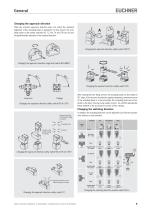
Adjustability: The document explains how the approach direction of actuating heads can be adjusted to suit different installation requirements, ensuring flexibility in various applications.
Specifications: The document outlines the design and functionality of safety switches, emphasizing the importance of proper mounting to ensure accessibility and tamper resistance. It describes the use of solenoids for guard locking and the flexibility in actuator head attachment, which can be rotated in 90° steps to suit different applications.
Electrical Connection: Modern wiring concepts are highlighted, with a preference for plug-in connections to facilitate easy replacement and reduce downtime. The document lists available plug connectors and accessories for the NZ and TZ series.
Operational Procedures: The document explains the operation of the TZ and TX series switches in three states: door open and not locked, door closed and not locked, and door closed and locked. It details the role of the locking arm and solenoid in ensuring safety by preventing unintentional contact closure.
Failsafe Locking Mechanism: A key feature is the failsafe locking mechanism, which prevents the switch from locking if the guard is open, ensuring a safe state as per DGUV Information 203-079.
Switching Elements: Various switching elements are described, including slow-action and snap-action types, with different configurations of positively driven contacts and NO/NC contacts. The document provides a numbering system for these elements and notes that replacement elements are not available.
Safety Switches Type 1: The document includes specifications for Type 1 safety switches with metal housing, detailing actuating elements, connection options, and optional features like LED indicators and exterior diaphragms for protection against dust and coolants.
Conclusion: The document emphasizes the importance of selecting the appropriate switch configuration and mounting method for specific applications to ensure safety and operational efficiency.
Specifications: The safety switches operate on a 24 V AC/DC power supply with a tolerance of -15% to +10%. They feature slow-action switching contacts with configurations such as 1 NC + 1 NO, 3 NC + 1 NO, and 2 NC + 2 NO. The switches are equipped with solenoid monitoring and door monitoring capabilities.
Features: Key features include emergency unlocking mechanisms, escape release options, protective plates to prevent tampering, and LED indicators for operational status. The actuator heads can be fitted on the left or right, and the approach direction is adjustable in 90° steps.
Ordering Information: The document includes detailed ordering tables specifying series connections, guard locking types, switch head configurations, and available versions. Options for mechanical and electrical connections are provided, including plug connectors like M20x1.5, M23 (RC18), MR10, and MR12.
Installation and Operation: Dimension drawings and wiring diagrams are provided for proper installation and operation. The document emphasizes the need to order actuators separately and provides references to additional technical data pages for further details.
Applications: These safety switches are suitable for environments requiring reliable guard locking and monitoring, with applications in industrial settings where safety and security are paramount.
Specifications: The document outlines the specifications for connectors and safety switches. The connectors have a degree of protection according to IEC 60529, with IP ratings of 65 and 67. They feature metal housing, 19 pins, and support cable diameters of 10-14 mm, with a nominal voltage of up to 32 V AC/DC.
Procedures: Details on the operation of safety switches are provided, including actuating force requirements for different switch types, and the importance of approach speed and angle for mechanical actuation. The document also describes various operating modes such as automatic and manual modes, and the significance of enabling switches and escape releases.
Standards and Norms: The document references several standards, including EN ISO 13849-1 for safety performance categories, EN 60529 for protection degrees, and EN 61508 for Safety Integrity Levels (SIL). It emphasizes compliance with these standards to ensure safety and reliability.
Recommendations: Recommendations include ensuring redundancy and diversity in safety systems to prevent failures, using protective plates to prevent tampering, and conducting regular testing to verify system functionality. The document also advises on the proper mounting of safety switches to prevent easy bypassing.
Glossary and Definitions: The appendix provides definitions for key terms such as actuating force, guard locking, and risk assessment. It explains concepts like closed-circuit and open-circuit current principles, and the role of safety relays and switches in maintaining safe operations.
Key Data from Tables and Diagrams: The document includes diagrams illustrating the states of safety switches and the layout of movable guards. It highlights the importance of locking force and retention force in maintaining safety, and the role of safety relays in evaluating connected switchgear.
See more

Catalog excerpts

Safety Switches with Metal Housing-1

Safety Switches with Metal Housing EUCHNER More than safety.

 Open the catalog to page 1
Safety Switches with Metal Housing-2

Internationally successful – the EUCHNER company EUCHNER GmbH + Co. KG is a world-leading company in the area of industrial safety technology. EUCHNER has been developing and producing high-quality switching systems for mechanical and systems engineering for more than 60 years. The medium-sized family-operated company based in Leinfelden, Germany, employs Headquarters in Leinfelden-Echterdingen around 750 people around the world. 18 subsidiaries and other sales partners in Germany and abroad work for our international success on the market. Quality and innovation – the EUCHNER products A look...

 Open the catalog to page 2
Safety Switches with Metal Housing-3

About this catalog 4 How can I find the right switch? 4 Function and technology used in safety switches 5 Attaching safety switches 10 Overview of the switching elements 13 Safety switches type 1, metal housing 17 Single limit switches N1A and NB01 17 Safety switches type 2, metal housing 51 Safety switches NZ.VZ without guard locking 51 Safety switches NZ.VZ.VS with guard locking 57 Safety switches TZ with guard locking and guard locking monitoring 63 Safety switches NX without guard locking 89 Safety switches TX with guard locking and guard locking monitoring...

 Open the catalog to page 3
Safety Switches with Metal Housing-4

General About this catalog The Safety Switches with Metal Housing catalog gives you an overview of our safety switches with metal housing. For numerous applications these switches are the right choice due to their robustness and long service life. You will find the technical data after the product overview. There is a reference to the page with the related technical data on the pages listing the products. At the front of the catalog you will find useful information on the topic of safety switches. We have prepared an overview of the standards and a glossary on this topic in the appendix. You...

 Open the catalog to page 4
Safety Switches with Metal Housing-5

General EUCHNER General EUCHNER Function and technology used in safety switches Standards Safety switches must meet the requirements for safety components as per the Machinery Directive. The Machinery Directive has been implemented in national law in the EU member states and, as a result, is binding for all manufacturers. Detailed requirements for the switches are defined in EN 60947 Part 5-1 (Low-voltage switchgear and controlgear - Part 5-1: Control circuit devices and switching elements. Electromechanical control circuit devices). If the requirements of this standard are met, conformity with...

 Open the catalog to page 5
Safety Switches with Metal Housing-6

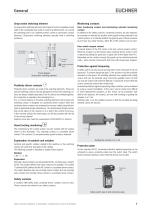
Attaining the safety function the continuous pressure from the compressed rubber can be reduced. In this way the load is reduced on the switch head and the door mechanism. Attaining the safety function Switching elements Different switching elements are available for the switches offered in the catalog: Single switching element Double switching element with two independent switching contacts Quadruple switching element with four independent switching contacts Safety switches type 2 On safety switches type 2, the actuating element for the switch is coded. The actuating elements are available in...

 Open the catalog to page 6
Safety Switches with Metal Housing-7

General EUCHNER General EUCHNER Contacts closed Snap-action switching element On snap-action switching elements, the change from the completely closed state to the completely open state is made at a defined point. As a result the operating point is at a defined position, unlike on slow-action contact elements. Snap-action switching elements typically have a switching hysteresis. Free position End position Travel diagram Snap-action switching element Positively driven contacts are used in the switching elements. These are special switching contacts that are designed to ensure the switching contacts...

 Open the catalog to page 7
Safety Switches with Metal Housing-8

Process protection To prevent the unintentional closing of a guard, lockout bars are available for switches type 2. The lockout bar is inserted in the safety switch instead of the actuator when the guard is open. The lockout bar can then be secured with commercially available padlocks (up to five locks) to protect against removal. Often a guard is only to be locked to prevent interruption to the process due to unintentional opening of the guard. In this case the position of the guard locking solenoid does not need to be integrated in the safety circuit. In this situation the series NZ.VZ.VS,...

 Open the catalog to page 8
Safety Switches with Metal Housing-9

General Changing the approach direction Often the actuator approach direction does not match the standard alignment of the actuating head as delivered. For this reason, the actuating heads on the safety switches NZ, TZ, NX, TX and STA can be very straightforwardly adjusted to the required direction. Changing the approach direction safety switch NX/TX Changing the approach direction single limit switch N1A/NB01 D Changing the approach direction safety switch STA Changing the approach direction safety switch NZ (4 x 90°) After undoing the four fixing screws, the actuating head can be rotated in...

 Open the catalog to page 9
Safety Switches with Metal Housing-10

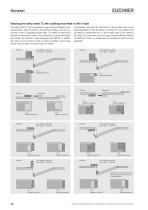
General Attaching the safety switch TZ with actuating head fitted on left or right The safety switch TZ can be mounted in a large number of different installation positions. Often the switch is mounted horizontally on the roof of a machine or with a suspended actuator head. The method of attachment depends on whether the switch is to be attached in a protected installation position, for instance to make tampering more difficult, or whether the switch is to be mounted so that it is easily accessible as the escape release must be within reach from inside the system. Plan view Door hinged on the...

 Open the catalog to page 10
Safety Switches with Metal Housing-11

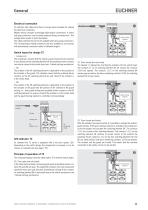
General Electrical connection On switches with cable entry there is a large space envelope for making the electrical connection. Modern wiring concepts increasingly utilize plug-in connections. A switch with plug connectors can be easily replaced during servicing work. This configuration results in short downtimes. The safety switches NZ and TZ are available with various plug connectors. The corresponding mating connectors are also available as accessories with permanently connected cables of different lengths. Guard locking solenoid Switch layout for design TZ Locking arm The locking arm ensures...

 Open the catalog to page 11
*Prices are pre-tax. They exclude delivery charges and customs duties and do not include additional charges for installation or activation options. Prices are indicative only and may vary by country, with changes to the cost of raw materials and exchange rates.