

Biogreen® End of life Tires

Biogreen® End of life Tires
This document outlines the Biogreen® process, a patented technology by ETIA, designed for the thermochemical conversion of scrap tires into energy products. The process addresses the global challenge of managing end-of-life tires (ELT) by transforming them into valuable energy resources.
The Biogreen® process operates at temperatures between 400-500°C in the absence of oxygen, converting rubber into a solid phase (char) and a gas phase. The char resembles carbon black, while the gas phase can be condensed into oil similar to heating oil n°2. Non-condensable gases can be used as a heating source.
The Biogreen® system can handle capacities up to 2000 kg/h. The typical output from processing shredded tires includes 35-40% char, 30-35% oil, and 25-35% gas. This process provides a sustainable alternative for ELT management, converting 40% of ELT into energy.
Annually, 1.4 billion tons of tires are sold, contributing to increasing volumes of waste. The global market for ELT processing is significant, with 4 million tons processed daily. The document highlights the distribution of ELT processing: 40% energy recovery, 38% material recycling, 18% retreading/export, and 4% landfill.
The improper disposal of used tires poses risks such as fire hazards, pest infestations, and environmental pollution. The Biogreen® process offers a solution to mitigate these risks by converting waste into energy.
The Biogreen® technology provides an efficient and sustainable method for converting scrap tires into energy, addressing both environmental concerns and the growing demand for waste management solutions.
Catalog excerpts
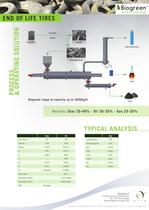
TYPICAL ANALYSIS Thermochemical Conversion Carrefour Jean Monnet BP 20101 - 60201 Compiegne cedex - France - Tel: + 33 3 441
Open the catalog to page 1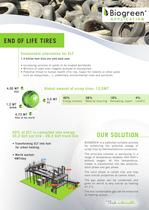
1.4 billion tons tires are sold each year. • Increasing volumes of waste to be treated worldwide. • Millions of used tires illegally dumped or stockpi I led. • Potential threat to human health (fire risk, haven for rodents or other pests Global amount of scrap tires: 13,5MT Energy recovery Material recycling Retreading, export Landfill 40% of ELT is converted into energy 30,2 GJ/t car tire - 26,4 GJ/t truck tire • Transforming ELT into fuel • World market: BIOGREEN is a patented suitable process for enhancing the potential energy of scrap tires by thermochemical conversion. The principle consists...
Open the catalog to page 2All ETIA catalogs and technical brochures
 EASYSTERIL
1 Page
 Safesteril
6 Pages
 QUANTIX
2 Pages
 UPK
UPK2 Pages
 UPX
UPX4 Pages
 SPIRAJOULE
4 Pages


- Kiln
- Electric furnace
- Heat treatment kiln
- Drying system
- Continuous drying system
- Tunnel kiln
- Air blast dewatering system
- Dewatering system for the food industry
- Hot air dryer
- Centrifugal drying system
- Dewatering system with belt conveyor
- Compact dryer
- Cleaning dewatering system
- Rotary drum dryer
- Bulk material dryer
- Cooler-heater
- Liquid cooler-heater
- Wood dryer
- Water cooler-heater
- Industrial cooler-heater