- Catalogs
- ESZ Wilfried Becker GmbH
- ESZ Type 200

ESZ Type 200

ESZ Type 200
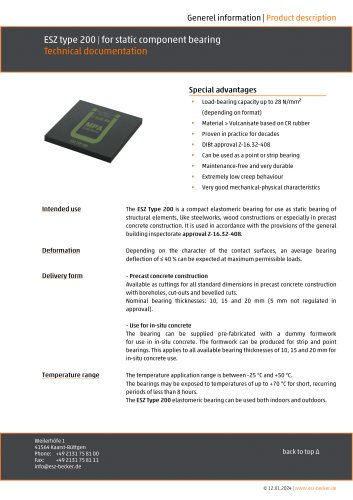
The ESZ Type 200 is an unreinforced elastomeric bearing with a load capacity of up to 28 N/mm², approved under national technical approval Z-16.52-408. It is designed for static component bearing in structures such as steelworks, wood constructions, and precast concrete. The product is maintenance-free, durable, and exhibits low creep behavior. It is available in nominal thicknesses of 10, 15, and 20 mm and can be used in both indoor and outdoor environments within a temperature range of -25°C to +50°C, with short-term exposure up to +70°C.
The document details the compression characteristic and bulging behavior of the ESZ Type 200. Compression characteristic curves and bulging behavior diagrams are provided for various bearing formats. The deflection is influenced by the compressive stress and the roughness of the contact surfaces, with typical roughness values for concrete and steel provided.
Design tables are included for different thicknesses (10 mm, 15 mm, and 20 mm), showing maximum permissible load-bearing capacities and rotational capacities. The tables serve as a guide, and users are advised to use the ESZ dimensioning tool for specific applications. The interaction between compressive stress and rotation is noted as not being practically accounted for in the tables.
Installation instructions emphasize the need for users to verify the suitability of the bearings for their specific applications. The document states that technical changes may occur due to new findings or product developments, and users should refer to the company's General Terms and Conditions of Sale.
The document provides specifications for ESZ type 200 elastomeric bearings, which are used for static component bearings. The bearings have a thickness ranging from 10 to 20 mm, with a maximum permissible compressive stress of 28 N/mm². The dimensions of the bearings and permissible boreholes are outlined, with specific conditions for rectangular, strip-shaped, and round bearings.
The design table included in the document shows the maximum permissible values of load-bearing capacity and rotational capacity parallel to side b (a). It is noted that the interaction between compressive stress and rotation is not practically accounted for. The shape factor changes when holes are drilled in the bearing, affecting the design basis.
For specific dimensioning, users are advised to use the ESZ dimensioning tool online. The document also outlines the process for calculating load-bearing capacity and considering the angle of rotation, including surcharges for angular torsion.
The bearings have national technical approval Z-16.32-408. The document emphasizes the need for proof of usability and compliance with approval conditions.
It is recommended to consider the effects of compressive stress and rotation when designing elastomeric bearings. The document advises against using elastomeric bearings to absorb constant external shear forces.
The tables provide detailed values for load-bearing capacities and rotational capacities for various dimensions and configurations of the bearings. The tables also specify the maximum permissible values for different shape factors and dimensions.
For further inquiries, contact ESZ Wilfried Becker GmbH at Weilerhéfe 1, 41564 Kaarst-Buttgen, Phone: +49 2131 75 81 00, Email: [email protected].
The document outlines the design specifications for the ESZ type 200 elastomeric bearing, focusing on load-bearing capacity and support torsion. It includes formulas for calculating the load-bearing capacity for both rectangular and round bearings, considering geometric imperfections and deviations from plane parallelism. The document emphasizes the importance of recognizing these imperfections with a minimum of 0.01 rad and adjusting calculations accordingly.
The ESZ type 200 bearing is described as incompressible, leading to transverse expansion under compressive load. This expansion can cause shear stresses and tensile stresses in adjacent materials, potentially leading to damage. The document provides calculation methods for transverse tensile forces, comparing the "old" DIN 4141-Part 15 method with the DIBt approval method, and recommends using the less favorable calculation for reinforcement design.
Calculations for load capacity under rotation are provided, with specific formulas and character meanings explained. The document includes tables for determining the design value of load-bearing capacity based on shape factors and aspect ratios.
Installation guidelines emphasize the need for clean, debris-free bearing surfaces, proper alignment, and adherence to technical specifications. The document advises against stacking storage units and highlights the importance of ensuring that lateral surfaces are not hindered in their planned deformation. It also stresses the need for proper joint separation and the careful production of bed joints in in-situ concrete applications.
Catalog excerpts

ELASTOMER SERVICE ZENTRALE ESZ Type 200 Unreinforced elastomeric bearing with national technical approval Z-16.52-408 General information Product description Deformation behaviour Compression characteristic and bulging behaviour Compression characteristic curve Bulging behaviour of the bearing Planning tools Design Design Design Tender Dimensions - Shape factor - Boreholes Load capacity and rotation Rotation - twisting surcharge Transverse tensile forces Calculation example load capacity under rotation Installation instructions tables t=10 mm tables t=15 mm tables t=20 mm texts Our technical information and other printed material is provided to the best of our knowledge and reflects our state of knowledge based on extensive technical application experience at the time of printing. However, the content is not legally binding. We therefore accept no liability for incorrect or omitted advice. The user of our products is obliged to check the suitability and application possibilities for the intended purpose himself. We make technical changes due to new findings or product developments. Our General Terms and Conditions of Sale, which can be found at www.esz-becker.de, apply exclusively.
Open the catalog to page 1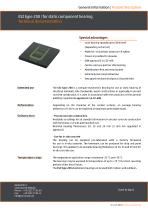
Generel information | Product description ESZ type 200 | for static component bearing Material > Vulcanisate based on CR rubber Proven in practice for decades DIBt approval Canbe used asa point or strip bearing Maintenance-free and very durable Extremely low creep behaviour Very good mechanical-physical characteristics The ESZ Type 200 is a compact elastomeric bearing for use as static bearing of structural elements, like steelworks, wood constructions or especially in precast concrete construction. It is used in accordance with the provisions of the general building inspectorate approval Z-16.32-408....
Open the catalog to page 2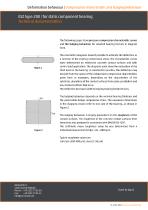
Deformation behaviour | Compression characteristic and bulging behaviour ESZ type 200 | for static component bearing The following pages show pressure compression characteristic curves and the bulging behaviour for selected bearing formats in diagram form. The orientation diagrams make it possible to estimate the deflection as a function of the existing compressive stress. The characteristic curves i centric load application. The diagrams each show the evaluation at the third load on the bearing. In construction practice, the deflection may deviate from the values of the compressive compression...
Open the catalog to page 3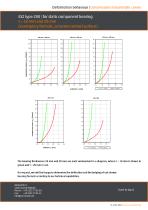
Deformation behaviour | Compression characteristic curves ESZ type 200 | for static component bearing The bearing thicknesses 10 mm and 20 mm are each summarised in a diagram, where t = 10 mm is shown in green and t = 20 mm in red. On request, we will be happyto determine the deflection and the bulging of not shown bearing formats according to our technical capabilities.
Open the catalog to page 4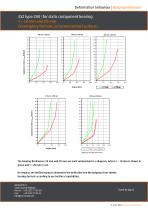
Deformation behaviour | Bulging behaviour ESZ type 200 | for static component bearing compressive stress 0,py [Nimm?] Bulging over short side shown dashed The bearing thicknesses 10 mm and 20 mm are each summarised in a diagram, where t = 10 mm is shown in green and t = 20 mm in red. On request, we will be happy to determine the deflection and the bulging of not shown bearing formats according to our technical capabilities.
Open the catalog to page 5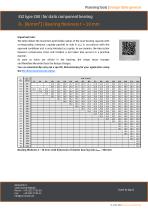
Planning tools | Design table general ESZ type 200 | for static component bearing Important note: The table shows the maximum permissible values of the load-bearing capacity with corresponding rotational capacity parallel to side b (a) in accordance with the approval conditions and is only intended as a guide. In our opinion, the interaction between into account and therefore the entire basis for design changes. You can conveniently carry out a specific dimensioning for your application using the ESZ dimensioning tool online. ay Bearing thickness t = 10 mm: Limit dimension of shorter bearing...
Open the catalog to page 6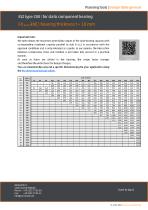
Planning tools | Design table general ESZ type 200 | for static component bearing Important note: The table shows the maximum corresponding permissible values of the load-bearing capacity with parallelto side approval conditions and is only intended as a guide. In our opinion, the interaction between compressive stress and rotation is not taken into account in a practical manner. As soon as holes are drilled in the bearing, the shape factor changes and therefore the entire basis for design changes. You can conveniently carry out a specific dimensioning for your application using the ESZ dimensioning...
Open the catalog to page 7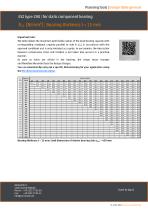
Planning tools | Design table general ESZ type 200 | for static component bearing Important note: The table shows the maximum permissible values of the load-bearing capacity with corresponding rotational capacity parallel to side b (a) in accordance with the approval conditions and is only intended as a guide. In our opinion, the interaction between into account and therefore the entire basis for design changes. You can conveniently carry out a specific dimensioning for your application using the ESZ dimensioning tool online. Oy Bearing thickness t = 15 mm: Limit dimension of shorter bearing...
Open the catalog to page 8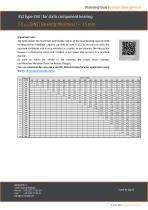
Planning tools | Design table general ESZ type 200 | for static component bearing Important note: The table shows the maximum permissible values of the load-bearing capacity with corresponding rotational capacity parallel to side b (a) in accordance with the approval conditions and is only intended as a guide. In our opinion, the interaction between into account and therefore the entire basis for design changes. You can conveniently carry out a specific dimensioning for your application using the ESZ dimensioning tool online. a, [%o]
Open the catalog to page 9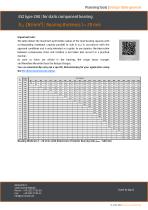
Planning tools | Design table general ESZ type 200 | for static component bearing Important note: The table shows the maximum permissible values of the load-bearing capacity with corresponding rotational capacity parallel to side b (a) in accordance with the approval conditions and is only intended as a guide. In our opinion, the interaction between compressive stress and rotation is not taken into account in a practical manner. As soon as holes are drilled in the bearing, the shape factor changes and therefore the entire basis for design changes. You can conveniently carry out a specific dimensioning...
Open the catalog to page 10All ESZ Wilfried Becker GmbH catalogs and technical brochures
 ESZ Type 200 Composite
12 Pages
 ESZ Pyramid bearing
14 Pages
 ESZ type 100
20 Pages
 ESZ type 150
20 Pages
 Pyramid bearings
2 Pages
 LeCo Dämmblock NRS
4 Pages