- Catalogs
- ESZ Wilfried Becker GmbH
- ESZ Type 200 Composite

ESZ Type 200 Composite

ESZ Type 200 Composite
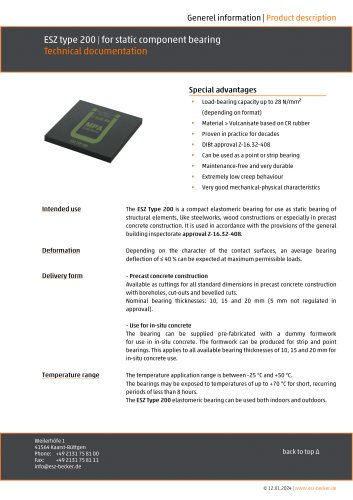
The ESZ Type 200 Composite is a steel-reinforced structural bearing designed for static component storage. It features compact elastomer layers made from chloroprene rubber (CR) and reinforcement layers of S235 JR steel. The product is maintenance-free, durable, and has a load-bearing capacity of up to 37 N/mm². It is approved under DIBt approval Z-16.33-513 and is suitable for use between reinforced concrete contact surfaces.
Specifications
The bearing thickness ranges from 15 mm to 65 mm, with a temperature application range of -25 °C to +50 °C, and short-term exposure up to +70 °C. Boreholes are allowed, with specific limitations on size and placement.
Planning Tools and Load Capacity
The document provides a design table for load capacities, detailing the relationship between bearing dimensions, shape factor, and load capacity. The shape factor is crucial for determining the load-bearing capacity, and the minimum pressure must not be less than 5 N/mm².
Dimensions and Torsion
Dimension limits and rotation capabilities are outlined, with specific values for different bearing thicknesses and elastomer layers. The document emphasizes the importance of considering torsion and rotation in design calculations.
Tender Texts
Guidelines for the supply and installation of the ESZ Type 200 Composite bearings are provided, including verification of usability and specific requirements for bearing type, thickness, and drill holes.
Load Capacity and Rotation
The load-bearing capacity is limited to 37 N/mm², but higher pressures may be possible with specific support situations. The document discusses the effects of compressive stress and rotation on bearing performance.
Transverse Tensile Forces
The elastomeric part of the bearing expands transversely under compressive load, leading to shear stresses in the joint. These stresses can cause damage to adjacent materials, and reinforcement should be placed close to the bearing.
Installation Instructions
Detailed instructions are provided for the installation of the bearings, emphasizing the importance of clean, ice-free surfaces, proper alignment, and the avoidance of point overloads. The document also advises against stacking multiple storage units and highlights the need for proper joint separation between components.
Catalog excerpts

ELASTOMER SERVICE ZENTRALE ESZ Type 200 Composite Steel-reinforced structural bearing with national technical approval Z-16.53-513 General information Product description Delivery forms - schematic representation Planning tools Design table- load capacity Dimensions and torsion Tender texts Transverse tensile forces Dimensions-Shape factor-Boreholes Load capacity and rotation Installation instructions Our technical information and other printed material is provided to the best of our Knowledge and reflects our state of knowledge based on extensive technical application experience at the time of printing. However, the content is not legally binding. We therefore accept no liability for incorrect or omitted advice. The user of our products is obliged to check the suitability and application possibilities for the intended purpose himself. We make technical changes due to new findings or product developments. Our General Terms and Conditions of Sale, which can be found at www.esz-becker.de, apply exclusively.
Open the catalog to page 1
General information | Product description ESZ Type 200 Composite | for static component storage Load-bearing capacity up to 37 N/mm? (depending on format) Materials: Vulcanisate based on CR rubber/steel $235 JR Maintenance-free and very durable Very good mechanical-physical characteristics ESZ Type 200 Composite is a steel-reinforced structural bearing with compact elastomer combined with reinforcement layers made larger than the elastomer layers all round. is intended for the static support of components, particular for large bearing heights. It is used in accordance with the provisions of the...
Open the catalog to page 2
General information | Product description ESZ Type 200 Composite | for static component storage Temperature range The temperature application range is between -25 °C and +50 °C. The bearings may be exposed to temperatures of up to +70 °C for short, recurring periods of less than 8 hours. Delivery form As blanks for all standard reinforced and prestressed precast concrete construction elastomer base surfaces with drill holes. Total bearing height t = 15 / 25*/30/35/40/45/50/55/60 and 65 mm. (*not regulated in the approval) Boreholes Up to four boreholes are permitted per bearing, whereby the surface...
Open the catalog to page 3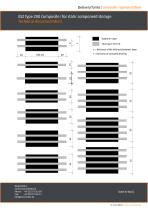
ESZ Type 200 Composite | for static component storage Technical t, = thickness of the thickest elastomer layer |
Open the catalog to page 4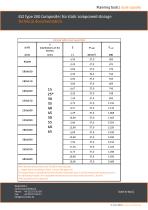
Planning tools | Load capacity ESZ Type 200 Composite | for static component storage Design table load capacities t axb total thickness 400x400 Other formats are possible (see ESZ dimensioning tool) § = shape factor according to Table 1 of the DIBt approval The shape factor is calculated from the thickest elastomer layer (ti) of the respective bearing structure. For all bearing heights, the calculated minimum pressure must not be less than 5 N/mm? *Not regulated in the approval
Open the catalog to page 5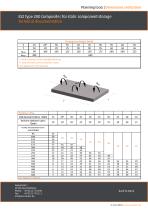
Planning tools | Dimensions and torsion ESZ Type 200 Composite | for static component storage t =total thickness of the unloaded bearing T=total thickness of the elatomer layers *not regulated in the approval Rotation @ [%o] total bearing thickness t[mm] thickness elastomer T[mm] bearing side subjected to tarsion backto topA
Open the catalog to page 6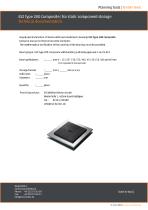
Planning tools | Tender texts ESZ Type 200 Composite | for static component storage Supply and installation of steel-reinforced elastomeric bearings ESZ Type 200 Composite between precast reinforced concrete elements. The mathematical verification of the usability of the bearings must be provided. Bearing type: ESZ Type 200 Composite with building authority approval Z-16.33-513 Bearing thickness Storage format Diameter: Drill holes Becker GmbH
Open the catalog to page 7
Planning tools | dimensions - shape factor - boreoles ESZ Type 200 Composite | with national technical approval Conditions > Dimensions of the bearings and permissible boreholes (according to abZ section 2.1.1) The shape factor Sfor rectangular bearings is calculated as follows: The following applies to rectangular bearings: a>90mm,b290mm Boreholes (base and lateral surfaces) must still be with taken into account (=deducted) in the calculation! thickness of the unloaded bearing thickness of the thickest elastomer layer shorter side of the bearing longer side of the bearing 1 of the general approval,...
Open the catalog to page 8
Planning tools | Load capacity and rotation ESZ Type 200 Composite | with national technical approval Calculation of the load-bearing capacity and consideration of the angle of rotation incl. surcharges The load-bearing capacity of the ESZ Type 200 Composite is limited by the manufacturerto 37 N/mm, the design function in Table 1 of the approval indicates significantly higher load-bearing capacities depending on the form factor. If the specific support situation is known and in direct consultation with ESZ, higher pressures may also be possible. The vertical load on an elastomeric bearing leads...
Open the catalog to page 9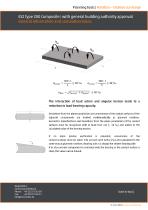
Planning tools | Rotation - rotation surcharge ESZ Type 200 Composite | with general building authority approval reduction in load-bearing capacity. Deviations from the plane parallelism and unevenness of the contact surfaces of the adjacent Geometric imperfections and deviations from the plane parallelism of the contact surfaces must be recognised with at least 0.01 rad [= 10 %e] and added to the calculated value of the bearing torsion. If contact surfaces must be taken into account with 625/a [%o] and calculated in the Same way as planned rotations. Bearing side a is always the shorter bearing...
Open the catalog to page 10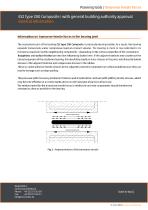
Planning tools | Transverse tensile forces ESZ Type 200 Composite | with general building authority approval Information on transverse tensile forces in the bearing joint The elastomeric part of the bearing ESZ type 200 Composite is practically incompressible. As a result, the bearing expands transversely under compressive load at constant volume. transverse expansion by the neighbouring components - depending on the surface properties of the component. Roughness and surface friction are decisive influencing factors here. If the adjacent surfaces now counteract the lateral expansion of the elastomer...
Open the catalog to page 11All ESZ Wilfried Becker GmbH catalogs and technical brochures
 ESZ Pyramid bearing
14 Pages
 ESZ type 100
20 Pages
 ESZ type 150
20 Pages
 ESZ Type 200
20 Pages
 Pyramid bearings
2 Pages
 LeCo Dämmblock NRS
4 Pages