

Work operation Low Temperature Chambers

Work operation Low Temperature Chambers
Overview
This document presents technical details and specifications for ESPEC's low temperature work operation chambers designed for simultaneous testing and specimen handling. These chambers maintain a stable temperature environment using an air curtain and are optimized for seated operation with features enhancing usability and specimen visibility.
Key Features and Utilities
- Air Curtain Technology: Prevents dew condensation on specimens and reduces temperature fluctuations when the door is partially opened by directing air flow down the door surface, minimizing outside air ingress.
- Temperature Uniformity: Achieves ±0.5℃ uniformity over a wide range from -40℃ to +85℃ (model WU-200), ensuring a stable test environment.
- Reach-in Port Guard: Optional accessory for low temperature testing that prevents outside air effects, enabling more rigorous testing.
- Dehumidifier Function: Automatically prevents dew condensation on specimens and inside the glass door during temperature transitions from low to high.
- All-Glass Power Sliding Door: Features double-layer glass with an air gap and heating element to prevent fogging, providing clear specimen visibility even at -40℃. The door slides vertically, can be locked at half-open (125mm) or fully open (380mm) positions, and includes safety features such as an emergency stop switch and photoelectric sensor.
- Compact Table Model Design: Dimensions of 750H × 750W × 440D mm allow seated operation, facilitating ease of specimen handling and extended test procedures.
- Space-Saving Ventilation: Top ventilation design eliminates rear space requirements and side protrusions, allowing parallel placement of instruments and easy mobility via casters.
Control and Operation
- Temperature Settings: User-friendly panel allows registration of up to three test temperature presets.
- Specimen Temperature Measurement: Standard thermocouple input terminal enables measurement and display of specimen surface or internal temperatures on the operation panel.
- Refrigerator Defrost Function: Facilitates easy defrosting with a 90-minute preset operation, controlling humidity rise and allowing selection of post-defrost mode (test restart or standby).
- Safety Functions: Multiple protections including specimen power supply control terminal that cuts power during errors, upper and lower temperature alarms, automatic overheat protection triggered at 10℃ above set temperature, independent overheat protector for the chamber, and various electrical safety devices.
Specifications
The chambers operate within a temperature range of -40℃ to +85℃ with temperature uniformity of ±0.5℃. The document includes detailed technical specifications such as dimensions, temperature control parameters, and electrical requirements (not fully extracted here due to formatting).
Safety Devices
- Leakage breaker for power supply
- Air circulator temperature switch
- Electrical compartment door switch
- Short circuit protection fuse for control circuit
- Reverse-prevention relay
- Circuit protector
- Refrigerator safety circuit including high-pressure switch, thermal relay, temperature switch
- Door motor overload shutoff circuit
- Door emergency stop switch
- Photoelectric sensor
- Overheat protector
- Thermal fuse
- Specimen power supply control terminal
Dimensions and Accessories
The chambers are compact table models with dimensions approximately 750 mm height, 750 mm width, and 440 mm depth. Accessories include reach-in port guard, connectors for specimen power supply and thermocouples, thermocouples (2m), cable port rubber plug, cartridge fuses, and user manual.
Options
- Portable paperless recorder with temperature range -50 to +100℃, 1 input channel expandable to 6, data saving cycle of 5 seconds, and CF memory card storage.
- Installed temperature recorder (100 mm, 6 dots)
- Overcool protector
- Thermocouples of various lengths (2m, 4m, 6m)
- Cable port rubber plug
- E-BUS cables (5m, 10m)
Summary of Critical Information
- Stable temperature environment maintained by air curtain technology to prevent dew and temperature fluctuations during specimen handling.
- High temperature uniformity (±0.5℃) over a broad range (-40 to +85℃).
- Safety features extensively integrated to protect specimens and equipment.
- Compact, user-friendly design enabling seated operation and easy specimen viewing.
- Multiple control and measurement functions including specimen temperature monitoring and defrosting capabilities.
Catalog excerpts
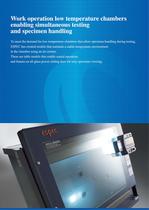
Work operation low temperature chambers enabling simultaneous testing and specimen handling To meet the demand for low temperature chambers that allow specimen handling during testing, ESPEC has created models that maintain a stable temperature environment in the chamber using an air curtain. These are table models that enable seated operation, and feature an all-glass power sliding door for easy specimen viewing. ‚P
Open the catalog to page 2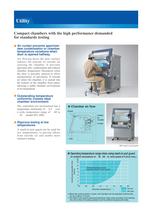
‚Q Utility Compact chambers with the high performance demanded for standards testing Air curtain prevents specimen dew condensation or chamber temperature variations when door is opened halfway. Air flowing down the door surface reduces the amount of outside air entering the chamber. It prevents specimen dew condensation and reduces chamber temperature fluctuation when the door is partially opened to allow manipulation of specimens. If outside air enters the chamber, it is sucked into the bottom of the chamber front panel, allowing a stable chamber environment to be maintained. Outstanding temperature...
Open the catalog to page 3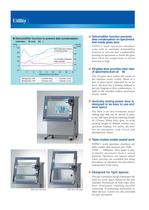
‚R Utility Dehumidifier function prevents dew condensation on specimens and inside glass door ESPEC's work operation chambers come with an automatic dehumidifier function to prevent dew condensation forming on specimens or inside the glass door when the temperature is raised from low to high. All-glass door provides clear view of specimens even at |40Ž The all-glass door makes the inside of the chamber easily visible. Made of a pair of glass layers separated by an air layer, the door has a heating element to prevent fogging or dew condensation. A light in the chamber makes specimens clearly visible....
Open the catalog to page 4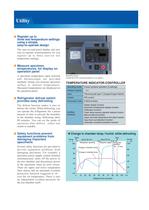
‚S Utility Register up to three test temperature settings using a simple, easy-to-operate design The easy-to-read panel display and new easy-to-operate instrumentation let you register up to three user-set test temperature settings. Measure specimen temperatures, for display on operation panel A specimen temperature input terminal and thermocouple are provided standard, letting you measure specimen surface or internal temperatures. Measured temperatures are displayed on the operation panel. Refrigerator defrost switch provides easy defrosting The defrost function makes it easy to defrost the...
Open the catalog to page 5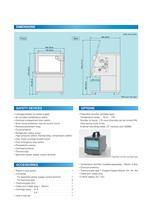
‚U SAFETY DEVICES • Leakage breaker for power supply • Air circulator temperature switch • Electrical compartment door switch • Short circuit protection fuse for control circuit • Reverse-prevention relay • Circuit protector • Refrigerator safety circuit (high-pressure switch, thermal relay, temperature switch) • Door motor overload shutoff circuit • Door emergency stop switch • Photoelectric sensor • Overheat protector • Thermal fuse • Specimen power supply control terminal DIMENSIONS .. !!" # • Reach-in port guard 1 • Connector For specimen power supply control terminal 1 For thermocouple 2...
Open the catalog to page 7All ESPEC catalogs and technical brochures
 TDDB Evaluation System
8 Pages
 High-performance Clean Oven
12 Pages
 Thermal Shock Chamber (TSD-100)
16 Pages
 Constant Climate Cabinet
8 Pages
 Platinous J Series
40 Pages
 Thermal Shock Chamber TSA series
24 Pages
 Vacuum Ovens
16 Pages








Archived catalogs
 High Performance Clean Oven
12 Pages
- Kiln
- Chamber kiln
- Test cabinet
- Electric furnace
- Heat treatment kiln
- Temperature test chamber
- Climatic test cabinet
- Humidity test cabinet
- Drying kiln
- Combustion kiln
- Gas kiln
- Test chamber with window
- Vacuum oven
- Thermostatic test chamber
- High-capacity test chamber
- Accelerated test chamber
- Modular test chamber
- Thermal shock chamber