
- Catalogs
- esd electronics gmbh
- Data Sheet VME-CAN4

Data Sheet VME-CAN4
Data Sheet VME-CAN4
Catalog excerpts
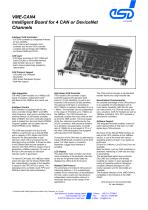
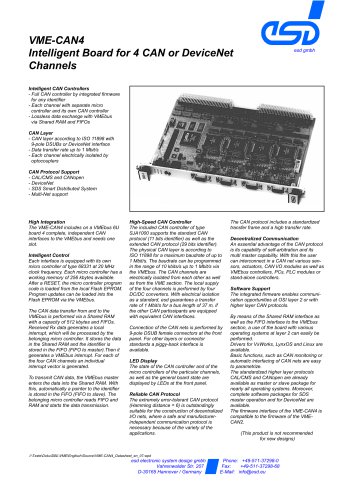
Intelligent Board for 4 CAN or DeviceNet Channels Intelligent CAN Controllers - Full CAN controller by integrated firmware for any identifier - Each channel with separate micro controller and its own CAN controller - Lossless data exchange with VMEbus via Shared RAM and FIFOs - CAN layer according to ISO 11898 with 9-pole DSUBs or DeviceNet interface - Data transfer rate up to 1 Mbit/s - Each channel electrically isolated by optocouplers - SDS Smart Distributed System - Multi-Net support The VME-CAN4 includes on a VMEbus 6U board 4 complete, independent CAN interfaces to the VMEbus and needs one slot. Each interface is equipped with its own micro controller of type 68331 at 20 MHz clock frequency. Each micro controller has a working memory of 256 kbytes available. After a RESET, the micro controller program code is loaded from the local Flash EPROM. Program updates can be loaded into the Flash EPROM via the VMEbus. The CAN data transfer from and to the VMEbus is performed via a Shared RAM with a capacity of 512 kbytes and FIFOs. Received Rx data generates a local interrupt, which will be processed by the belonging micro controller. It stores the data in the Shared RAM and the identifier is stored in the FIFO (FIFO to master).Then it generates a VMEbus interrupt. For each of the four CAN channels an individual interrupt vector is generated. To transmit CAN data, the VMEbus master enters the data into the Shared RAM. With this, automatically a pointer to the identifier is stored in the FIFO (FIFO to slave). The belonging micro controller reads FIFO and RAM and starts the data transmission. The included CAN controller of type SJA1000 supports the standard Can protocol (11 bits identifier) as well as the extended CAN protocol (29 bits identifier). The physical CAN layer is according to ISO 11898 for a maximum baudrate of up to 1 Mbit/s. The baudrate can be programmed in the range of 10 kbits/s up to 1 Mbit/s via the VMEbus. The CAN channels are electrically isolated from each other as well as from the VME section. The local supply of the four channels is performed by four DC/DC converters. With electrical isolation as a standard, esd guarantees a transfer rate of 1 Mbit/s for a bus length of 37 m, if the other CAN partissipants are equipped with equivalent CAN interfaces. Connection of the CAN nets is performed by 9-pole DSUB female connectors at the front panel. For other layers or connector standards a piggy-back interface is available. The state of the CAN controller and of the micro controllers of the particular channels, as well as the general board state are displayed by LEDs at the front panel. The extremely error-tolerant CAN protocol (Hamming distance = 6) is outstandingly suitable for the construction of decentralized I/O nets, where a safe and manufacturer-independent communication protocol is necessary because of the variety of the applications. The CAN protocol includes a standardized transfer frame and a high transfer rate. Decentralized Communication An essential advantage of the CAN protocol is its capability of self-arbitration and its multi master capability. With this the user can interconnect in a CAN net various sensors, actuators, CAN I/O modules as well as VMEbus controllers, PCs, PLC modules or stand-alone controllers. Software Support The integrated firmware enables communication opportunities at OSI layer 2 or with higher layer CAN protocols. By means of the Shared RAM interface as well as the FIFO interface to the VMEbus section, a use of the board with various operating systems at layer 2 can easily be performed. Drivers for VxWorks, LynxOS and Linux are available. Basic functions, such as CAN monitoring or automatic interfacing of CAN nets are easy to parametrize. The standardized higher layer protocols CAL/CMS and CANopen are already available as master or slave package for nearly all operating systems. Moreover, complete software packages for SDS master operation and for DeviceNet are available. The firmware interface of the VME-CAN4 is compatible to the firmware of the VME-CAN2. (This product is not recommended for new designs) esd electronic system design gmbh Phone: +49-511-37298-0 D-30165 Hannover/ Germany E-Mail: [email protected]
Open the catalog to page 1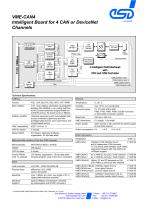
Intelligent Board for 4 CAN or DeviceNet Channels VME-CAN4-1 as V. 1408.02, but only 1 CAN channel V. 1408.06 pole VMEbus connector (like VME64) VME-CAN4- VxWorks VxWorks object licence V. 1408.15 VME-CAN4-Linux Linux object licence P.1408.58 VME-CAN4-LynxOS LynxOS object licence P.1408.53 VME-CAN4-DN DeviceNet master object licence P.1408.63 Technical Specifications: Base address: A16 - base address selectable via geographic address (like VME64) or via coding switches, A24/A32 base addresses programmable for A16/D16 access, the board covers 2 Mbytes Address modifier: Standard supervisory and...
Open the catalog to page 2All Esd electronics gmbh catalogs and technical brochures
 Data Sheet ARINC825
2 Pages
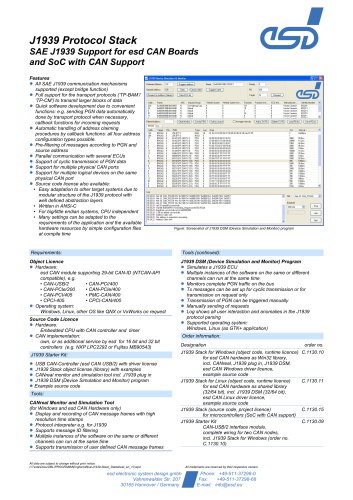 Data Sheet J1939 Stack
1 Page
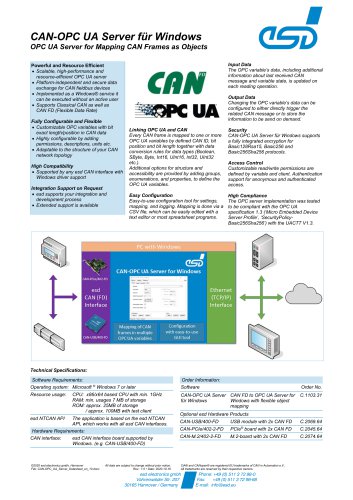 CAN-OPC UA Server
1 Page
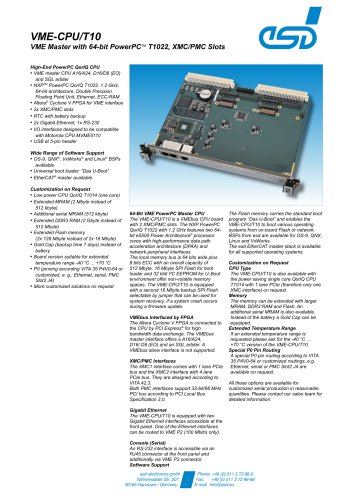 Data Sheet VME-CPU/T10
2 Pages
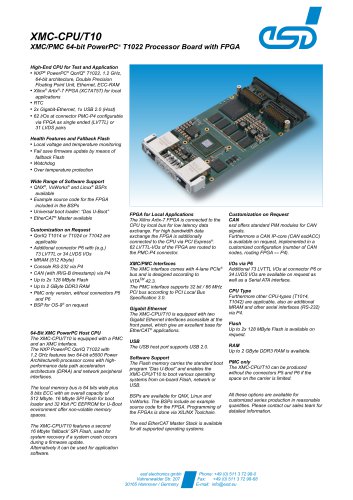 Data Sheet XMC-CPU/T10
2 Pages
 Data Sheet CPCI-DIO1616
1 Page
 Data Sheet CPCI-PS24
1 Page
 Data Sheet CPCI-CPU/5201
1 Page
 Data Sheet CAN-CBX-COM2
1 Page
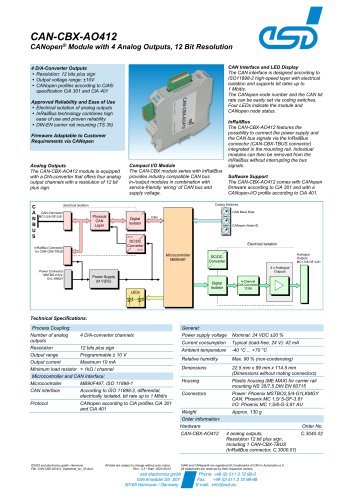 Data Sheet CAN-CBX-AO412
1 Page
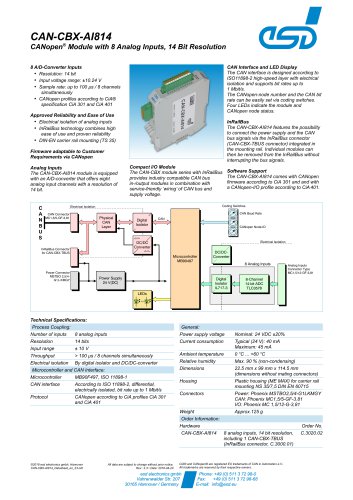 Data Sheet CAN-CBX-AI814
1 Page
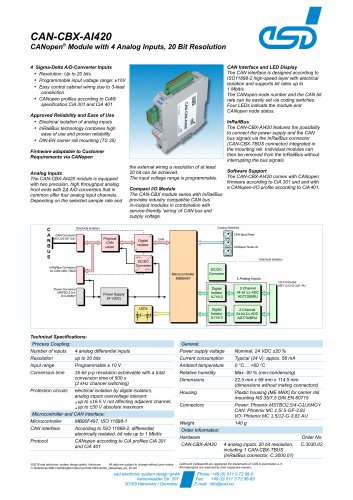 Data Sheet CAN-CBX-AI420
1 Page
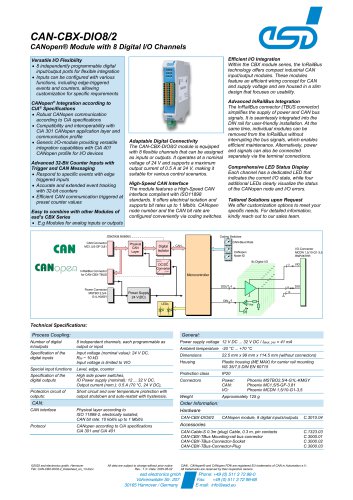 Data Sheet CAN-CBX-DIO8
1 Page
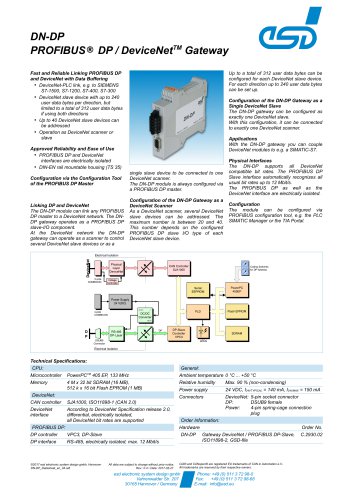 Data Sheet DN-DP
1 Page
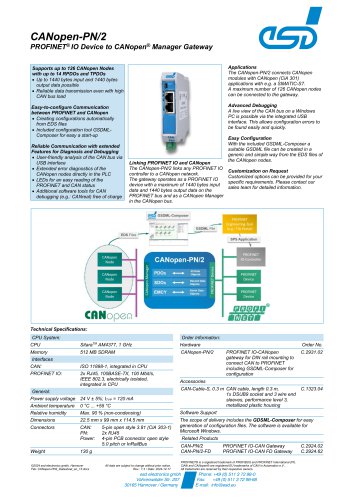 Data Sheet CANopen-PN/2
1 Page
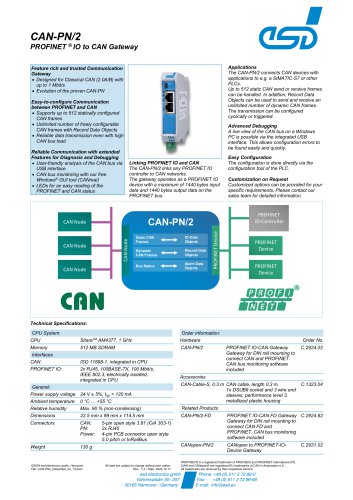 Data Sheet CAN-PN/2
1 Page
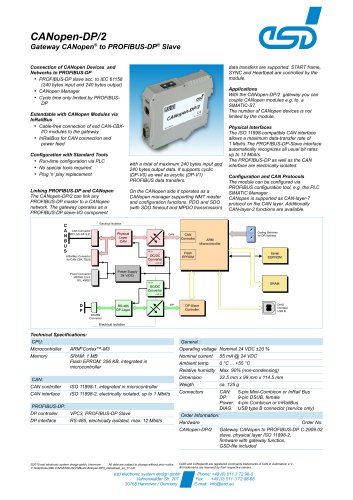 Data Sheet CANopen-DP/2
1 Page
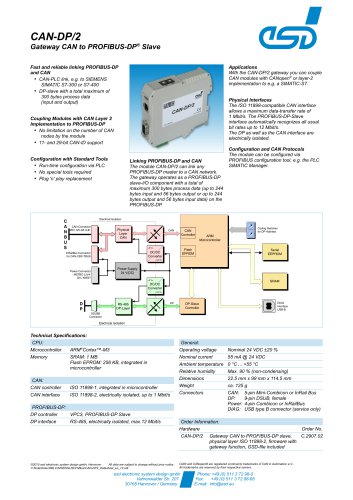 Data Sheet CAN-DP/2
1 Page
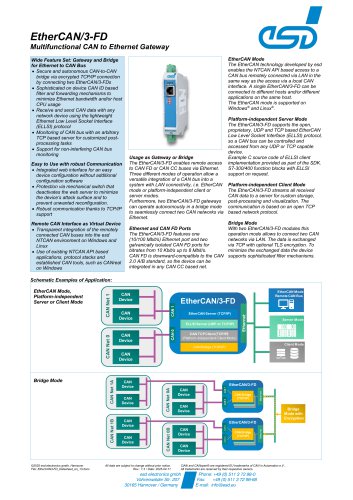 Data Sheet EtherCAN/3-FD
2 Pages
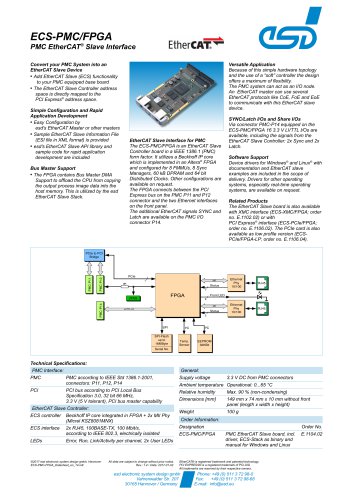 Data Sheet ECS-PMC/FPGA
1 Page
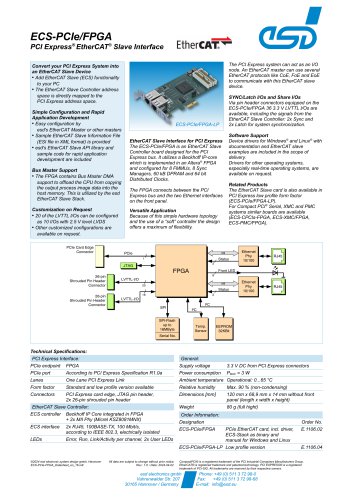 Data Sheet ECS-PCIe/FPGA
1 Page
 Data Sheet CAN-EtherCAT/2-FD
2 Pages
 Data Sheet ECX-EC
1 Page
 Data Sheet ECX-DIO8
1 Page
 Data Sheet ECS-M.2/FPGA
1 Page
 Data Sheet CAN-USB/3-FD
1 Page
 Products Catalog 2025
56 Pages
 CPCIserial-CAN/402-4-FD
2 Pages
 CPCI-CAN/402-4(-FD)
2 Pages
 CAN Cables and Accessories
2 Pages
 CAN-USB/400-FD
2 Pages
 EPPC-T10
2 Pages
 Switch16/Com3
1 Page
 XMC-CPU/Zulu
2 Pages
 CANopen-PN
1 Page
 XMC-CAN/402-4-FD
2 Pages
 PMC-CAN/402-4-FD
2 Pages
 CAN-PCIeMini/402-2(-FD)
2 Pages
 CAN-PCIe/402-FD
2 Pages
 PMC-CPU/405
1 Page
 CPCIserial-CAN/402
2 Pages
 CAN-USB/400
2 Pages
 ECS-XMC/FPGA
1 Page
- Electrical cable
- Ethernet switch
- Automation software solution
- Industrial network switch
- Analysis software solution
- Digital I/O
- Process software
- Real-time software
- Windows software
- Cloud-based software
- Control software
- Managed switch
- Analog I/O
- Electrical data cable
- RJ45 network switch
- Monitoring software solution
- Digital IO module
- DIN rail mounted network switch
- Industrial software