
- Catalogs
- esd electronics gmbh
- Data Sheet EtherCAN/3-FD

Data Sheet EtherCAN/3-FD
Data Sheet EtherCAN/3-FD
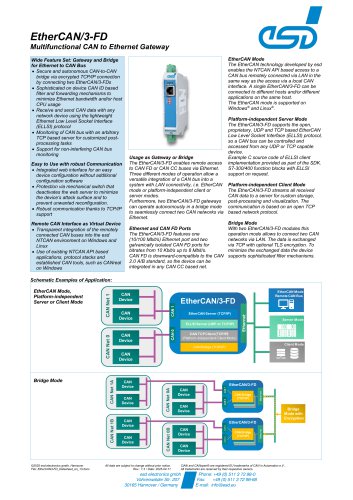
- Gateway and Bridge Functionality: Secure CAN-to-CAN bridging via encrypted TCP/IP, sophisticated CAN ID filtering, and forwarding mechanisms to optimize Ethernet bandwidth and CPU usage.
- Easy Configuration: Integrated web interface for configuration without additional software, with a mechanical switch to deactivate the web server for security.
- Remote CAN Interface: Transparent integration into the esd NTCAN environment on Windows and Linux, supporting existing NTCAN API applications and tools.
- Ports: One Ethernet port (10/100 Mbit/s) and two galvanically isolated CAN FD ports supporting bitrates from 10 Kbit/s to 8 Mbit/s.
- Power Supply: Nominal 24 VDC, with a range of 12 VDC to 32 VDC, and a maximum power consumption of 5 W.
- Environmental Conditions: Operates in temperatures from -20 °C to 70 °C, with a maximum relative humidity of 90% (non-condensing).
- Dimensions and Housing: Measures 22.5 mm x 99 mm x 114.5 mm, housed in a plastic casing for DIN rail mounting, with IP20 protection class.
- Hardware: EtherCAN/3-FD Gateway (Order No. C.2055.62).
- Accessories: Various CAN cables and connectors available, including CAN-Cable-S, CAN-Cable-B, and CAN-CBX-TBUS connectors.
- Software Support: Includes CAN drivers for Windows/Linux, with optional higher CAN layer protocols like CANopen and J1939 stacks.
- EtherCAN Mode: Allows NTCAN API-based access to a remotely connected CAN bus via LAN, supported on Windows and Linux.
- Platform-independent Server Mode: Utilizes the ELLSI protocol for control and access from any UDP or TCP capable device.
- Platform-independent Client Mode: Streams CAN data to a server for custom processing and visualization.
- Bridge Mode: Connects two CAN networks via LAN using two EtherCAN/3-FD modules, with optional TLS encryption and data filtering.
Catalog excerpts

EtherCAN/3-FD Multifunctional CAN to Ethernet Gateway Wide Feature Set: Gateway and Bridge for Ethernet to CAN Bus • Secure and autonomous CAN-to-CAN bridge via encrypted TCP/IP connection by connecting two EtherCAN/3-FDs • Sophisticated on device CAN ID based filter and forwarding mechanisms to minimize Ethernet bandwidth and/or host CPU usage • Receive and send CAN data with any network device using the lightweight Ethernet Low Level Socket Interface (ELLSI) protocol • Monitoring of CAN bus with an arbitrary TCP based server for customized postprocessing tasks • Support for non-interfering CAN bus monitoring EtherCAN Mode The EtherCAN technology developed by esd enables the NTCAN API based access to a CAN bus remotely connected via LAN in the same way as the access via a local CAN interface. A single EtherCAN/3-FD can be connected to different hosts and/or different applications on the same host. The EtherCAN mode is supported on Windows® and Linux®. Easy to Use with robust Communication • Integrated web interface for an easy device configuration without additional configuration software • Protection via mechanical switch that deactivates the web server to minimize the device’s attack surface and to prevent unwanted reconfiguration. • Robust communication thanks to TCP/IP support Usage as Gateway or Bridge The EtherCAN/3-FD enables remote access to CAN FD or CAN CC buses via Ethernet. Three different modes of operation allow a versatile integration of a CAN bus into a system with LAN connectivity, i.e. EtherCAN mode or platform-independent client or server modes. Furthermore, two EtherCAN/3-FD gateways can operate autonomously in a bridge mode to seamlessly connect two CAN networks via Ethernet. Remote CAN Interface as Virtual Device • Transparent integration of the remotely connected CAN buses into the esd NTCAN environment on Windows and Linux • Use of existing NTCAN API based applications, protocol stacks and established CAN tools, such as CANreal on Windows Ethernet and CAN FD Ports The EtherCAN/3-FD features one (10/100 Mbit/s) Ethernet port and two galvanically isolated CAN FD ports for bitrates from 10 Kbit/s up to 8 Mbit/s. CAN FD is downward-compatible to the CAN 2.0 A/B standard, so the device can be integrated in any CAN CC based net. Platform-independent Server Mode The EtherCAN/3-FD supports the open, proprietary, UDP and TCP based EtherCAN Low Level Socket Interface (ELLSI) protocol, so a CAN bus can be controlled and accessed from any UDP or TCP capable device. Example C source code of ELLSI client implementation provided as part of the SDK. S7-300/400 function blocks with ELLSI support on request. Platform-independent Client Mode The EtherCAN/3-FD streams all received CAN data to a server for custom storage, post-processing and visualization. The communication is based on an open TCP based network protocol. Bridge Mode With two EtherCAN/3-FD modules this operation mode allows to connect two CAN networks via LAN. The data is exchanged via TCP with optional TLS encryption. To minimize the exchanged data the device supports sophisticated filter mechanisms. Schematic Examples of Application: EtherCAN Mode, Platform-independent Server or Client Mode Bridge Mode ©2025 esd electronics gmbh, Hannover File: EtherCAN3-FD_Datasheet_en_13.docx All data are subject to change without prior notice. Rev.: 1.3 • Date: 2025-04-11 CiA® and CANopen® are registered EU trademarks of CAN in Automation e.V.. All trademarks are reserved by their respective owners. esd electronics gmbh Vahrenwalder Str. 207 30165 Hannover / Germany
Open the catalog to page 1
EtherCAN/3-FDMultifunctional CAN to Ethernet Gateway Housing Details: Technical Specifications: physical layer according to ISO 11898-2, galvanically isolated CAN CC bit rate:10 kBit/s up to 1 Mbit/s, CAN FD bit rate up to 8 Mbit/s Power supply voltage Nominal: 24 VDC / IMAX_24v = 210 mA Min,/max.: 12 VDC/32 VDC Order Information: 2 CAN ports according to ISO 11898-1, galvanically isolated, integrated web interface Power consumption PMAX = 5 W Relative humidity Max. 90 % (non-condensing) (without mating connectors) Housing Plastic housing (Phoenix MEMAX) for hat rail Phoenix FK-MCP 1,5/5-STF-3,81...
Open the catalog to page 2All Esd electronics gmbh catalogs and technical brochures
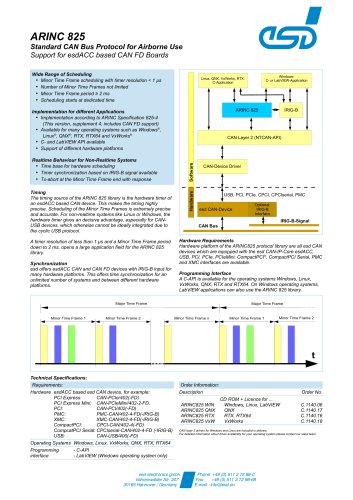 Data Sheet ARINC825
2 Pages
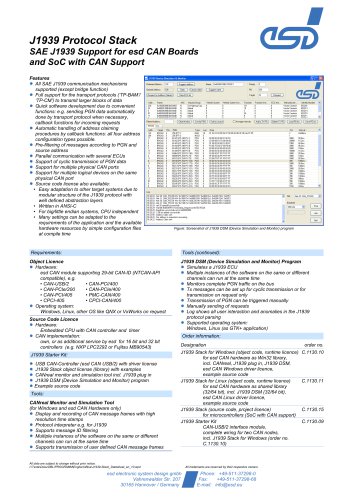 Data Sheet J1939 Stack
1 Page
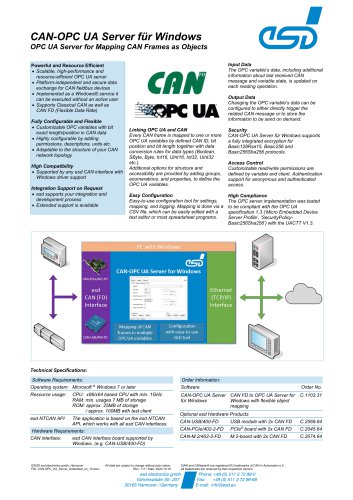 CAN-OPC UA Server
1 Page
 Data Sheet VME-CPU/T10
2 Pages
 Data Sheet XMC-CPU/T10
2 Pages
 Data Sheet VME-CAN4
2 Pages
 Data Sheet CPCI-DIO1616
1 Page
 Data Sheet CPCI-PS24
1 Page
 Data Sheet CPCI-CPU/5201
1 Page
 Data Sheet CAN-CBX-COM2
1 Page
 Data Sheet CAN-CBX-AO412
1 Page
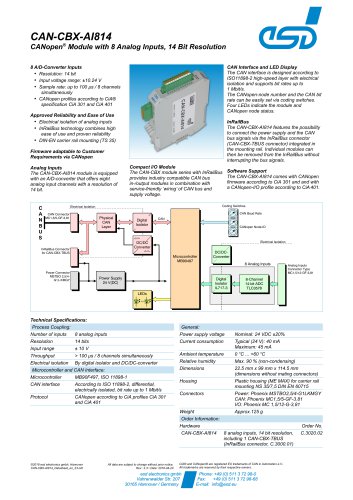 Data Sheet CAN-CBX-AI814
1 Page
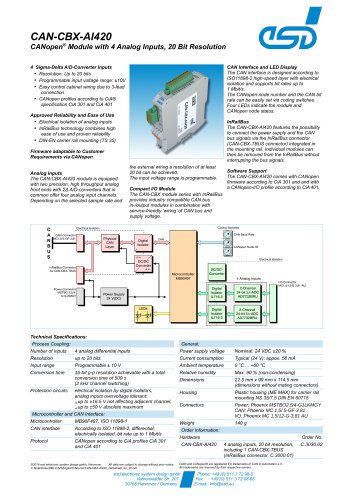 Data Sheet CAN-CBX-AI420
1 Page
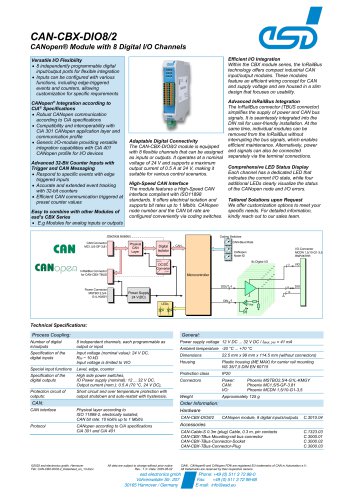 Data Sheet CAN-CBX-DIO8
1 Page
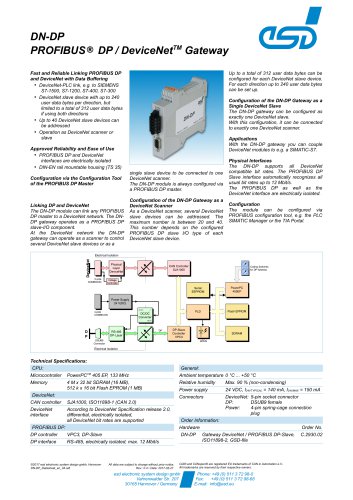 Data Sheet DN-DP
1 Page
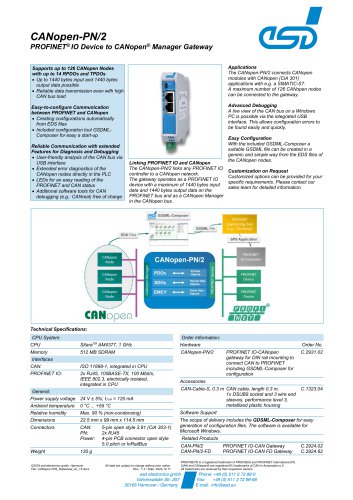 Data Sheet CANopen-PN/2
1 Page
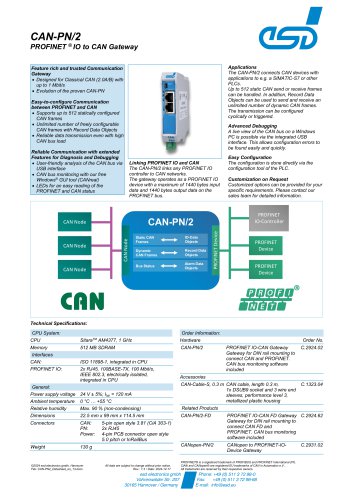 Data Sheet CAN-PN/2
1 Page
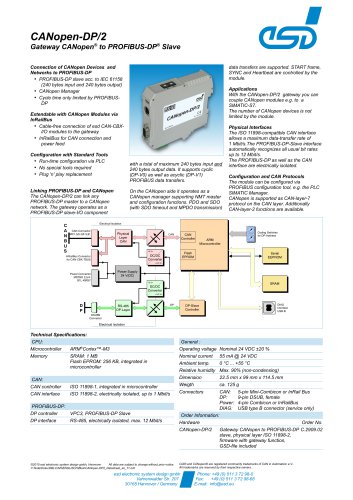 Data Sheet CANopen-DP/2
1 Page
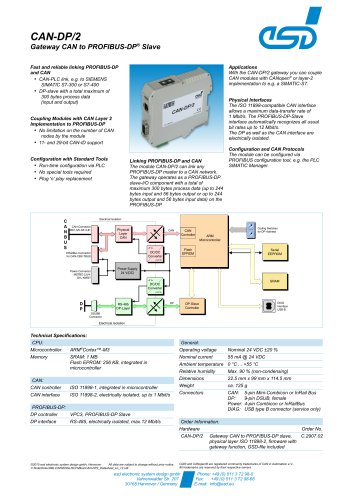 Data Sheet CAN-DP/2
1 Page
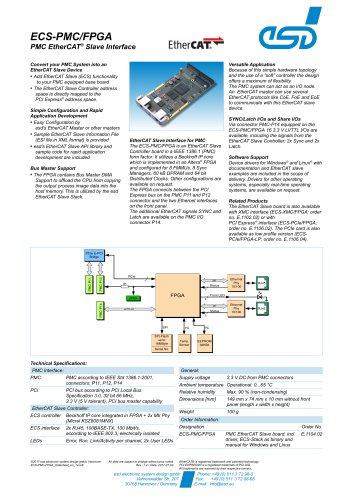 Data Sheet ECS-PMC/FPGA
1 Page
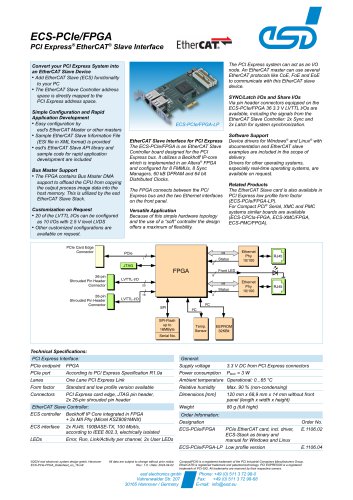 Data Sheet ECS-PCIe/FPGA
1 Page
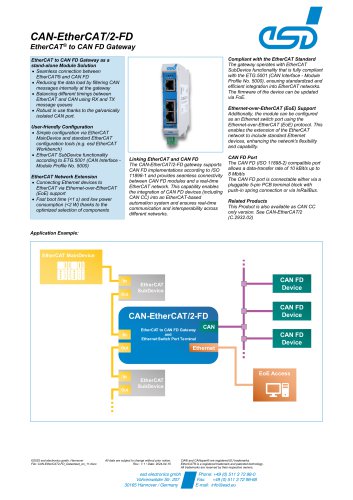 Data Sheet CAN-EtherCAT/2-FD
2 Pages
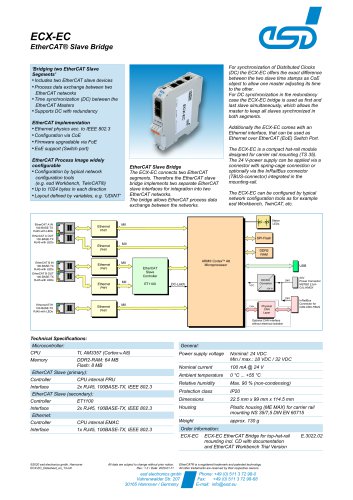 Data Sheet ECX-EC
1 Page
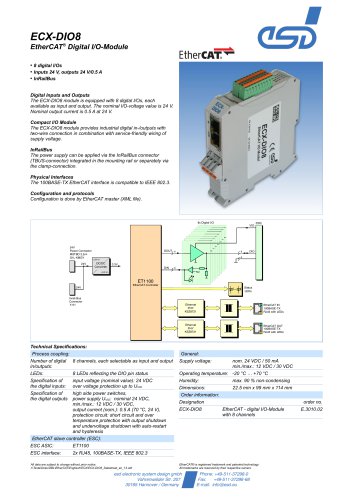 Data Sheet ECX-DIO8
1 Page
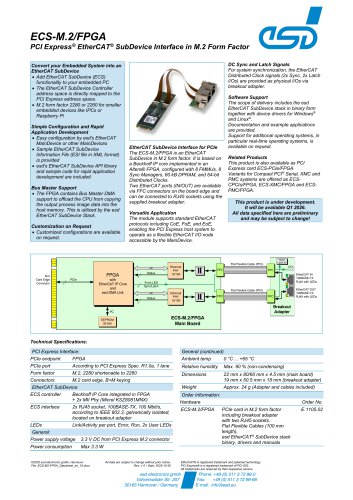 Data Sheet ECS-M.2/FPGA
1 Page
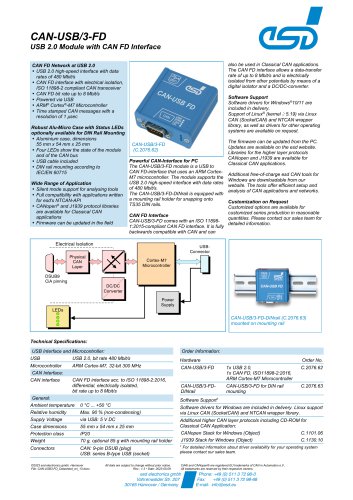 Data Sheet CAN-USB/3-FD
1 Page
 Products Catalog 2025
56 Pages
 CPCIserial-CAN/402-4-FD
2 Pages
 CPCI-CAN/402-4(-FD)
2 Pages
 CAN Cables and Accessories
2 Pages
 CAN-USB/400-FD
2 Pages
 EPPC-T10
2 Pages
 Switch16/Com3
1 Page
 XMC-CPU/Zulu
2 Pages
 CANopen-PN
1 Page
 XMC-CAN/402-4-FD
2 Pages
 PMC-CAN/402-4-FD
2 Pages
 CAN-PCIeMini/402-2(-FD)
2 Pages
 CAN-PCIe/402-FD
2 Pages
 PMC-CPU/405
1 Page
 CPCIserial-CAN/402
2 Pages
 CAN-USB/400
2 Pages
 ECS-XMC/FPGA
1 Page
- Electrical cable
- Ethernet switch
- Automation software solution
- Industrial network switch
- Analysis software solution
- Digital I/O
- Process software
- Real-time software
- Windows software
- IO module
- Cloud-based software
- Control software
- Managed switch
- Analog I/O
- Electrical data cable
- RJ45 network switch
- Monitoring software solution
- Digital IO module
- DIN rail mounted network switch
- Industrial software